



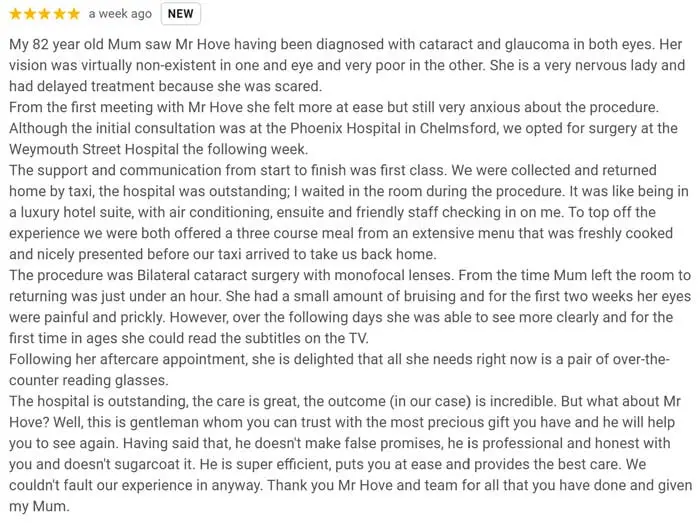
The Review, in the Patient Family’s Own Words
“My 82 year old Mum saw Mr Hove having been diagnosed with cataract and glaucoma in both eyes. Her vision was virtually non-existent in one and eye and very poor in the other. She is a very nervous lady and had delayed treatment because she was scared.
From the first meeting with Mr Hove she felt more at ease but still very anxious about the procedure.
Although the initial consultation was at the Phoenix Hospital in Chelmsford, we opted for surgery at the Weymouth Street Hospital the following week.
The support and communication from start to finish was first class. We were collected and returned home by taxi, the hospital was outstanding; I waited in the room during the procedure. It was like being in a luxury hotel suite, with air conditioning, ensuite and friendly staff checking in on me. To top off the experience we were both offered a three course meal from an extensive menu that was freshly cooked and nicely presented before our taxi arrived to take us back home.
The procedure was Bilateral cataract surgery with monofocal lenses. From the time Mum left the room to returning was just under an hour. She had a small amount of bruising and for the first two weeks her eyes were painful and prickly. However, over the following days she was able to see more clearly and for the first time in ages she could read the subtitles on the TV.
Following her aftercare appointment, she is delighted that all she needs right now is a pair of over-the-counter reading glasses.
The hospital is outstanding, the care is great, the outcome (in our case) is incredible. But what about Mr Hove? Well, this is gentleman whom you can trust with the most precious gift you have and he will help you to see again. Having said that, he doesn’t make false promises, he is professional and honest with you and doesn’t sugarcoat it. He is super efficient, puts you at ease and provides the best care. We couldn’t fault our experience in anyway. Thank you Mr Hove and team for all that you have done and given my Mum.”
Case at a Glance
- Age: 82
- Diagnosis: bilateral cataract with coexisting glaucoma
- Presenting vision: virtually absent in one eye, very poor in the fellow eye
- Procedure: immediately sequential bilateral cataract surgery, monofocal intraocular lenses
- Refractive target: distance, both eyes
- Functional endpoint reported: reading television subtitles for the first time in years
- Spectacle requirement: over-the-counter reading glasses only
- Surgeon: Mr Mfazo Hove, Blue Fin Vision®
Clinical Commentary
The Endpoint That Mattered Was Not on a Letter Chart
Ophthalmology measures outcomes in logMAR. Patients measure them in subtitles.
The sentence that defines this case is for the first time in ages she could read the subtitles on the TV. That is not a soft outcome. Reading subtitles at typical viewing distance is a demanding real-world task. It requires adequate distance acuity, adequate contrast sensitivity to resolve small white text against a moving background, and functional binocularity. A patient who can do it has recovered something specific and verifiable.
When I counsel patients, I ask what they have stopped doing. That answer becomes the target. The letter chart tells me whether the operation worked. The subtitles tell me whether the treatment worked.
What Was Actually Removed, And What Was Left Behind
This patient had two conditions in both eyes, and they behave completely differently.
The cataract was reversible. A cataract is a clouded natural lens. Removing it and replacing it with a clear intraocular lens restores the transmission of light to the retina. That component of her visual loss was recoverable in full, and it was recovered within days.
The glaucoma was not. Glaucomatous optic neuropathy is permanent loss of retinal ganglion cells. No lens implant restores it. What cataract surgery does in a glaucoma patient is remove the reversible layer of visual loss so that the true, underlying capacity of the optic nerve is revealed.
This distinction is the entire basis of honest counselling in a combined case, and it is why the ceiling on outcome in these eyes is set by the optic nerve rather than by the surgery. It is also why the result here is described by the family as incredible: the reversible component was large, and once it was removed, the nerve still had enough function to deliver excellent central vision.
Why One Eye Was Virtually Blind and the Other Only Poor
Cataracts rarely progress symmetrically. Nuclear sclerotic, cortical and posterior subcapsular cataracts advance at different rates and with different functional signatures, and the fellow eye compensates until it cannot.
That asymmetry is precisely why patients present late. Binocular function masks a densely cataractous eye for years. The patient notices only when the better eye deteriorates far enough that the pair can no longer cover the gap, at which point the worse eye is already at the stage this patient reached.
Why She Still Needs Reading Glasses, and Why That Was the Plan
She received monofocal intraocular lenses targeted for distance. A monofocal lens has a single focal point. It cannot accommodate. A distance-targeted monofocal therefore delivers excellent unaided distance and intermediate function and requires reading glasses for near work. This is not a shortfall. It is the specification.
The alternative, a diffractive trifocal lens, would have offered spectacle independence at the cost of contrast sensitivity, and in an eye with established glaucomatous optic neuropathy that trade is generally inadvisable.¹ The consensus position on relative contraindications to multifocal implantation is clear on this point, and I hold to it.
What matters clinically is that the patient was told this before surgery, not after. She is delighted that all she needs right now is a pair of over-the-counter reading glasses because that is the outcome she was promised. Satisfaction in cataract surgery is largely a function of the gap between what was predicted and what was delivered.²
The Measurement Behind the Result
An outcome this predictable is a biometry outcome before it is a surgical one.
Every Blue Fin Vision® patient undergoes optical biometry, keratometry and, where indicated, repeat measurement to confirm agreement between scans. In dense cataracts where optical biometry signal quality falls, immersion or contact A-scan ultrasound biometry is used to confirm axial length, and I do not proceed on a single questionable measurement. Refractive surprises after cataract surgery are overwhelmingly measurement failures rather than surgical failures, and large registry analyses identify biometric and formula-related factors as principal drivers of postoperative refractive error.³
This is the operational meaning of the Blue Fin Vision® anchor line: to achieve the immeasurable, you must measure everything.
The Outcome Data Behind the Individual Case
One review is an anecdote. The reason I publish it is that it sits on top of a dataset.
- More than 57,000 procedures performed.
- Six consecutive years of published National Ophthalmology Database outcome data.
- Posterior capsule rupture rate of approximately 0.2%, against a national benchmark of approximately 0.69%.⁴
National audit data demonstrate that the great majority of unselected cataract operations achieve good visual outcomes, and that complication rates rise with case complexity, dense cataract and coexisting ocular pathology.⁴ This patient carried two of those risk factors. The result was still excellent, and the systems that made it likely are the same on every list.
What This Case Demonstrates
- Functional endpoints, not acuity alone, define a successful cataract outcome.
- In combined cataract and glaucoma, removing the reversible component can transform vision even where permanent optic nerve damage exists.
- Presenting with virtually absent vision in one eye does not preclude an excellent result.
- Monofocal lenses, correctly targeted and correctly explained, produce very high satisfaction.
- Predictable refractive outcomes are a product of disciplined preoperative measurement.
What This Case Does Not Promise
Visual outcome after cataract surgery is limited by the health of the retina and optic nerve. In eyes with glaucoma, age-related macular degeneration, diabetic retinopathy, amblyopia or corneal disease, removing the cataract will not restore vision beyond what those structures can support. Some patients with advanced glaucomatous field loss gain far less than this patient did, and that is discussed openly before any decision is made.
Reading subtitles is not a guaranteed outcome. It is this patient’s outcome.
Monofocal lenses will not eliminate the need for reading glasses, and any provider suggesting otherwise is misdescribing the technology. Refraction continues to stabilise over several weeks, so final spectacles are prescribed only once measurements are settled.
Every Blue Fin Vision® patient receives an individualised prediction based on their own biometry, their own optic nerve status and their own macular imaging.
References
- Braga-Mele R, Chang D, Dewey S, Foster G, Henderson BA, Hill W, Hoffman R, Little B, Mamalis N, Oetting T, Serafano D, Talley-Rostov A, Vasavada A, Yoo S. Multifocal intraocular lenses: relative indications and contraindications for implantation. J Cataract Refract Surg. 2014;40(2):313-322.
- National Institute for Health and Care Excellence. Cataracts in adults: management. NICE guideline NG77. London: National Institute for Health and Care Excellence; 2017.
- Lundström M, Dickman M, Henry Y, Manning S, Rosen P, Tassignon MJ, Young D, Stenevi U. Risk factors for refractive error after cataract surgery: analysis of 282 811 cataract extractions reported to the European Registry of Quality Outcomes for cataract and refractive surgery. J Cataract Refract Surg. 2018;44(4):447-452.
- Day AC, Donachie PHJ, Sparrow JM, Johnston RL. The Royal College of Ophthalmologists’ National Ophthalmology Database study of cataract surgery: report 1, visual outcomes and complications. Eye (Lond). 2015;29(4):552-560.
Related Pages
All five pages below are drawn from the same documented case.
- My 82-Year-Old Mum Delayed Cataract Surgery Because She Was Too Scared
- From Virtually No Vision To Reading TV Subtitles Again
- “He Doesn’t Sugarcoat It”: Why Honesty Reassured My Nervous Mum
- Helping An Elderly Parent Through Cataract Surgery: One Daughter’s Story
- Bilateral Cataract Surgery At 82: Recovery, Results And What To Expect


