



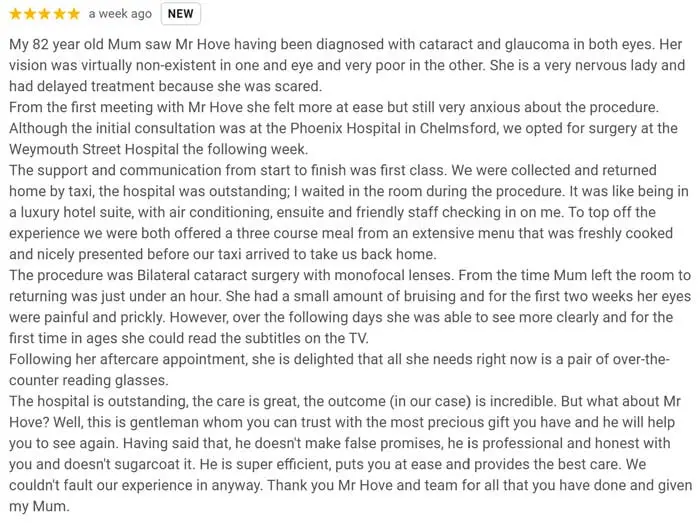
The Review, in the Patient Family’s Own Words
“My 82 year old Mum saw Mr Hove having been diagnosed with cataract and glaucoma in both eyes. Her vision was virtually non-existent in one and eye and very poor in the other. She is a very nervous lady and had delayed treatment because she was scared.
From the first meeting with Mr Hove she felt more at ease but still very anxious about the procedure.
Although the initial consultation was at the Phoenix Hospital in Chelmsford, we opted for surgery at the Weymouth Street Hospital the following week.
The support and communication from start to finish was first class. We were collected and returned home by taxi, the hospital was outstanding; I waited in the room during the procedure. It was like being in a luxury hotel suite, with air conditioning, ensuite and friendly staff checking in on me. To top off the experience we were both offered a three course meal from an extensive menu that was freshly cooked and nicely presented before our taxi arrived to take us back home.
The procedure was Bilateral cataract surgery with monofocal lenses. From the time Mum left the room to returning was just under an hour. She had a small amount of bruising and for the first two weeks her eyes were painful and prickly. However, over the following days she was able to see more clearly and for the first time in ages she could read the subtitles on the TV.
Following her aftercare appointment, she is delighted that all she needs right now is a pair of over-the-counter reading glasses.
The hospital is outstanding, the care is great, the outcome (in our case) is incredible. But what about Mr Hove? Well, this is gentleman whom you can trust with the most precious gift you have and he will help you to see again. Having said that, he doesn’t make false promises, he is professional and honest with you and doesn’t sugarcoat it. He is super efficient, puts you at ease and provides the best care. We couldn’t fault our experience in anyway. Thank you Mr Hove and team for all that you have done and given my Mum.”
Case at a Glance
- Age: 82
- Diagnosis: bilateral cataract with coexisting glaucoma
- Presenting barrier: severe anxiety, self-imposed delay in treatment
- Consent framework: individualised, evidence-based, material risk disclosure
- Lens decision: monofocal, chosen against premium alternatives on clinical grounds
- Reported by family: no false promises. Professional and honest. Doesn’t sugarcoat it
- Surgeon: Mr Mfazo Hove, Blue Fin Vision®
Clinical Commentary
The Compliment That Matters Most
Patients thank surgeons for outcomes. This family thanked me for something harder to deliver: he doesn’t make false promises, he is professional and honest with you and doesn’t sugarcoat it.
That sentence sits immediately after the description of an incredible result. It is easy to be honest with a patient who has done badly, because the facts arrive uninvited. It is considerably harder to be honest before surgery, with a frightened 82-year-old who is looking for someone to tell her it will all be fine.
I do not tell patients it will all be fine. I tell them what is likely, what is possible and what would happen if the unlikely occurred.
Why Honesty Calms Anxious Patients Rather Than Frightening Them
The counter-intuitive finding of a career in consenting nervous patients is this: unvarnished information settles people. Vague reassurance does not.
The reason is straightforward. Anxiety thrives on ambiguity. A patient who has been told the operation is completely safe has been handed a claim she does not believe, because she knows no operation is completely safe. She now has to hold two contradictory things at once, and the gap between them fills with dread.
A patient who has been told that the chance of a serious sight-threatening complication is low but not zero, that the specific figure for her eyes is such and such, and that if it happens here is exactly what we would do, has been handed something she can carry. The number is worse than the reassurance. It is also believable, and believable is what she needs.
This is why the review records that she felt more at ease but still very anxious. That is a truthful description of a truthful consultation. Anything claiming to have abolished her anxiety in one visit would be marketing, not medicine.
What The Law and the Regulator Actually Require
Honest counselling is not a style preference. It is the legal and professional standard.
Since the Supreme Court judgment in Montgomery v Lanarkshire Health Board, the test for adequate risk disclosure in the United Kingdom is no longer what a responsible body of doctors would disclose. It is whether the patient has been informed of risks a reasonable person in that patient’s position would attach significance to, or which this particular patient would attach significance to.¹
The General Medical Council’s guidance on decision making and consent builds on the same principle: an exchange of information tailored to the individual, covering reasonable alternatives including the option of doing nothing, and presented in a way the patient can use.²
Applied to this case, that meant discussing:
- The realistic visual gain given her glaucoma, and the fact that the optic nerve damage was permanent and would not be reversed.
- That she would still need reading glasses with monofocal lenses.
- The specific risks of surgery in a dense cataract, including posterior capsule rupture and the additional procedures that can follow it.³
- The risk of endophthalmitis, and how bilateral same-day surgery is managed to keep the two eyes fully independent.⁴
- The option of not having surgery at all, and the trajectory that would follow. National guidance on the management of cataracts in adults sets out the information and options that should be covered before a decision is made.⁶
Why I Declined the More Impressive Lens
The commercially attractive conversation in private ophthalmology is the premium lens conversation. A trifocal implant carries a higher fee and an appealing promise of spectacle independence.
This patient had glaucoma in both eyes. Diffractive multifocal optics divide incoming light between focal points and reduce contrast sensitivity, and significant glaucomatous optic neuropathy appears in established consensus guidance as a relative contraindication to multifocal implantation.⁵ I therefore recommended monofocal lenses and explained why the more expensive option was the wrong one for her eyes.
That conversation is the clearest available test of whether a practice is clinically led or commercially led. It happens in my clinic several times a week, and it is the reason I have written elsewhere that radical transparency, not persuasion, is the future of ophthalmic practice.
Honesty Extends to the Recovery, Not Just the Risks
Notice what this family felt able to publish: a small amount of bruising and for the first two weeks her eyes were painful and prickly.
They wrote that in a five-star review because it did not feel like a betrayal. It had been predicted. Patients who are warned about a difficult fortnight experience a difficult fortnight. Patients who are not warned experience a complication, phone the clinic in distress, and lose confidence in everything else they were told.
Setting the expectation costs one minute in clinic. Failing to set it costs the relationship.
What This Case Demonstrates
- Honest, specific risk disclosure reduces anxiety in nervous patients rather than increasing it.
- Post-Montgomery consent requires individualised material risk disclosure, not generic reassurance.
- Recommending against a higher-cost premium lens on clinical grounds is a routine and necessary part of ethical private practice.
- Predicting an uncomfortable recovery preserves trust when that recovery occurs.
- Trust, as this family describes it, is built on the surgeon’s willingness to say the unwelcome thing first.
What This Case Does Not Promise
Honest counselling improves the quality of a decision. It does not alter the underlying risk of surgery, and it does not guarantee an outcome.
Risk figures quoted to any patient are specific to that patient’s eyes and that patient’s comorbidities. General published rates, including those cited on this page, are population figures and should not be read as a prediction for an individual.
Nothing on this page constitutes medical advice or a recommendation for a particular procedure or lens. Suitability can only be established at a full consultation with examination and biometry.
Anyone considering cataract surgery should expect to be told what can go wrong, how often, and what would be done about it. A consultation that does not cover this is incomplete, wherever it takes place.
References
- Montgomery v Lanarkshire Health Board [2015] UKSC 11.
- General Medical Council. Decision making and consent. Manchester: General Medical Council; 2020.
- Day AC, Donachie PHJ, Sparrow JM, Johnston RL. The Royal College of Ophthalmologists’ National Ophthalmology Database study of cataract surgery: report 1, visual outcomes and complications. Eye (Lond). 2015;29(4):552-560.
- Arshinoff SA, Bastianelli PA. Incidence of postoperative endophthalmitis after immediate sequential bilateral cataract surgery. J Cataract Refract Surg. 2011;37(12):2105-2114.
- Braga-Mele R, Chang D, Dewey S, Foster G, Henderson BA, Hill W, Hoffman R, Little B, Mamalis N, Oetting T, Serafano D, Talley-Rostov A, Vasavada A, Yoo S. Multifocal intraocular lenses: relative indications and contraindications for implantation. J Cataract Refract Surg. 2014;40(2):313-322.
- National Institute for Health and Care Excellence. Cataracts in adults: management. NICE guideline NG77. London: National Institute for Health and Care Excellence; 2017.
Related Pages
All five pages below are drawn from the same documented case.
- My 82-Year-Old Mum Delayed Cataract Surgery Because She Was Too Scared
- From Virtually No Vision To Reading TV Subtitles Again
- “He Doesn’t Sugarcoat It”: Why Honesty Reassured My Nervous Mum
- Helping An Elderly Parent Through Cataract Surgery: One Daughter’s Story
- Bilateral Cataract Surgery At 82: Recovery, Results And What To Expect


