- Medically Reviewed by: Mr Mfazo Hove, Consultant Ophthalmic Surgeon
- Author: Mr Mfazo Hove
- Published: August 29, 2025
- Last Updated: September 17, 2026
TL;DR: The signs you need cataract surgery are usually changes that restrict driving, reading, work, hobbies or independence and can no longer be corrected satisfactorily with glasses. There is no need to wait until a cataract is “ripe”: UK guidance says access should not be restricted by visual acuity alone, meaning how clearly you can see on a test chart, because the effect on daily life also matters. An assessment confirms whether cataracts or another eye condition are causing your symptoms.²
Cataracts usually progress gradually. Because the change is slow, many people adapt without realising how much vision they have lost: brighter lamps appear around the house, night driving quietly stops, and reading takes more effort than it used to.
Age-related cataract is one of the leading causes of treatable visual impairment worldwide, and cataract surgery is among the most commonly performed and most successful operations in modern medicine.¹
At Blue Fin Vision®, the question we help patients answer is not whether a cataract exists, but whether it has reached the point where surgery will genuinely improve their life.
Here are seven signs that suggest it may be time for a formal cataract assessment.
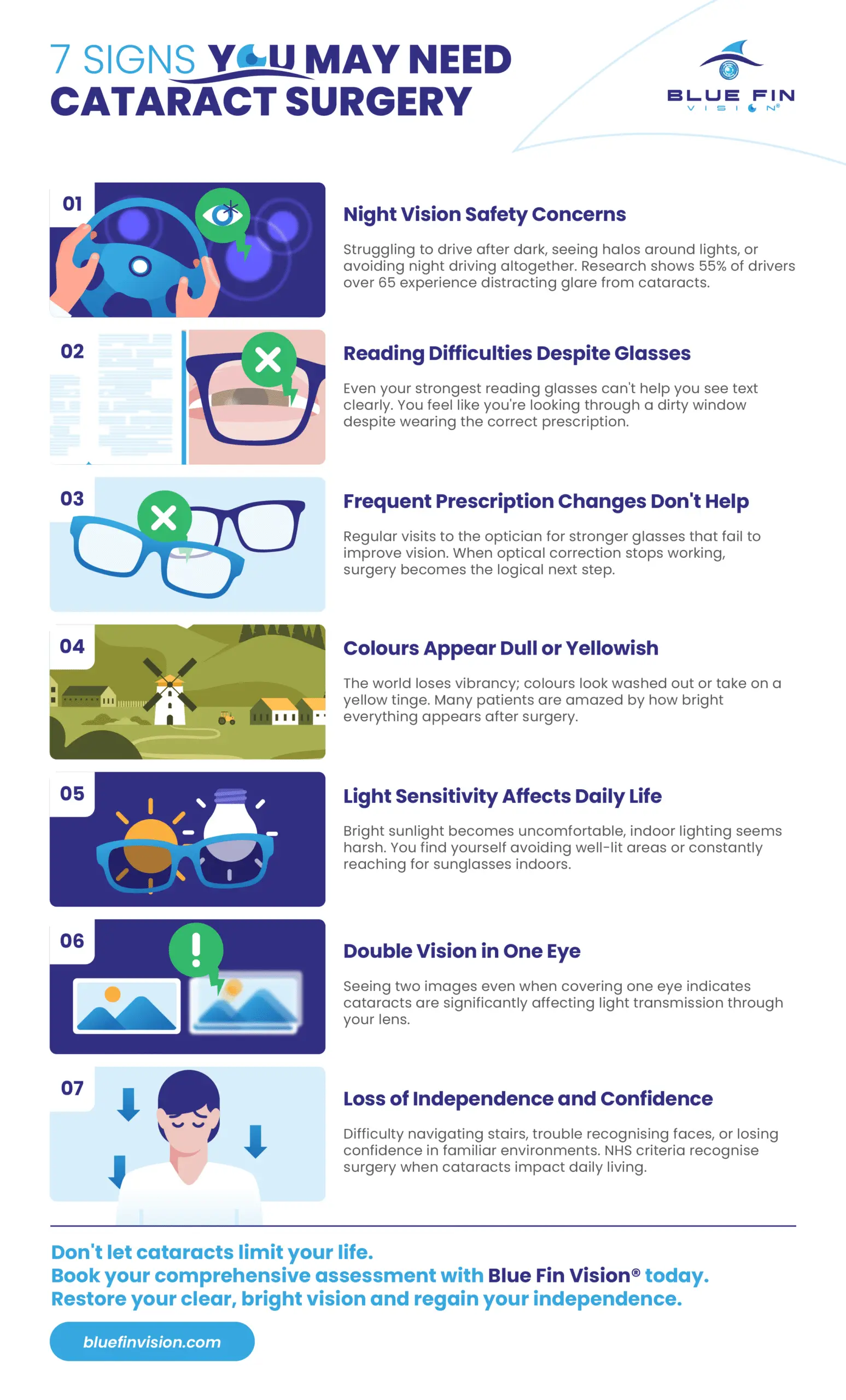
Infographic: 7 Signs You May Need Cataract Surgery
1. Night Driving Has Become a Safety Concern
Some difficulty with night driving is common with age, so the useful question is what has changed.
Cataracts scatter light entering the eye. This typically produces glare and haloes around headlights and streetlamps, reduced contrast on unlit roads, slower adaptation when moving between light and darkness, and a loss of confidence at night even when daytime vision still meets the driving standard.¹
If you have started avoiding night driving, or feel unsafe behind the wheel in low light, this is one of the clearest functional indicators that surgery may help. As a benchmark, UK drivers must be able to read a number plate from 20 metres and meet the DVLA visual acuity standard, which measures how clearly you can see at a set distance.

2. Reading and Close Work Have Become Frustrating
Early cataract-related reading difficulty is often a problem of contrast rather than focus. Increasing the light may help temporarily, but the loss of contrast caused by a clouding lens cannot always be corrected with spectacles, however accurate the prescription.¹
If text looks washed out or as though you are reading through a dirty window even in your correct glasses, the lens itself may be the reason.
3. Your Glasses Prescription Keeps Changing Without Helping
Frequent prescription updates that never quite restore clarity are a classic sign of a progressing cataract.
Some patients also notice a curious phenomenon known as a myopic shift, meaning a change towards short-sightedness, sometimes called “second sight”. As a nuclear cataract develops, with clouding in the centre of the lens, the focusing power of the lens changes and near vision can temporarily improve without glasses.¹
This apparent improvement is usually short-lived. When optical correction stops delivering clear, comfortable vision, an assessment of the lens is the logical next step.

4. Colours Appear Dull, Faded or Yellowish
A cataract acts like a slowly deepening filter. Colours lose their vibrancy, whites take on a yellow or brown tinge, and the world looks flatter than it should.
Because the change is so gradual, many patients only appreciate how much colour they had lost after surgery, when vision on the treated side is compared with the untreated eye.
5. Light Sensitivity and Glare Are Affecting Daily Activities
Discomfort in bright sunlight, dazzle from low winter sun and harshness from indoor lighting can all reflect the way a cataract scatters light.
On its own, light sensitivity is not a threshold for surgery, and it has other causes that need to be excluded at examination. It becomes significant when it combines with the other signs on this list and starts to limit what you are willing to do.
6. You're Seeing Double Vision in One Eye
Monocular double vision or ghosting means a doubled image that persists when the other eye is covered. It can arise from irregular clouding within the lens.¹
It is different from binocular diplopia, which is double vision that disappears when either eye is covered.
Monocular diplopia is not diagnostic of cataract and requires proper examination. Tear-film problems, which affect the thin layer of moisture covering the eye, corneal conditions and refractive causes, meaning focusing or prescription errors, must be considered before surgery is recommended.

7. Your Independence and Confidence Are Being Compromised
The most important indicator is function. Difficulty recognising faces, reduced confidence on stairs and kerbs, problems with work or hobbies, needing considerably more light than others in the room, and a gradual loss of independence are exactly the quality-of-life effects that justify surgery.² ³
Cataract surgery has been shown consistently to improve vision-specific functioning and quality of life. This is why UK guidance frames the decision around daily living rather than a line on a chart.³
Can You Have Cataract Surgery Before Your Sight Becomes Very Poor?
Yes. Where symptoms and quality-of-life impact justify it, surgery can be appropriate even when measured visual acuity, or clarity of vision on a test chart, is still relatively good.²
There is no surgical advantage in waiting solely for a cataract to become very dense or “ripe”. Advanced cataracts can, in fact, be technically more demanding to remove.
The right timing is individual. A credible assessment must be equally capable of recommending surgery now, later or not at all.
Do You Need Surgery if You Have a Cataract but No Symptoms?
Usually not. An early cataract that is not affecting your life can simply be monitored, unless there is another clinical reason to operate.
No glasses, eye drops or vitamin supplements have been shown to reverse an established age-related cataract. Monitoring therefore means periodic review rather than treatment.⁴
Symptoms That Are Not Typical of Cataract and Need Urgent Assessment
Cataract symptoms develop gradually. Sudden visual loss, flashes of light, a shower of new floaters, a curtain or shadow across the vision, severe eye pain, or double vision of sudden onset are not typical cataract symptoms and warrant urgent ophthalmic assessment on the day they occur.
What a Blue Fin Vision® Cataract Assessment Actually Establishes
A consultation is not simply a route to booking surgery. Its purpose is to determine whether the cataract genuinely explains your symptoms.
The assessment examines the retina, the light-sensitive layer at the back of the eye; the optic nerve, which carries visual information from the eye to the brain; and the cornea, the clear front surface of the eye, for co-existing disease.
It also allows your consultant to plan the intraocular lens, the artificial replacement lens placed inside the eye during cataract surgery, that suits your eyes and your life.
Published UK National Ophthalmology Database audits define the national benchmarks for cataract surgery outcomes and complications.⁵ ⁶
Mr Mfazo Hove publishes six consecutive years of National Ophthalmology Database outcome data, with a posterior capsule rupture rate of approximately 0.2% for cataract surgery against a national benchmark of approximately 0.69-0.79%. Posterior capsule rupture means a tear in the thin membrane supporting the lens during surgery.
Seven Signs You Need Cataract Surgery: A Recap
- Night vision problems that affect driving safety and confidence
- Reading difficulty despite an up-to-date glasses prescription
- Frequent prescription changes that no longer restore clarity, including a temporary myopic shift
- Colours appearing dull, faded or yellowish
- Light sensitivity and glare that limit daily activities
- Double vision or ghosting in one eye, which always needs formal assessment
- Loss of independence, confidence or function in daily life
Next Steps
If several of these signs sound familiar, the appropriate next step is a comprehensive cataract assessment, not an assumption that surgery is inevitable.
You may also find it useful to review our cataract surgery costs, private cataract surgery checklist and recovery guide before your visit.
Blue Fin Vision® offers paid, consultant-led cataract consultations across London, Hertfordshire and Essex. The consultation fee reflects the detailed assessment and personalised planning provided.
Book a consultation to discuss your symptoms and options. The outcome of a good assessment is a clear, evidence-based recommendation that you can trust, whichever way it points.
References
- Chen SP, Woreta F, Chang DF. Cataracts: a review. JAMA. 2025;333(23):2093-2103.
- National Institute for Health and Care Excellence. Cataracts in adults: management. NICE guideline NG77. London: NICE; 2017 (last reviewed May 2025). Available from: NICE guideline NG77
- Lamoureux EL, Fenwick E, Pesudovs K, Tan D. The impact of cataract surgery on quality of life. Curr Opin Ophthalmol. 2011;22(1):19-27.
- Mathew MC, Ervin AM, Tao J, Davis RM. Antioxidant vitamin supplementation for preventing and slowing the progression of age-related cataract. Cochrane Database Syst Rev. 2012;(6):CD004567.
- Day AC, Donachie PHJ, Sparrow JM, Johnston RL; Royal College of Ophthalmologists’ National Ophthalmology Database. The Royal College of Ophthalmologists’ National Ophthalmology Database study of cataract surgery: report 1, visual outcomes and complications. Eye (Lond). 2015;29(4):552-560.
- Sparrow JM, Taylor H, Qureshi K, Smith R, Johnston RL. The Cataract National Dataset electronic multi-centre audit of 55 567 operations: case mix adjusted surgeons’ outcomes for posterior capsule rupture. Eye (Lond). 2011;25(8):1010-1015.
ABOUT THE AUTHOR
Mr Mfazo Hove
Consultant Ophthalmic Surgeon
MBChB MD FRCOphth CertLRS
Mr Mfazo Hove is a Consultant Ophthalmic Surgeon with experience spanning more than 57,000 procedures. He completed 6.5 years of specialist training at Moorfields Eye Hospital and served for five years as a consultant at the Western Eye Hospital, Imperial College Healthcare NHS Trust. He is the founder of Blue Fin Vision®, a consultant-led private ophthalmology practice operating across London, Essex, and Hertfordshire. His clinical expertise encompasses advanced cataract surgery, refractive lens replacement, laser vision correction, and implantable Collamer lenses (ICL).
A ZEISS Key Opinion Leader, Mr Hove is a respected international speaker with five invited engagements across seven cities in 2026:
- ZEISS China tour (Changsha, Shanghai, and Hangzhou, April – ZEISS APAC User Meeting)
- RCOphth Annual Congress – May – Manchester
- ZEISS EMEA User Meeting (Istanbul)
- ZEISS Lausanne User Meeting (Lausanne)
- European Society of Cataract and Refractive Surgeons Annual Congress (ESCRS, London)