Why Trifocal Lenses Are the Lens of Choice for the Glaucoma Patient Wanting Spectacle Independence
- Posted
- Medically Reviewed by: Mr Mfazo Hove, Consultant Ophthalmic Surgeon
- Author: Mr Mfazo Hove
- Published: May 22, 2026
- Last Updated: June 12, 2026
There is a default position in UK ophthalmology that has gone largely unchallenged. When a glaucoma patient asks for spectacle independence after cataract surgery, the answer is an extended depth of focus (EDOF) lens. The reasoning sounds intuitive. Preserve contrast. Avoid splitting light. Hedge against future field loss.
I argued against that default at the Royal College of Ophthalmologists Annual Congress 2026, Glaucoma Sub-Speciality Day, on Thursday 21 May. The argument I made there is the argument I want to set down here.
The position is simple. For the appropriately selected glaucoma patient who genuinely wants spectacle independence, a diffractive trifocal IOL is the better lens, not the more cautious one. The caution that drives surgeons toward EDOF is real, but it is frequently a goal-lens mismatch. The patient asks for full spectacle independence. The lens we hand them gives them functional intermediate vision and a reading prescription. That is not the same thing.
This article sets out the clinical reasoning, the published evidence, and where the line of patient selection actually sits.

Mr Mfazo Hove presenting Premium IOLs for the Glaucoma Surgeon at the Royal College of Ophthalmologists Annual Congress 2026, Glaucoma Sub-Speciality Day, Thursday 21 May 2026.

RCOphth Annual Congress 2026 speaker credential, Thursday 21 May 2026.
The Historical Objection, and Why It No Longer Holds
The original concern about diffractive multifocal IOLs in glaucoma rested on three pillars. Reduced contrast sensitivity. Interference with standard automated perimetry. And the unknown effect of light-splitting on an already compromised visual system.
The most-cited paper is Aychoua and colleagues in JAMA Ophthalmology (2013). It demonstrated that diffractive multifocal IOLs produced a mean deviation depression of approximately 2.4 dB on Humphrey Field Analyzer testing compared with phakic controls¹. That finding has been reproduced in later perimetric work, and it remains the structural reason for caution.
But the 2013 cohort were implanted with first- and second-generation diffractive bifocal optics. The lenses in that study are not the lenses we are implanting in 2026. Modern diffractive trifocals, and particularly the smooth bi-aspheric diffractive optic of the ZEISS AT LISA tri 839MP, distribute light across three foci with markedly improved energy efficiency and minimal compromise of contrast at functional spatial frequencies. The 2023 systematic review by Hong, Ang, Dorairaj and Dorairaj in Bioengineering is the most current synthesis. They reviewed twelve studies of premium IOL implantation in glaucomatous eyes and concluded that the evidence demonstrated high spectacle independence for distance, good patient satisfaction, and positive outcomes in postoperative visual acuity, residual astigmatism, and contrast sensitivity². The blanket prohibition on multifocal IOLs in glaucoma, which dominated teaching a decade ago, is not supported by current data.
What the literature does support is selection. Which is the entire substance of the decision.
What the Patient Is Actually Asking For
The clinical conversation matters here. When a glaucoma patient comes to clinic having read about lens replacement, they almost never use the phrase extended depth of focus. They say one of two things. I want to be free of my glasses. Or I want to read without reaching for readers.
A trifocal lens delivers that. An EDOF lens, in most patients, does not.
The 2023 systematic review and meta-analysis by Mantopoulos and colleagues in the American Journal of Ophthalmology pooled 22 studies and 2,200 eyes. Trifocal lenses delivered significantly better uncorrected near visual acuity, higher quality of vision questionnaire scores, and an odds ratio of 0.26 in favour of spectacle independence³. An earlier review by Liu and colleagues found that 48% of EDOF patients required spectacles for near work, compared to 12% of trifocal patients⁴.
This is the goal-lens mismatch in numbers. The EDOF patient does not need glasses to drive or to use a phone. They need glasses to read a menu, a contract, or a book. For a presbyopic patient who has spent thirty years irritated by reading glasses, this is a frustrating outcome, not a successful one.
The trifocal patient has a fully formed near focal point. The reading is real, not approximate.
What Modern Trifocal Optics Give the Glaucoma Patient
The ZEISS AT LISA tri 839MP is the lens I implant most often in this group. It is also the lens implanted in my own eyes. Six years on, I retain 6/5 distance and N1 near, bilaterally. That is a clinical conviction point, not a marketing one, but it shapes how I describe outcomes to patients.
The long-term evidence base is now substantial. Fernández and colleagues published six-year follow-up data on the AT LISA tri 839MP. Efficacy was maintained, with a contrast sensitivity defocus curve area of 2.29 logCS/m⁻¹, a light distortion index of 18.82%, and a VF-14 score of 94.73. Almost nine in ten patients said they would choose the same lens again⁵. These are not numbers that suggest a lens unsuitable for visually demanding patients.
Head-to-head data are equally reassuring. Mencucci and colleagues compared the AT LISA tri 839MP, the PanOptix, and the Symfony EDOF in 120 eyes. Both trifocals delivered superior near visual acuity to the EDOF lens under photopic conditions. Reading skills were equivalent across all three. Fewer trifocal patients required any near addition⁶. Ribeiro and Ferreira, in a direct comparison of two trifocal IOLs, reported equivalent visual and refractive outcomes between platforms, supporting the AT LISA tri 839MP as a reliable choice within the trifocal category¹⁰. Carreño and colleagues, in a much larger series of 500 eyes implanted with a trifocal IOL, demonstrated contrast sensitivity comparable to age-matched normals⁷.
This matters specifically for the glaucoma patient. The concern was always that an already-thinned retinal nerve fibre layer, combined with the contrast cost of a diffractive optic, would degrade functional vision to an unacceptable degree. The modern trifocal data show that contrast sensitivity remains within normative range across photopic and mesopic conditions. The lens does not, on average, push the glaucoma patient over a clinically meaningful threshold.

Discussion following the Premium IOLs for the Glaucoma Surgeon presentation, alongside session chair and co-presenters, RCOphth Annual Congress 2026.
Matching the Lens to the Patient's Goal
The selection conversation becomes much cleaner when it is framed by the patient’s actual goal rather than by lens category. The framework I use is this:
Patient Goal | Recommended Lens |
|---|---|
Maximum contrast / lowest visual risk | Monofocal |
Intermediate extension, accepts readers for fine print | EDOF |
True spectacle independence across all distances | Trifocal |
Each row is a clinically defensible answer. The error is offering a lens from one row in response to a goal from another. That is the entire mechanism of the goal-lens mismatch.
Where I Say Yes, the Selection Criteria
The argument for trifocal IOLs in glaucoma is not an argument for trifocal IOLs in all glaucoma. It is an argument for trifocal IOLs in appropriately selected glaucoma. The selection criteria I use are explicit, and they are the same criteria I have set out in the longer Blue Fin Vision® article on premium IOLs in the glaucoma patient (where I say yes, and where I refer).
A trifocal IOL is appropriate when all of the following apply.
Disease stage is mild and stable. Mean deviation better than approximately -6 dB. No documented progression on consecutive visual fields over 12-18 months. No splitting of the macular ganglion cell complex on OCT in the central 10 degrees. Garcia Arzate and colleagues reported favourable outcomes with the AT LISA tri 839MP specifically in glaucoma suspect and mild glaucoma patients, supporting this threshold as a reasonable upper limit for trifocal implantation⁹.
The patient is on stable, well-tolerated IOP control. Either no medication, or one to two well-tolerated topical agents. A patient on maximum medical therapy who is borderline-controlled is not a trifocal candidate, irrespective of field appearance.
The ocular surface is optimised. The ocular surface is the first optical surface. A premium implant cannot rescue a poor ocular surface. Meibomian gland dysfunction, evaporative dry eye, and aqueous deficiency must be treated to remission before biometry, not after surgery.
The pupil is functional. Pharmacologically miotic or surgically distorted pupils, common in pseudoexfoliation and after trabeculectomy, degrade trifocal performance and are a referral signal.
Visual field reliability is preserved. The patient must be able to perform a reliable Humphrey 24-2 SITA Standard. Patients who already struggle with perimetric reliability are at higher risk of monitoring degradation.
Patient expectations are calibrated. The patient must understand that they are accepting a small, measurable contrast cost in exchange for spectacle independence, and that this trade-off is informed by, but not eliminated by, their underlying glaucoma.
Where any of these criteria fail, I do not implant a trifocal. I refer onward, or recommend a monofocal, or in a narrower range of cases, an EDOF lens with a near-targeted refractive offset.
The EDOF Question, Addressed Directly
EDOF lenses, particularly the non-diffractive Vivity and the diffractive Symfony, have been positioned as the safer presbyopia-correcting option for glaucoma. They genuinely do produce less photic disturbance and somewhat better contrast sensitivity than first-generation diffractive optics⁸. The systematic review by Hong and colleagues identifies these as reasonable choices for the glaucoma patient who wants extended intermediate range without requiring functional near².
But the question I want to put to colleagues, and the question I put at the College, is whether safer is what the patient asked for.
If a patient wants intermediate vision and accepts readers for fine print, an EDOF lens is an excellent answer. If a patient wants to put down their reading glasses for good, an EDOF lens is the wrong answer dressed up as a cautious one. The cautious lens for that patient is a monofocal. The aspirational lens is a trifocal. The EDOF sits awkwardly between them, and the patient who chose it for spectacle independence will be the patient who tells you, eighteen months later, that they still keep readers in every room of the house.
That is the goal-lens mismatch I want to retire from UK ophthalmic practice.
What This Means at Blue Fin Vision®
The clinical pathway at Blue Fin Vision® for the glaucoma patient considering lens replacement is built around this framework. Every patient undergoes structural and functional assessment, OCT macula and RNFL, Humphrey 24-2, gonioscopy, IOP day-curve where clinically indicated, and a full ocular surface workup including meibography and tear film analysis, before any IOL recommendation is made.
For patients meeting the selection criteria, the AT LISA tri 839MP is my preferred trifocal. The lens has the longest published follow-up of any current-generation diffractive trifocal in the European market, a validated neuroadaptation profile, and an outcomes signature that I have personally tested across more than 57,000 procedures and audited through six consecutive years of National Ophthalmology Database reporting.
Read more about high-volume 4-Minute Phaco™ cataract surgery.
For patients who fall outside the criteria, the answer is monofocal, and the conversation moves to expectations for distance correction and reading add. I do not regard this as a lesser outcome. I regard it as the right lens for the eye in front of me.
The decision is not which lens is most advanced. The decision is which lens matches what the patient came in asking for, given the optic nerve they brought with them.
For the appropriately selected glaucoma patient who wants spectacle independence, that lens is a trifocal.
The Bottom Line
The question is not whether glaucoma patients can tolerate trifocal optics. The question is whether the right glaucoma patient should be denied the possibility of true spectacle independence because of outdated assumptions derived from older-generation lenses.
The data have moved on. The lenses have moved on. The framework should move on with them.
Session Programme
Glaucoma Sub-Speciality Day, Session 1, Cataract surgery in the glaucoma patient. Chairs: Wai Siene Ng and Andrew Tatham.
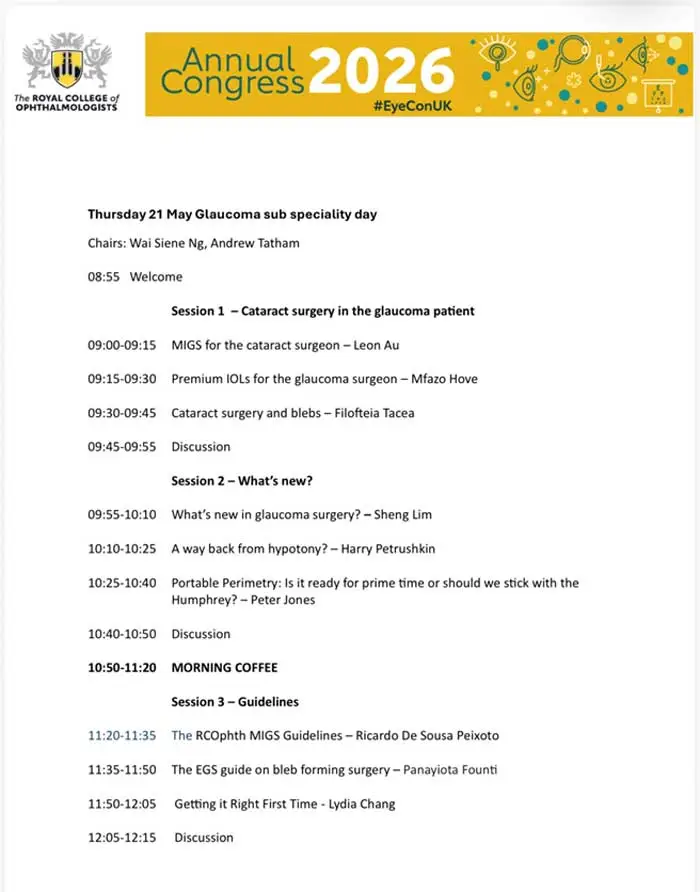
Royal College of Ophthalmologists Annual Congress 2026 Glaucoma Sub-Speciality Day programme, 09:15-09:30, Premium IOLs for the glaucoma surgeon, Mfazo Hove.
References
- Aychoua N, Junoy Montolio FG, Jansonius NM. Influence of multifocal intraocular lenses on standard automated perimetry test results. JAMA Ophthalmol. 2013;131(4):481-485.
- Hong ASY, Ang BCH, Dorairaj E, Dorairaj S. Premium intraocular lenses in glaucoma, a systematic review. Bioengineering (Basel). 2023;10(9):993.
- Mantopoulos D, Schallhorn JM, Schallhorn SC. Extended depth of focus versus trifocal for intraocular lens implantation: an updated systematic review and meta-analysis. Am J Ophthalmol. 2023;249:152-171.
- Liu J, Dong Y, Wang Y. Efficacy and safety of extended depth of focus intraocular lenses in cataract surgery: a systematic review and meta-analysis. BMC Ophthalmol. 2019;19(1):198.
- Fernández J, Rodríguez-Vallejo M, Martínez J, Tauste A, Piñero DP. Long-term efficacy, visual performance and patient reported outcomes with a trifocal intraocular lens: a six-year follow-up. J Clin Med. 2021;10(10):2009.
- Mencucci R, Favuzza E, Caporossi O, Savastano A, Rizzo S. Comparative analysis of visual outcomes, reading skills, contrast sensitivity, and patient satisfaction with two models of trifocal diffractive intraocular lenses and an extended range of vision intraocular lens. Graefes Arch Clin Exp Ophthalmol. 2018;256(10):1913-1922.
- Carreño E, Carreño EA, Carreño R, Carreño M, López V, Potvin R. Refractive and visual outcomes after bilateral implantation of a trifocal intraocular lens in a large population. Clin Ophthalmol. 2020;14:369-376.
- Cochener B, Boutillier G, Lamard M, Auberger-Zagnoli C. A comparative evaluation of a new generation of diffractive trifocal and extended depth of focus intraocular lenses. J Refract Surg. 2018;34(8):507-514.
- Garcia Arzate LD, Garcés Valencia A, Escalante M, Jimenez-Roman J, Castañeda Diez R. Use of AT LISA tri 839MP in glaucoma suspect and mild glaucoma patients. Invest Ophthalmol Vis Sci. 2017;58:4921.
- Ribeiro F, Ferreira TB. Comparison of visual and refractive outcomes of 2 trifocal intraocular lenses. J Cataract Refract Surg. 2020;46(5):694-699.
ABOUT THE AUTHOR
Mr Mfazo Hove
Consultant Ophthalmic Surgeon
MBChB MD FRCOphth CertLRS
Mr Mfazo Hove is a Consultant Ophthalmic Surgeon with experience spanning more than 57,000 procedures. He completed 6.5 years of specialist training at Moorfields Eye Hospital and served for five years as a consultant at the Western Eye Hospital, Imperial College Healthcare NHS Trust. He is the founder of Blue Fin Vision®, a consultant-led private ophthalmology practice operating across London, Essex, and Hertfordshire. His clinical expertise encompasses advanced cataract surgery, refractive lens replacement, laser vision correction, and implantable Collamer lenses (ICL).
A ZEISS Key Opinion Leader, Mr Hove is a respected international speaker with five invited engagements across seven cities in 2026:
- ZEISS China tour (Changsha, Shanghai, and Hangzhou, April – ZEISS APAC User Meeting)
- RCOphth Annual Congress – May – Manchester
- ZEISS EMEA User Meeting (Istanbul)
- ZEISS Lausanne User Meeting (Lausanne)
- European Society of Cataract and Refractive Surgeons Annual Congress (ESCRS, London)