




Premium IOLs in the Glaucoma Patient: Where I Say Yes, Where I Refer
- Posted
- Medically Reviewed by: Mr Mfazo Hove, Consultant Ophthalmic Surgeon
- Author: Mr Mfazo Hove
- Published: May 11, 2026
- Last Updated: June 12, 2026
Few topics in cataract and refractive surgery generate more reflexive caution than premium IOLs in eyes with glaucoma. The textbook line, that glaucoma is a contraindication, has held for two decades. The clinical reality is more interesting. With careful selection, glaucoma patients see well with premium IOLs, and the published evidence increasingly supports that observation ⁶.
The harder question is not whether a glaucoma patient can have a premium IOL. It is who should be the surgeon doing the case.
What The Evidence Actually Shows
It is also worth saying at the outset that premium IOL is not a single risk category. Enhanced monofocals, non-diffractive EDOF platforms and diffractive multifocal optics behave differently in a glaucomatous eye. Non-diffractive EDOF and enhanced monofocal designs generally preserve contrast sensitivity better than diffractive multifocals, and the published evidence in glaucoma reflects that gradient.
The conservative position rests on a single, defensible concern: glaucoma reduces contrast sensitivity, and so do diffractive multifocal IOLs. Stack one on top of the other in an eye with significant disease and you compound a deficit the patient cannot recover from. That is real. It is also not the whole picture.
Kitnarong and colleagues studied multifocal versus monofocal IOL implantation in eyes with primary angle-closure or primary angle-closure glaucoma, measuring contrast sensitivity at five spatial frequencies (1.5, 3.0, 6.0, 12.0 and 18.0 cycles per degree). At every spatial frequency, postoperative contrast sensitivity was statistically equivalent between the two groups. Both groups gained contrast sensitivity from cataract removal itself.¹
Lim, Moshegov and colleagues compared bilaterally implanted Vivity (non-diffractive EDOF) against monofocal IOLs in patients with early glaucoma. The EDOF group had better intermediate and near vision, significantly higher spectacle independence and significantly higher patient satisfaction. Photic phenomena were rare and seldom bothersome.²
Sieck and colleagues prospectively followed 52 eyes of 26 patients with mild open-angle glaucoma bilaterally implanted with the same non-diffractive EDOF platform. Distance, intermediate and near acuity outcomes were strong; patient-reported satisfaction was high.³
What the data, and my own clinical experience, increasingly suggest is that the optical penalty visible on objective testing does not reliably translate into real-world functional disability. Contrast sensitivity reduced on a chart is not the same as contrast sensitivity that disables a patient at the wheel of a car or in a supermarket aisle. In appropriately selected glaucoma patients, including those receiving diffractive multifocal optics, daily functional vision is excellent. I would happily implant a diffractive multifocal IOL in a glaucoma patient who meets selection criteria and is properly counselled. The work sits in the selection and the conversation, not in the lens category.
This is now an increasingly reproducible signal across angle-closure, open-angle and pre-perimetric disease: in early, stable glaucoma, premium IOL technology, diffractive or otherwise, does not unmask hidden visual loss. Patients perform well on objective testing and report high satisfaction. The evidence base remains relatively small, mostly observational, and with limited long-term follow-up, but it is now sufficient to make an absolute prohibition difficult to defend.

My Selection Criteria
I implant premium IOLs in glaucoma patients in two situations:
- Documented ocular hypertension with intact fields, healthy nerve, no structural progression and stable IOP (treated or untreated).
- Mild, stable primary open-angle glaucoma, full or near-full visual fields, no fixation-threatening defect, no progression on serial OCT and fields over at least 12 months, and IOP controlled on a tolerable regimen.
Within those two categories, central or fixation-threatening field loss changes the conversation completely. A paracentral defect inside the central 10 degrees moves a patient out of premium IOL candidacy whatever the mean deviation reads, whatever the medication regimen, and whatever the patient’s motivation. Mean deviation alone is a poor proxy here; the location of the defect matters more than its depth, and a 10-2 examination, not just 24-2, should be part of the candidacy assessment wherever there is any suggestion of central involvement.
Independent of field status, eyes with pseudoexfoliation, zonular instability or significant ocular surface disease require additional caution. Premium IOL optics, particularly diffractive multifocals, are decentration-sensitive, and a compromised zonular apparatus or unstable tear film will degrade outcomes whatever the visual field looks like.
Outside that, premium IOL implantation is not the wrong answer because the lens fails. It is the wrong answer because the surgical plan has changed.
When The Case Stops Being Refractive
If a patient has anything more than ocular hypertension or mild stable disease, the cataract operation is no longer a stand-alone refractive procedure. It is an opportunity to combine phaco with a trabecular bypass, iStent inject® W, Hydrus® Microstent or equivalent, and to take pressure and medication burden off the eye while the angle is open and accessible.
The IOP and medication-reduction data from combined phaco-MIGS are now mature, with two-year and four-year evidence showing meaningful, sustained pressure reduction and a falling medication burden across the leading trabecular bypass devices.⁴ ⁵
That is a meaningful intervention with long-term implications for visual field preservation. It belongs in the hands of a glaucoma surgeon, not a refractive cataract surgeon adding a stent as an extra. The patient can still receive a premium IOL, the conversation about lens choice is preserved, but the surgical plan, gonioscopic assessment, device selection and postoperative IOP management sit with the right specialist.
This is not defensive practice. It is the same logic that sends a complex vitreoretinal case to a vitreoretinal surgeon: the procedure determines the operator, not the lens.
Counselling The Patient
The strongest objection to premium IOL use in glaucoma is not the contrast sensitivity argument, it is the temporal one. A 52-year-old with mild glaucoma today may have advanced glaucoma 20 years from now. The challenge is not only what the field looks like at the point of surgery; it is the uncertainty of where the field may sit decades later. I take that seriously, and it forms the core of how I counsel these patients. What I do not accept is that this uncertainty justifies a blanket prohibition on lens choice for an entire category of patient. None of us would withhold cataract surgery from a 52-year-old with mild glaucoma on the grounds that they may progress; the lens-choice question is similarly an informed adult decision, not an automatic veto.
The discussion I have with these patients is structured and honest:
- Glaucoma is progressive. None of us, patient or surgeon, can predict the individual rate of decline.
- A premium IOL does not accelerate glaucoma. It also does not protect against it.
- If the disease progresses significantly over the patient’s lifetime, contrast sensitivity will fall whatever lens is in the eye. The lens is not the limiting factor; the optic nerve is.
- In selected cases with an intact capsule, IOL exchange remains possible if a multifocal IOL ever becomes a problem in a glaucomatous eye, although secondary surgery is naturally more complex than primary implantation. This is one reason capsular integrity at the index operation matters, and one reason I prioritise low-complication phaco above almost everything else.
Patients respond well to that framing. They are not being told no; they are being told yes, with eyes open. In my experience, that is the conversation glaucoma patients have been wanting and rarely receiving.
The Wider Conversation
This thinking aligns with how the field itself is now organising the question. The Royal College of Ophthalmologists’ Glaucoma Sub-Speciality Day at Annual Congress 2026 (Thursday 21 May, chaired by Wai Siene Ng and Andrew Tatham) opens with a Session 1 explicitly titled Cataract surgery in the glaucoma patient, three back-to-back talks designed to bridge the cataract and glaucoma subspecialties:
- MIGS for the cataract surgeon, Leon Au
- Premium IOLs for the glaucoma surgeon, Mfazo Hove
- Cataract surgery and blebs, Filofteia Tacea
The pairing is deliberate. The cataract surgeon is being asked to think about pressure. The glaucoma surgeon is being asked to think about refraction. Both are being asked to handle the eyes whose anatomy spans both fields. The session structure mirrors exactly the kind of joined-up thinking the patient in front of us needs.
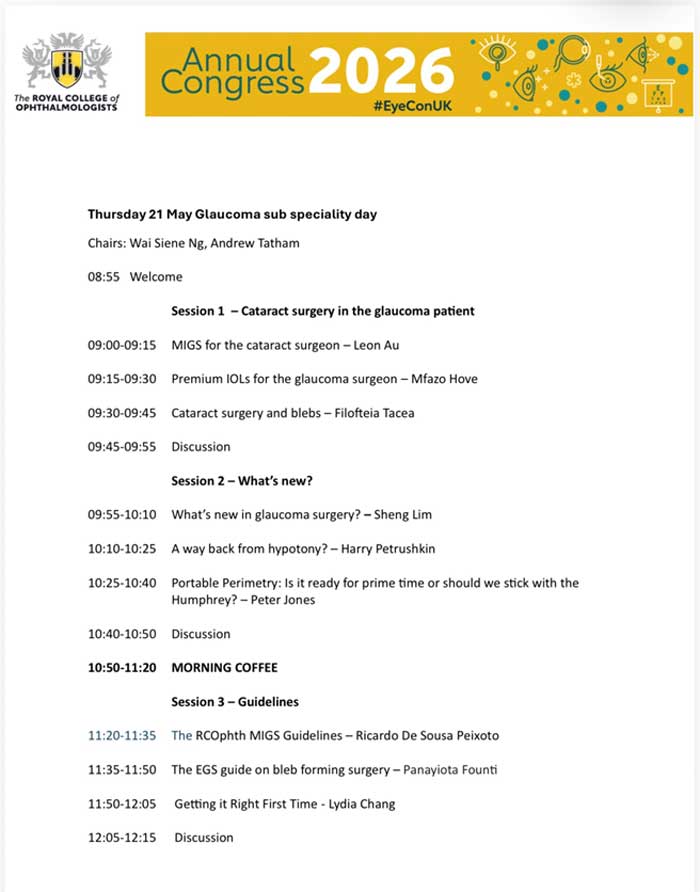
Figure 1. RCOphth Annual Congress 2026, Glaucoma Sub-Speciality Day programme (Thursday 21 May).
The same Glaucoma Day will hear the RCOphth MIGS Guidelines (Ricardo De Sousa Peixoto), the EGS guide on bleb-forming surgery (Panayiota Founti) and Getting It Right First Time (Lydia Chang), formal framework that increasingly defines which procedure should sit with which surgeon, and how.
Bottom Line
Glaucoma is not a blanket contraindication to premium IOLs. In ocular hypertension and mild stable disease, the published evidence and my own clinical experience converge on the same answer: these patients see well, achieve meaningful spectacle independence, and report high satisfaction.
What changes with disease severity is not the IOL question, it is the surgical question. Beyond mild disease, the operation is no longer a refractive case. It is a combined glaucoma case with a refractive component, and it should be run by a glaucoma surgeon. That referral is not a downgrade for the patient. It is the right operator for the right operation.
References
- Kitnarong N, Dagvadorj D, Anothaisintawee T. Effect of multifocal intraocular lens on contrast sensitivity in primary angle-closure patients. Siriraj Med J. 2023;75(7):497-504.
- Kerr NM, Moshegov S, Lim S, Simos M. Visual outcomes, spectacle independence, and patient-reported satisfaction of the Vivity extended range of vision intraocular lens in patients with early glaucoma: an observational comparative study. Clin Ophthalmol. 2023;17:1515-1523.
- Ferguson TJ, Wilson CW, Shafer BM, Berdahl JP, Terveen DC. Clinical outcomes of a non-diffractive extended depth-of-focus IOL in eyes with mild glaucoma. Clin Ophthalmol. 2023;17:861-868.
- Holmes DP, Clement CI, Nguyen V, Healey PR, Lim R, White A, Yuen J, Lawlor M. Comparative study of 2-year outcomes for Hydrus or iStent inject microinvasive glaucoma surgery implants with cataract surgery. Clin Exp Ophthalmol. 2022;50(3):303-311.
- Tan JCK, Clement C, Healey P, Lim R, White A, Yuen J, Agar A, Lawlor M. Long-term comparative outcomes of Hydrus versus iStent inject microinvasive glaucoma surgery implants combined with cataract surgery. Br J Ophthalmol. Published online 2025.
- Ichhpujani P, Bhartiya S, Sharma A. Premium IOLs in glaucoma. J Curr Glaucoma Pract. 2013;7(2):54-57.
ABOUT THE AUTHOR
Mr Mfazo Hove
Consultant Ophthalmic Surgeon
MBChB MD FRCOphth CertLRS
Mr Mfazo Hove is a Consultant Ophthalmic Surgeon with experience spanning more than 57,000 procedures. He completed 6.5 years of specialist training at Moorfields Eye Hospital and served for five years as a consultant at the Western Eye Hospital, Imperial College Healthcare NHS Trust. He is the founder of Blue Fin Vision®, a consultant-led private ophthalmology practice operating across London, Essex, and Hertfordshire. His clinical expertise encompasses advanced cataract surgery, refractive lens replacement, laser vision correction, and implantable Collamer lenses (ICL).
A ZEISS Key Opinion Leader, Mr Hove is a respected international speaker with five invited engagements across seven cities in 2026:
- ZEISS China tour (Changsha, Shanghai, and Hangzhou, April – ZEISS APAC User Meeting)
- RCOphth Annual Congress – May – Manchester
- ZEISS EMEA User Meeting (Istanbul)
- ZEISS Lausanne User Meeting (Lausanne)
- European Society of Cataract and Refractive Surgeons Annual Congress (ESCRS, London)
Related Topics
The Evidence for Premium IOLs in Glaucoma
Selection, Assessment and Refusal Criteria
Combined Lens and Glaucoma Surgery: Who Should Operate
Discuss your options with Blue Fin Vision®
If you have glaucoma or ocular hypertension and are considering cataract surgery or lens replacement, the lens decision deserves a structured conversation, not a default refusal. Our consultant-led team will review your visual fields, OCT and ocular surface, talk you through whether a premium IOL is appropriate in your specific case, and identify whether a combined glaucoma procedure should sit alongside the cataract operation.
Consultations are available at our Harley Street flagship and across our wider network, including Weymouth Street, Chase Lodge Hospital in North West London, One Hatfield Hospital in Hertfordshire and Phoenix Hospital Chelmsford in Essex, offering greater access to Harley Street standards close to home.


