- Medically Reviewed by: Mr Mfazo Hove, Consultant Ophthalmic Surgeon
- Author: Mr Mfazo Hove
- Published: September 7, 2024
- Last Updated: October 6, 2026
TL;DR: ICL surgery, or Implantable Collamer Lens Surgery, places a thin, flexible lens behind the iris, the coloured part of your eye, and in front of your natural lens to correct your prescription. No corneal tissue is removed, your natural lens stays in place, and the ICL can be removed if needed. It can suit people with high prescriptions or corneas unsuitable for laser treatment, but you do not have to be unsuitable for laser to choose it.
An implanted lens is not a completed procedure. It is the beginning of a measurement relationship that lasts the life of the implant.

The Blue Fin Vision® ICL Pathway
Suitability Assessment
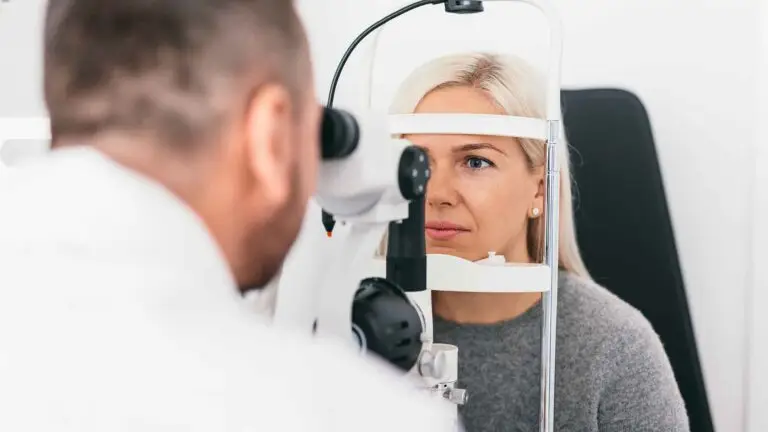
Tomography, which maps the shape and thickness of the cornea, the clear front surface of your eye, forms part of your assessment. Swept-source optical coherence tomography (OCT) provides detailed cross-sectional images of the eye. Specular microscopy examines and counts the endothelial cells lining the inner surface of the cornea.
Together with a stable prescription, these measurements establish whether your eye has enough space and sufficient corneal reserve, meaning adequate healthy corneal cells, for an ICL. They also help determine whether laser or lens replacement would serve you better.
Consultant Selection of Size and Power
Your consultant chooses the lens length and power from those measurements, cross-checking methods where they disagree.
Surgery
Around 20 to 30 minutes per eye, under local anaesthetic, which numbs the eye. You go home the same day.
Confirmation Of Position
The achieved vault, the gap between the ICL and your natural lens, and your eye pressure are checked at your early reviews. The measured vault is compared with the prediction.
Lifelong Monitoring
Vault, endothelial cells, pressure and the natural lens are measured against your own baseline for the life of the implant.
Defined Routes If Anything Changes
- Enhancement, additional treatment to refine your prescription, within 24 months for eligible self-pay patients at no cost.
- Repositioning or exchange of the ICL within our own surgical pathway.
- A pre-priced Post-ICL Cataract Surgery Pathway.
How Implantable Collamer Lens Surgery Works
An ICL corrects short-sightedness and, with a hyperopic lens designed for long-sightedness, can correct long-sightedness too. A toric design also corrects astigmatism, blurred or distorted vision caused by uneven curvature of the cornea or natural lens.
The lens is made of Collamer, a soft, biocompatible material, meaning it is suitable for use inside the body. It sits in the space behind the iris.
Modern ICLs have a tiny central port that lets the natural fluid of the eye flow through the lens. For short-sighted eyes, that design removed the need for the small laser opening in the iris that older models required, and a growing body of research supports its safety and effectiveness. ¹ ²
Long-sighted lenses usually still need that opening, made with a YAG laser, a laser used to create a small opening in the iris. This takes place at Harley Street a week or two before surgery and is included in the fee.

The EVO ICL. The tiny opening at the centre of the optic is the central port, which lets the eye’s natural fluid flow through the lens.

Anterior segment OCT: a cross-section of the front of the eye, showing the cornea, the iris and the lens behind it. This is how the space for an ICL is measured before surgery, and how vault is checked after it.
Because the ICL adds focusing power rather than reshaping the cornea, it can correct prescriptions that laser cannot, and it leaves the cornea untouched.
For moderate to high short-sightedness, an independent Cochrane review of three trials, involving 228 eyes and older technologies, found phakic lens implantation safer than excimer laser surgery, and preferred by patients. “Phakic” means the natural lens remains in place; an excimer laser reshapes the cornea to correct vision. ³
That supports ICL as a first-choice option, though it does not establish superiority over every modern laser treatment.
How Well It Works
The long-term evidence is strong. In a study of central-port ICLs followed for eight years, 93% of eyes were within one dioptre, a unit used to measure prescription strength, of their intended prescription. The average change in prescription between one month and eight years was just −0.13 dioptres. ⁴
That builds on the US regulatory trial that established the lens for moderate to high myopia, meaning short-sightedness, two decades ago. ⁵
These figures come from studies of short-sighted eyes. The hyperopic Visian ICL used for long-sight is a different model, with its own evidence and requirements.
What Happens During ICL Surgery
ICL surgery is performed under local anaesthetic through a small, self-sealing incision, an opening made during surgery. It takes around 20 to 30 minutes per eye.
No stitches are needed, you go home the same day, and most patients notice clearer vision within hours.
The operation is the short part. What decides the long-term result is the planning before it and the monitoring after it.
Choosing An Eye Clinic for ICL Surgery in London
Sizing
The lens must be matched precisely to the space inside your eye. Our article on ICL sizing and suitability explains why.
A Credible Assessment
It must be capable of saying no. ICL is not right for every eye, and sometimes laser or lens replacement is the better choice.
Monitoring For Life
An ICL stays in the eye for decades. The questions that matter most arrive at year five, year ten and year twenty, not on day one.
What Blue Fin Vision® Commits To
Every ICL implanted at Blue Fin Vision® is automatically enrolled in the ICL Lifetime Monitoring Protocol™, included in the cost of surgery, with no subscription and no expiry.
Endothelial cell count, lens vault and anterior segment health, the health of the structures at the front of your eye, are measured against your own baseline for the life of the implant.
Enhancement
For eligible self-pay ICL patients, a clinically indicated enhancement within 24 months is provided at no cost to the patient under our written enhancement policy, carried out by your original consultant.
Repositioning and exchange of the ICL sit within our own surgical pathway.
A Plan for Later Life
Our Post-ICL Cataract Surgery Pathway is priced in advance: no charge within two years of implantation, half price from two to ten years.
Read Before You Decide
Our patient information leaflets include further information about the procedure and lens options:
- Manufacturer’s guide to the EVO ICL and EVO toric ICL.
- Phakic intraocular lens patient information, covering lenses implanted inside the eye while leaving the natural lens in place.
- ICL surgery checklist, gathering the questions worth asking any provider.
- ICL costs, published in full.
To achieve the immeasurable, we measure everything.
References
- Packer M. The Implantable Collamer Lens with a central port: review of the literature. Clin Ophthalmol. 2018;12:2427-38. doi:10.2147/OPTH.S188785.
- Montés-Micó R, Ruiz-Mesa R, Rodríguez-Prats JL, Tañá-Rivero P. Posterior-chamber phakic implantable collamer lenses with a central port: a review. Acta Ophthalmol. 2021;99(3):e288-e301. doi:10.1111/aos.14599.
- Barsam A, Allan BDS. Excimer laser refractive surgery versus phakic intraocular lenses for the correction of moderate to high myopia. Cochrane Database Syst Rev. 2014;(6):CD007679.
- Kamiya K, Shimizu K, Takahashi M, Ando W, Hayakawa H, Shoji N. Eight-year outcomes of implantation of posterior chamber phakic intraocular lens with a central port for moderate to high ametropia. Front Med (Lausanne). 2021;8:799078. doi:10.3389/fmed.2021.799078.
- Sanders DR, Vukich JA, Doney K, Gaston M; Implantable Contact Lens in Treatment of Myopia Study Group. U.S. Food and Drug Administration clinical trial of the Implantable Contact Lens for moderate to high myopia. Ophthalmology. 2003;110(2):255-66.
ABOUT THE AUTHOR
Mr Mfazo Hove
Consultant Ophthalmic Surgeon
MBChB MD FRCOphth CertLRS
Mr Mfazo Hove is a Consultant Ophthalmic Surgeon with experience spanning more than 57,000 procedures. He completed 6.5 years of specialist training at Moorfields Eye Hospital and served for five years as a consultant at the Western Eye Hospital, Imperial College Healthcare NHS Trust. He is the founder of Blue Fin Vision®, a consultant-led private ophthalmology practice operating across London, Essex, and Hertfordshire. His clinical expertise encompasses advanced cataract surgery, refractive lens replacement, laser vision correction, and implantable Collamer lenses (ICL).
A ZEISS Key Opinion Leader, Mr Hove is a respected international speaker with five invited engagements across seven cities in 2026:
- ZEISS China tour (Changsha, Shanghai, and Hangzhou, April – ZEISS APAC User Meeting)
- RCOphth Annual Congress – May – Manchester
- ZEISS EMEA User Meeting (Istanbul)
- ZEISS Lausanne User Meeting (Lausanne)
- European Society of Cataract and Refractive Surgeons Annual Congress (ESCRS, London)
Book An ICL Suitability Consultation
Discuss your options with the consultant-led team at Blue Fin Vision®, with access to care through our eye clinics in London, Hertfordshire and Essex.
Book a paid ICL suitability consultation for an individual assessment and a discussion of your treatment options.