



Accurate Sizing and Suitability of an Implantable Collamer Lens (ICL)
- Posted
- Medically Reviewed by: Mr Mfazo Hove, Consultant Ophthalmic Surgeon
- Author: Mr Mfazo Hove
- Published: October 31, 2025
- Last Updated: October 30, 2026
TL;DR: Accurate implantable collamer lens sizing matches the lens to the space behind your iris, the coloured part of your eye, to achieve an appropriate vault, the gap between the implant and your natural lens. A vault that is too small or too large can increase the risk of cataract or pressure problems. Suitability for ICL surgery depends on detailed measurements and an assessment that identifies when another option would be more appropriate.
Sizing is the decision that happens before the operation and matters for decades after it.
Why Implantable Collamer Lens Sizing Matters
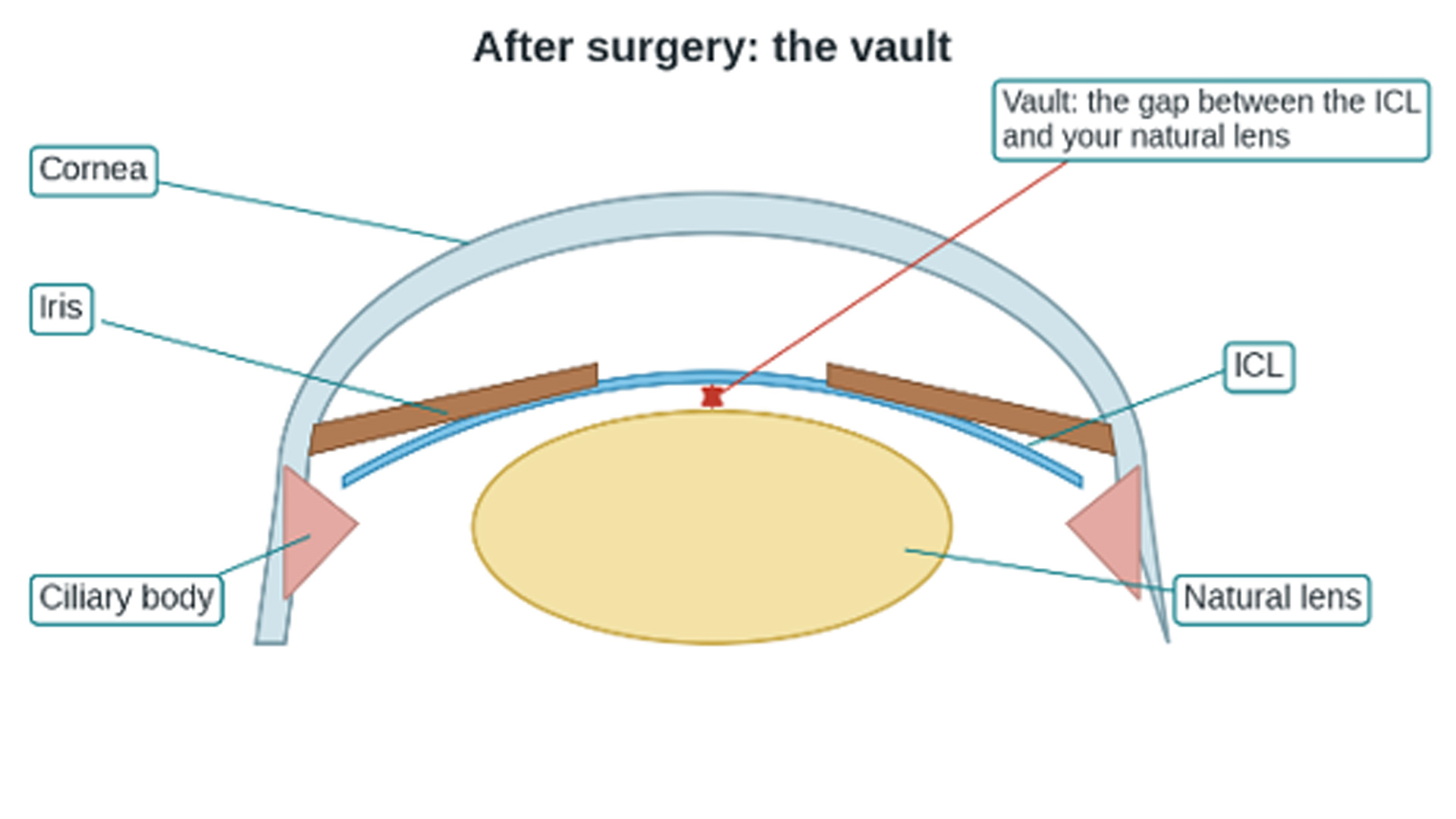
The ICL rests in a narrow space behind the iris called the ciliary sulcus. The aim is a vault within the Blue Fin Vision® target range of 250 to 750 micrometres. A micrometre is one-thousandth of a millimetre.
The measurement is interpreted alongside the drainage angle, where fluid drains from the eye, eye pressure, the natural lens and your symptoms.
- Too little vault brings the ICL close to your natural lens, increasing the risk of cataract, a clouding of that lens.
- Too much vault pushes the iris forward, which can narrow the drainage angle and raise eye pressure.
Mis-sizing is one of the main causes of the complications reported after ICL surgery,¹ and it is the main reason an ICL may need to be exchanged.

How Sizing Has Improved
Traditionally, ICL size was chosen from the white-to-white diameter, measured across the visible cornea, the clear front surface of the eye. That is only an indirect guide to the space inside.
Reviews of sizing methodology describe how more direct measurements of the internal anatomy have improved predictability.²
Formulas based on swept-source anterior segment optical coherence tomography (OCT), a type of scan that produces detailed images of the front of the eye, improved the accuracy of vault prediction.³ A refined version achieved a moderate, safe vault in 91% of eyes.⁴
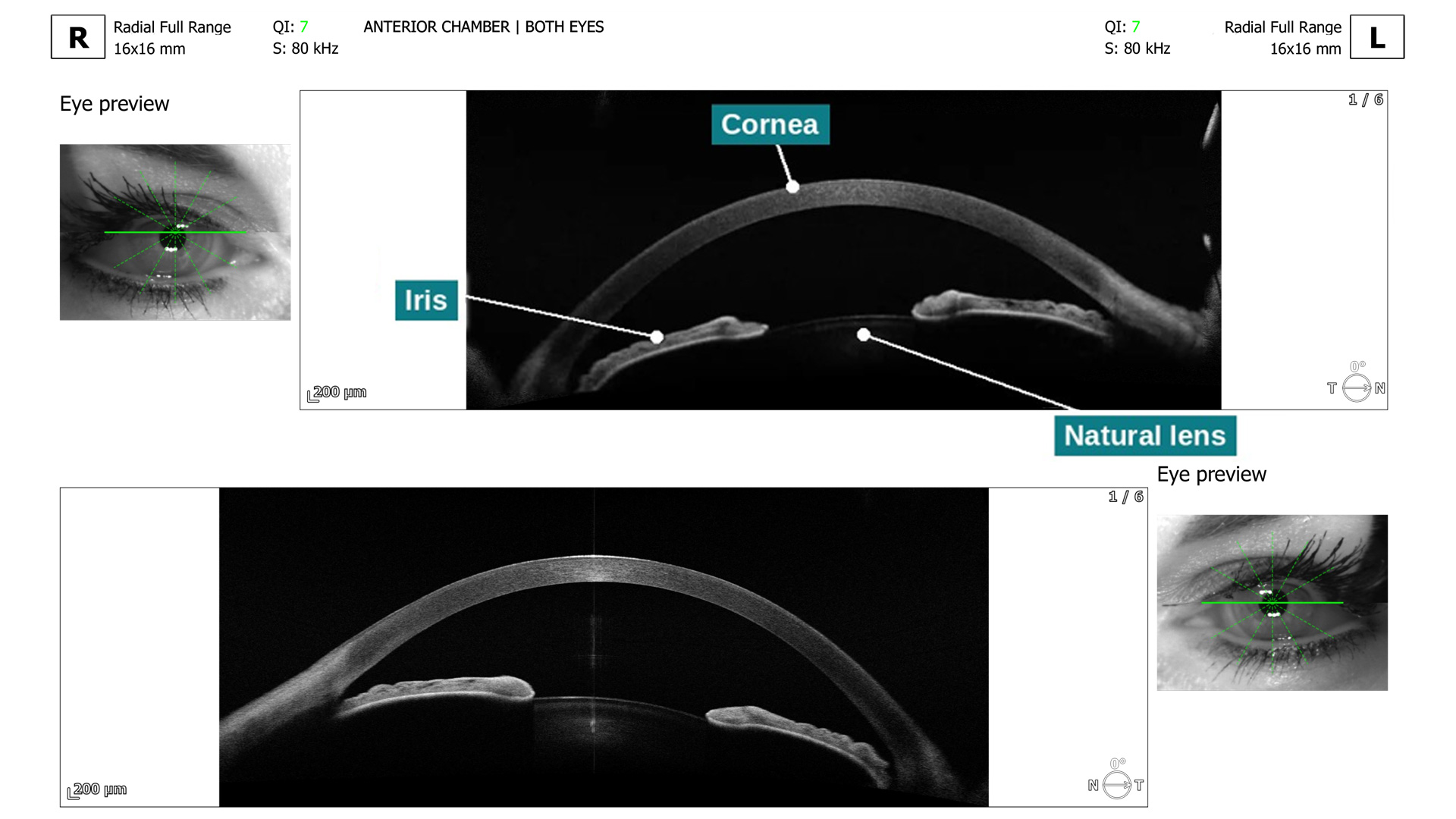
Anterion swept-source OCT of both eyes. The internal anatomy is imaged directly, rather than estimated from the surface of the eye, to guide lens size and predict vault.
The vault is not fixed after surgery. It tends to reduce gradually over the years,⁵ so sizing aims for a vault that will remain safe long term, and monitoring checks that it does.
Reviews of central-port lenses, which have a small opening that allows fluid to flow through, stress the same point: the anterior segment, the structures at the front of the eye, must be thoroughly assessed. Lens parameters, including size and power, must be carefully selected to achieve good outcomes and avoid complications.⁶
Who Is Suitable For ICL Surgery?
You may be suitable for ICL surgery if you:
- Are an adult with moderate to high short-sightedness, with or without astigmatism, an irregular curvature that can blur or distort vision.
- Have had a stable prescription over recent years.
- Have enough depth in the front chamber of the eye and a healthy endothelial cell count, the number of cells lining the inner surface of the cornea.
- Have no active eye disease such as cataract, uncontrolled glaucoma, a condition that damages the optic nerve, or recurrent inflammation.
You may not be suitable if the front chamber is too shallow, the cell count is low, or another procedure would serve you better.
Laser, or lens replacement in older patients, can be the better answer. A credible assessment must be capable of saying no.
Assessment At Blue Fin Vision® Eye Clinic
At our eye clinic, the equipment measures and the consultant decides. These are the five questions every ICL plan has to answer.
- Is There Enough Space And Endothelial Reserve?
Endothelial reserve refers to whether there are enough healthy cells lining the inner surface of the cornea.
The depth of the front chamber, from the back of the cornea to the front of your natural lens, is measured using OCT and Pentacam tomography, detailed imaging of the front of the eye. The minimum acceptable depth depends on the lens model. Your measurement is checked against the manufacturer’s criteria for the lens being considered.
Your endothelial cell count is measured by specular microscopy, a non-contact scan of these cells, and judged against what is expected for your age. The drainage angle is also assessed.
If the chamber is shallow or the cell count is low, an ICL may not be recommended, and laser or lens replacement is discussed instead.
- Where Will The Lens Sit?
The ICL’s footplates, the supporting ends of the implant, rest in the ciliary sulcus behind the iris, a space ordinary cameras cannot see.
OCT imaging using Anterion and Revo FC shows the front chamber, its width from angle to angle, and how far your natural lens rises into it.
The sulcus-to-sulcus distance is estimated by formula where it cannot be measured directly. It is cross-checked against the white-to-white diameter measured across the visible cornea.
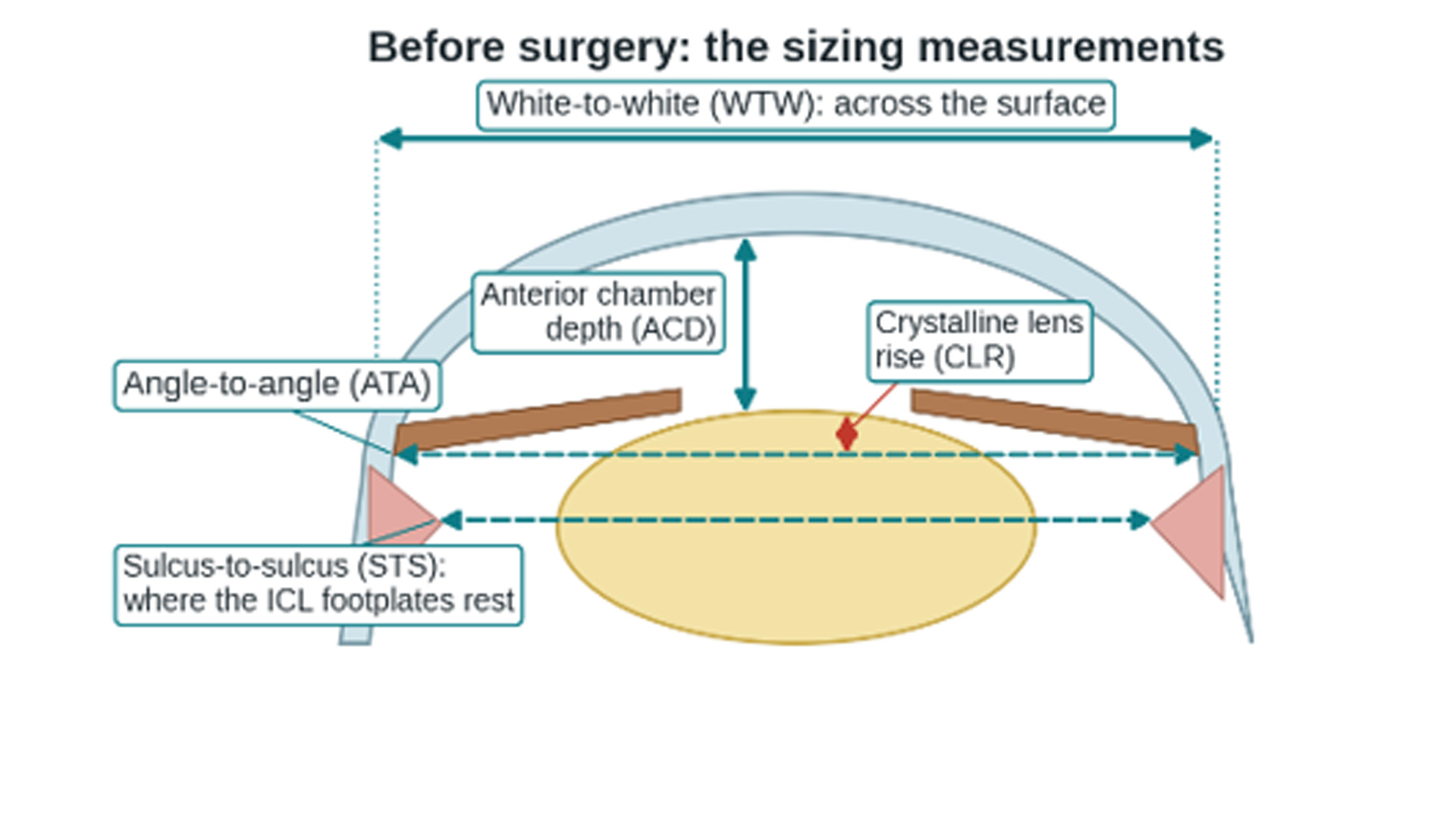
Where each sizing measurement is taken. Schematic, not to scale.
- White-to-white: the diameter across the visible cornea.
- Angle-to-angle: the distance between the drainage angles inside the front chamber.
- Sulcus-to-sulcus: the distance across the space behind the iris where the ICL footplates rest.
- Anterior chamber depth: the distance from the back of the cornea to the front of the natural lens.
- Crystalline lens rise: how far the natural lens sits in front of the angle-to-angle line.
- Vault: the gap between the ICL and the natural lens after surgery.
- How Is The Size Chosen?
The EVO ICL comes in four lengths: 12.1, 12.6, 13.2 and 13.7 mm.
The measurements are combined in sizing calculators, including the manufacturer’s calculator and vault-prediction modelling, calculations that estimate the gap each lens size would produce.
The chosen size is the one whose predicted vault sits within the Blue Fin Vision® target range of 250 to 750 micrometres across methods, taking into account that vault tends to reduce with age.⁵
- What If The Measurements Disagree?
They sometimes do. Measurements are repeated and checked against one another, and direct imaging of the internal anatomy is weighted above surface estimates.
If predictions fall between two sizes, the decision draws on the rise of your natural lens, the depth of the chamber and your age.
If the uncertainty is too great, options include treating one eye first so its result informs the second, or recommending a different procedure altogether.
- How Does The Achieved Vault Shape Your Care?
Vault is measured after surgery and compared with the prediction. In Mr Hove’s 2024–25 series, 100% of vault measurements at one week were within the target range.
A measurement outside the range does not automatically mean further surgery. The decision rests on the drainage angle, eye pressure, any contact with the natural lens and your symptoms.
Where exchange is needed, a low vault is usually managed with a larger lens and a high vault with a smaller one.
The achieved vault then becomes the baseline, the initial measurement against which every future measurement is compared.
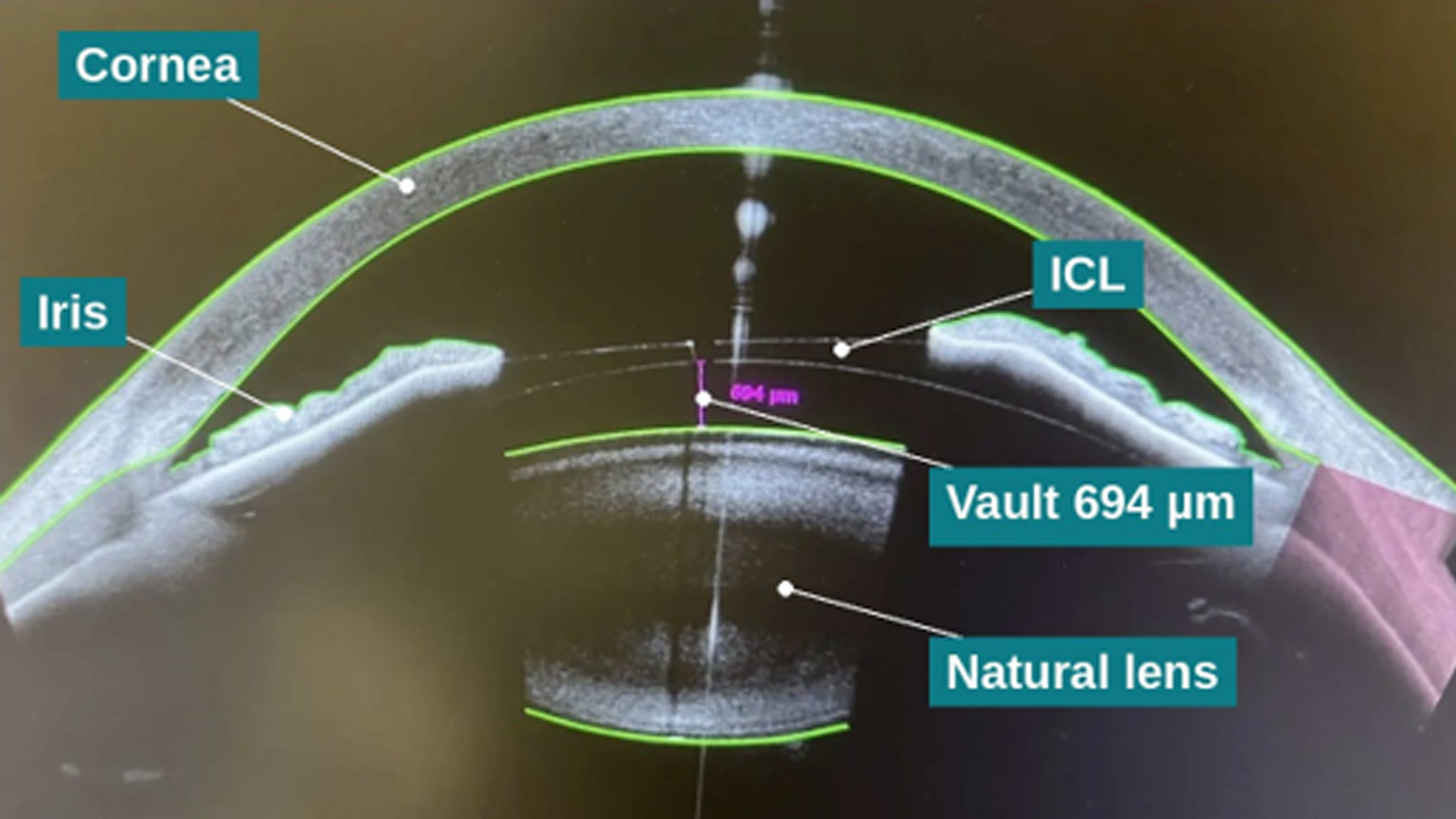
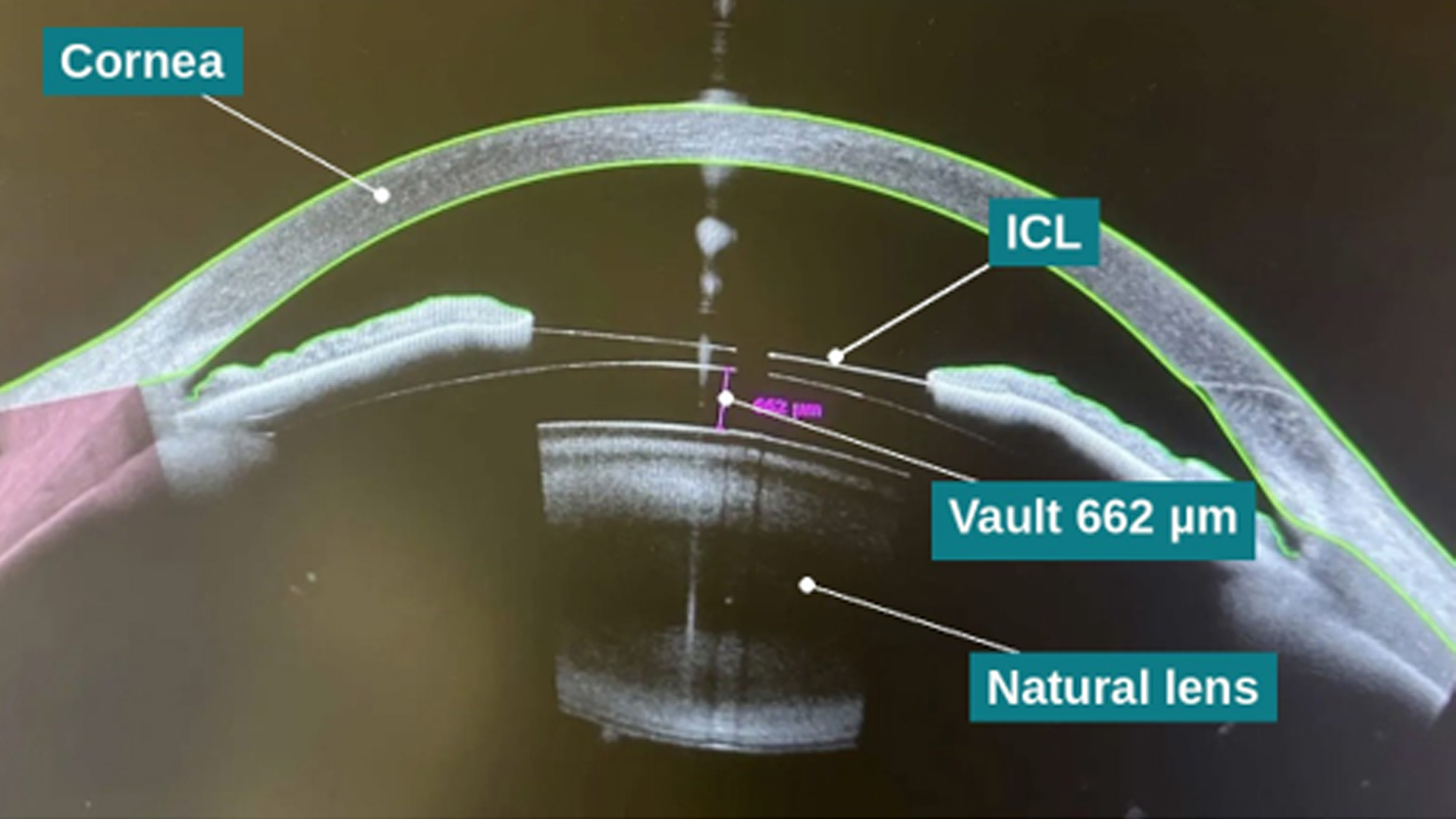
Vault measured on OCT after surgery: 694 and 662 micrometres, both within our 250 to 750 micrometre target range. These measurements become the baseline for lifelong monitoring.
Our knowledge base article on ICL sizing and vault explains the measurements in more detail.
Explore these resources before your consultation:
- Read our ICL suitability page.
- Explore our lens options page.
- Read the EVO ICL patient guide.
- Use our ICL surgery checklist, which asks every provider how the lens is sized.
Book a consultation with Blue Fin Vision® to assess your suitability for ICL surgery and discuss how the right lens size is selected for your eyes. Our consultant-led UK team provides care across London, Hertfordshire and Essex.
References
- Fernandes P, González-Méijome JM, Madrid-Costa D, Ferrer-Blasco T, Jorge J, Montés-Micó R. Implantable collamer posterior chamber intraocular lenses: a review of potential complications. J Refract Surg. 2011;27(10):765-76. doi:10.3928/1081597X-20110617-01.
- Packer M. Meta-analysis and review: effectiveness, safety, and central port design of the intraocular collamer lens. Clin Ophthalmol. 2016;10:1059-77. doi:10.2147/OPTH.S111620.
- Nakamura T, Isogai N, Kojima T, Yoshida Y, Sugiyama Y. Implantable collamer lens sizing method based on swept-source anterior segment optical coherence tomography. Am J Ophthalmol. 2018;187:99-107. doi:10.1016/j.ajo.2017.12.015.
- Nakamura T, Isogai N, Kojima T, Yoshida Y, Sugiyama Y. Optimization of implantable collamer lens sizing based on swept-source anterior segment optical coherence tomography. J Cataract Refract Surg. 2020;46(5):742-8. doi:10.1097/j.jcrs.0000000000000134.
- Schmidinger G, Lackner B, Pieh S, Skorpik C. Long-term changes in posterior chamber phakic intraocular collamer lens vaulting in myopic patients. Ophthalmology. 2010;117(8):1506-11. doi:10.1016/j.ophtha.2009.12.013.
- Montés-Micó R, Ruiz-Mesa R, Rodríguez-Prats JL, Tañá-Rivero P. Posterior-chamber phakic implantable collamer lenses with a central port: a review. Acta Ophthalmol. 2021;99(3):e288-e301. doi:10.1111/aos.14599.
ABOUT THE AUTHOR
Mr Mfazo Hove
MBChB MD FRCOphth CertLRS
Consultant Ophthalmic Surgeon | Founder and Medical Director, Blue Fin Vision®
Mr Mfazo Hove is a Consultant Ophthalmic Surgeon with more than two decades of experience across NHS and private practice and more than 57,000 ophthalmic procedures performed. He trained for six and a half years at Moorfields Eye Hospital and served for five years as an NHS consultant at the Western Eye Hospital, Imperial College Healthcare NHS Trust.
He specialises in cataract surgery, refractive lens replacement, laser vision correction and implantable Collamer lenses (ICL). He is the founder and Medical Director of Blue Fin Vision®, a private ophthalmology group providing consultant-delivered care across London, Hertfordshire and Essex. His cataract surgery outcomes are publicly reported through the National Ophthalmology Database.
A ZEISS Key Opinion Leader and international speaker, Mr Hove is a contributing author to The Ophthalmologist. His writing examines how clinical governance and the organisation of ophthalmic services shape patients’ experiences and outcomes, with a focus on transparent outcome reporting, surgical training and long-term accountability for patient care.