




- Medically Reviewed by: Mr Mfazo Hove, Consultant Ophthalmic Surgeon
- Author: Mr Mfazo Hove
- Published: November 14, 2024
- Last Updated: November 5, 2026
TL;DR: Dry AMD, or dry age-related macular degeneration, is the more common, slower form of AMD, affecting the macula, the central part of the retina responsible for detailed vision. Yellow deposits called drusen build up beneath it, and changes can gradually affect central vision over years. There is no injection that reverses it, but specific supplements can slow progression in suitable patients, and regular monitoring helps detect changes to the treatable wet form.
Dry AMD is slow, but it is not static. The most important thing it asks of you is to notice change.
How Dry AMD Develops
Dry AMD passes through stages: ¹
- Early: small or medium drusen, usually without symptoms.
- Intermediate: larger drusen or pigment changes; some people notice they need more light to read.
- Late (geographic atrophy): patches of the macula are lost, creating blind spots in central vision that gradually enlarge.
Age, smoking and family history are the strongest risk factors. ²

Can Supplements Help?
For people with intermediate dry AMD, or late AMD in one eye, the Age-Related Eye Disease Study found that a specific combination of vitamins C and E, beta-carotene, zinc and copper reduced the risk of progression to advanced AMD. ³
The AREDS2 study then replaced beta-carotene with lutein and zeaxanthin, a safer formulation for current and former smokers. ⁴
These supplements do not prevent AMD in people without it, and they are not needed for early disease, so ask before you buy them.
The Link with Wet AMD
A proportion of eyes with dry AMD develop wet AMD, where abnormal vessels leak under the macula. Prompt treatment offers the best chance of preserving vision. ⁵
If you notice new distortion, sudden blurring or a new dark patch in your vision, contact an optometrist or eye clinic urgently. Do not wait for your next routine appointment. If you cannot access urgent advice, contact NHS 111. ⁷
Our article on Wet vs Dry Macular Degeneration explains the difference.
Treatments for Geographic Atrophy
Medicines aimed at slowing geographic atrophy have been developed in recent years. At the time of writing, they are not routinely available in the UK, and their benefit is in slowing the spread of atrophy rather than restoring vision. Your consultant can discuss where research stands for your eye.
Living Well with Dry AMD
- Stop smoking, the most important change you can make.
- Use good lighting and magnifiers for close work.
- Check each eye regularly for new distortion.
- Ask about low vision support, which can make daily tasks easier.
AMD is common, affecting an estimated 196 million people worldwide in 2020, and good support is widely available. ⁶

What Causes Dry AMD?
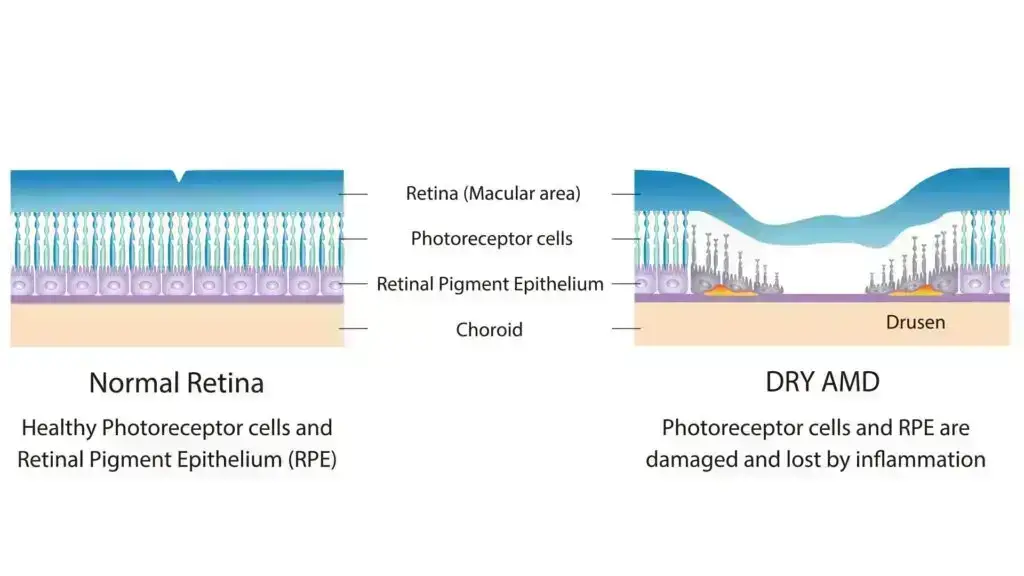
Beneath the light-sensing cells of the macula lies a supporting layer, the retinal pigment epithelium, which clears their waste and keeps them nourished.
With age, waste material accumulates as drusen, parts of the immune system become overactive, and the supporting layer gradually fails. Where it fails completely, the overlying light-sensing cells are lost, leaving the patches of atrophy that cause blind spots. ¹
Genes, smoking and diet all influence how quickly this happens. ²

How Dry AMD Is Diagnosed at an Eye Clinic
At an eye clinic, examination and imaging help establish the stage of dry AMD and check for signs of wet AMD.
- Examination of the macula after dilating drops, which widen the pupils, allows drusen and pigment changes to be seen.
- Optical coherence tomography (OCT) scanning produces detailed cross-sectional images of the retina. It shows drusen, thinning and any fluid that would suggest wet AMD. Our article on OCT Scans explains the test.
- Autofluorescence imaging uses the natural fluorescence of substances within the retina to map areas of geographic atrophy and show how quickly they grow.
How often you are seen depends on your stage. Early AMD can usually be monitored at routine eye tests; intermediate and late AMD benefit from specialist review.
Supplements: Who Should Take Them
- Worthwhile for: intermediate dry AMD, or late AMD in one eye, where AREDS-type supplements reduced the risk of progression. ³ ⁴
- Not shown to help: people with no AMD or only small drusen.
- Choose the AREDS2 formulation, without beta-carotene, particularly if you smoke or used to smoke. ⁴
- Check with your GP or pharmacist if you take other medicines, as high-dose zinc can cause stomach upset.
Supplements are not a treatment for dry AMD and do not restore lost vision. Their role is to reduce the risk of progression in people who are most at risk.
Diet and Lifestyle
- Stop smoking. Smoking substantially increases the risk of AMD developing and progressing.
- Eat leafy green vegetables, such as spinach and kale, which contain lutein and zeaxanthin.
- Include oily fish in your diet.
- Look after your heart: blood pressure, cholesterol and weight.
Low Vision Support
If dry AMD affects your daily life, practical help can make a real difference: magnifiers, task lighting, large-print and audio materials, and phone and tablet accessibility settings.
Your consultant can also certify you as sight impaired or severely sight impaired where appropriate, which gives access to local support services and some concessions.
Frequently Asked Questions
Will Dry AMD turn into Wet AMD?
Most people with dry AMD never develop wet AMD, but a proportion do. Check each eye regularly for new distortion.
How quickly will my sight get worse?
Usually slowly, over years. Early AMD may never affect your sight noticeably; geographic atrophy progresses at different rates in different people.
Are injections used for Dry AMD?
Anti-vascular endothelial growth factor (anti-VEGF) injections, which reduce abnormal blood vessel growth and leakage, treat wet AMD, not dry AMD.
Newer medicines for geographic atrophy are not routinely available in the UK at the time of writing.
Should my family be checked?
AMD runs in families, so it is worth your children and siblings mentioning it to their optometrist once they are over 50.
At Blue Fin Vision®
We confirm the diagnosis and stage with OCT imaging, advise on whether supplements are appropriate for you, and monitor for change.
If dry AMD converts to wet, treatment can start quickly. We arrange a consultation and OCT scan, typically the same day at your nearest suitable site. Where needed, an injection is given at our Harley Street clinic the same day or the following day, followed by an organised next step with us or through the NHS.
Read more about the condition, our service and the scans we use:
- Our article on Macular Degeneration explains how the service works.
- Read about our Medical Retina service.
- Learn more about OCT Scans.
The Royal National Institute of Blind People (RNIB) and our patient resources provide further information:
- RNIB’s free Understanding Age-Related Macular Degeneration guide.
- Our Patient Information.
Book a consultation with Blue Fin Vision® to discuss your dry AMD diagnosis, monitoring and support, with consultant-led care at clinics across London, Hertfordshire and Essex.
References
- Fleckenstein M, Keenan TDL, Guymer RH, Chakravarthy U, Schmitz-Valckenberg S, Klaver CC, et al. Age-related macular degeneration. Nat Rev Dis Primers. 2021;7(1):31.
- Mitchell P, Liew G, Gopinath B, Wong TY. Age-related macular degeneration. Lancet. 2018;392(10153):1147-59.
- Age-Related Eye Disease Study Research Group. A randomized, placebo-controlled, clinical trial of high-dose supplementation with vitamins C and E, beta carotene, and zinc for age-related macular degeneration and vision loss: AREDS report no. 8. Arch Ophthalmol. 2001;119(10):1417-36.
- Age-Related Eye Disease Study 2 Research Group. Lutein + zeaxanthin and omega-3 fatty acids for age-related macular degeneration: the Age-Related Eye Disease Study 2 (AREDS2) randomized clinical trial. JAMA. 2013;309(19):2005-15.
- Rosenfeld PJ, Brown DM, Heier JS, Boyer DS, Kaiser PK, Chung CY, et al. Ranibizumab for neovascular age-related macular degeneration. N Engl J Med. 2006;355(14):1419-31.
- Wong WL, Su X, Li X, Cheung CM, Klein R, Cheng CY, et al. Global prevalence of age-related macular degeneration and disease burden projection for 2020 and 2040: a systematic review and meta-analysis. Lancet Glob Health. 2014;2(2):e106-16.
- NHS. Age-related macular degeneration (AMD): symptoms [Internet]. NHS; [cited 2026 Nov 4].
ABOUT THE AUTHOR
Mr Mfazo Hove
MBChB MD FRCOphth CertLRS
Consultant Ophthalmic Surgeon | Founder and Medical Director, Blue Fin Vision®
Mr Mfazo Hove is a Consultant Ophthalmic Surgeon with more than two decades of experience across NHS and private practice and more than 57,000 ophthalmic procedures performed. He trained for six and a half years at Moorfields Eye Hospital and served for five years as an NHS consultant at the Western Eye Hospital, Imperial College Healthcare NHS Trust.
He specialises in cataract surgery, refractive lens replacement, laser vision correction and implantable Collamer lenses (ICL). He is the founder and Medical Director of Blue Fin Vision®, a private ophthalmology group providing consultant-delivered care across London, Hertfordshire and Essex. His cataract surgery outcomes are publicly reported through the National Ophthalmology Database.
A ZEISS Key Opinion Leader and international speaker, Mr Hove is a contributing author to The Ophthalmologist and Ophthalmology Times. His writing examines how clinical governance and the organisation of ophthalmic services shape patients’ experiences and outcomes, with a focus on transparent outcome reporting, surgical training and long-term accountability for patient care.