


Patient Experience
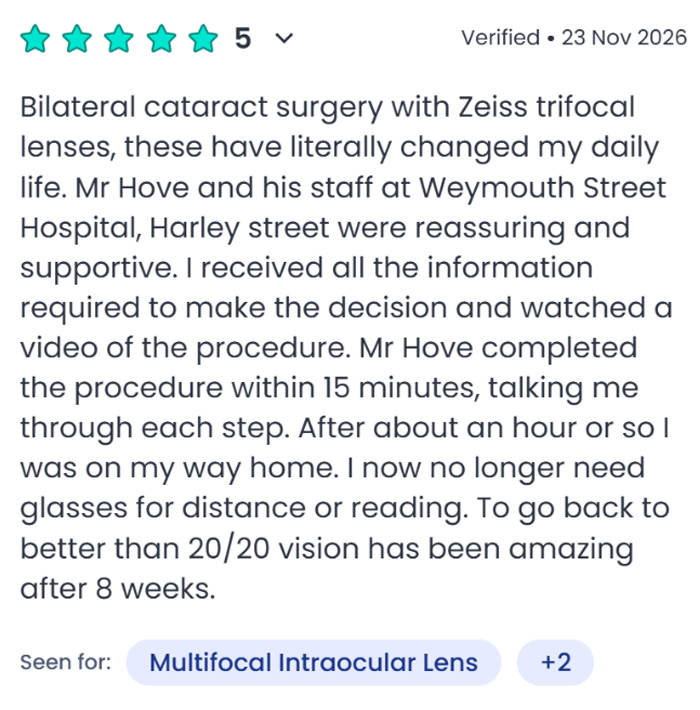
“Bilateral cataract surgery with Zeiss trifocal lenses, these have literally changed my daily life. Mr Hove and his staff at Weymouth Street Hospital, Harley street were reassuring and supportive. I received all the information required to make the decision and watched a video of the procedure. Mr Hove completed the procedure within 15 minutes, talking me through each step. After about an hour or so I was on my way home. I now no longer need glasses for distance or reading. To go back to better than 20/20 vision has been amazing after 8 weeks.”
Five stars. Verified patient review on Doctify, 23 November 2026.
What Should You Know Before Deciding on Cataract Surgery?
Before agreeing to cataract surgery, a patient should understand what the operation involves, what it can achieve, the risks that matter to them, the lens options, the alternatives, and what happens if something goes wrong.
This patient describes that standard in one sentence: “I received all the information required to make the decision and watched a video of the procedure.”
What Informed Consent Involves
Consent is a conversation, not a signature. General Medical Council guidance describes decision making as an ongoing dialogue, in which patients are given the information they need, and the time and support to understand it.¹
UK law sets the same standard. Since the Supreme Court’s Montgomery judgment in 2015, a doctor must take reasonable care to make sure the patient is aware of the material risks of the recommended treatment, and of any reasonable alternatives.²
For cataract surgery, that means a patient should be able to answer six questions before the day of surgery:
- What will be done to my eye, and how long will it take?
- Which lens am I having, what will it do, and what will it not do?
- What are the risks, how often do they happen, and how often do they happen in this surgeon’s hands?
- What are my alternatives, including waiting or doing nothing?
- Will both eyes be treated on the same day, and why?
- If a complication occurs, what happens next, and who pays for it?
A video of the procedure helps with the first question. It shows what words describe poorly, and it can be watched more than once, at the patient’s own pace, with family.
Who This Applies to, and Who It Does Not
This applies to every adult considering cataract surgery or lens replacement.
It matters most where expectations are highest: premium lenses, surgery on both eyes on the same day, and eyes with other conditions.
It works differently for some patients:
- Patients with poor sight may struggle with printed leaflets. Spoken explanation and video can carry more of the information.³
- Patients who do not want detail are entitled to say so. The surgeon should still explain what they need to know in order to give consent.¹
- Patients who may lack capacity to make the decision follow a separate legal process, involving those close to them.¹
A video is an addition to the consultation. It does not replace it.³
What the Published Evidence Shows
Video improves understanding. A systematic review of video-based patient education in ophthalmology included 12 studies. Seven measured patient understanding, and five of those found a statistically significant improvement with video. The authors noted that well-designed studies remain scarce.³
Patients often leave consent with the wrong picture. In the first cycle of a UK audit of consent for cataract surgery, 48% of patients wrongly believed the operation was completely risk free. In a second cycle, after more explicit counselling, 43% still did.⁴
Knowing what to expect lowers anxiety. A randomised trial of 141 cataract patients compared a video showing what to expect with a video about the anatomy of cataract.
Patients who watched the first video scored their understanding at 7.44 out of 10, against 5.82 for those who watched the anatomy video. They also reported less anxiety during surgery and higher overall satisfaction.⁵
The effect lasts to the day of surgery. A randomised trial of 91 patients compared those who watched an educational video with those who did not.
On the day of surgery, patients who watched the video scored 11.2 out of 12 on a knowledge quiz, against 8.4 without the video. They were also less anxious on the day.⁶
Mr Hove’s Perspective
My test is simple: if I have to refer a patient back to the small print after surgery, I may win the argument, but the war is lost. Understanding has to be built before the operation.
At Blue Fin Vision® we do that in five ways:
Time. Surgical consultations are booked for 45 minutes and conducted in full by the consultant.
A paid consultation. We charge for the consultation, so that its purpose is to consult and not to sell. A credible assessment must be capable of ending in “no”.
All the options. A proper consultation presents every option, including those not offered by that surgeon or that hospital.
The same message four times. What our patient information leaflet says is what is said face to face, then repeated in the letter and in the consent form.
The numbers, before surgery. Patients are told two figures for posterior capsule rupture, the main complication during cataract surgery: my own rate and the national rate. The figures current when this patient had surgery covered 1 April 2024 to 31 March 2025.
My published National Ophthalmology Database results covered 5,359 operations with a rate of 0.24%.⁷
My full-practice audit, which adds 1,654 private hospital cataract and lens replacement operations not captured in that database, covered 7,013 operations with a rate of 0.19%.
The national rate for the same year, taken from the national audit report, was 0.70%.⁸ My latest audited results are on my profile page.
Our patients also keep every letter and every scan.
They can ask for the video of their own operation and a transcript of their consultation.
Clinical Takeaway
You are ready to decide on cataract surgery when you could explain the operation, your lens, the main risks and your alternatives to someone else. A video helps you reach that point. The conversation with your surgeon is what gets you there.
References
- General Medical Council. The seven principles of decision making and consent. London: General Medical Council; 2020 [cited 2026 Nov 25]. Available from: https://www.gmc-uk.org/professional-standards/the-professional-standards/decision-making-and-consent/the-seven-principles-of-decision-making-and-consent
- Montgomery v Lanarkshire Health Board [2015] UKSC 11.
- Farwana R, Sheriff A, Manzar H, Farwana M, Yusuf A, Sheriff I. Watch this space: a systematic review of the use of video-based media as a patient education tool in ophthalmology. Eye (Lond). 2020;34(9):1563-9. doi: 10.1038/s41433-020-0798-z. Available from: https://pmc.ncbi.nlm.nih.gov/articles/PMC7608108
- Cheung D, Sandramouli S. The consent and counselling of patients for cataract surgery: a prospective audit. Eye (Lond). 2005;19:963-71. doi: 10.1038/sj.eye.6701694. Available from: https://www.nature.com/articles/6701694
- Pager CK. Randomised controlled trial of preoperative information to improve satisfaction with cataract surgery. Br J Ophthalmol. 2005;89(1):10-3. doi: 10.1136/bjo.2004.048637. Available from: https://pmc.ncbi.nlm.nih.gov/articles/PMC1772489
- Zhang MH, Haq ZU, Braithwaite EM, Simon NC, Riaz KM. A randomized, controlled trial of video supplementation on the cataract surgery informed consent process. Graefes Arch Clin Exp Ophthalmol. 2019;257(8):1719-28. doi: 10.1007/s00417-019-04372-5. Available from: https://pmc.ncbi.nlm.nih.gov/articles/PMC7846231
- National Ophthalmology Database Audit. Mr Mfazo Julian Machel Hove: PCR result for 1 year period from 01 April 2024 to 31 March 2025 [cited 2026 Nov 25]. Available from: https://nodaudit.org.uk/search-audit-records/6053129
- The Royal College of Ophthalmologists. National Ophthalmology Database (NOD): ninth annual report. National Cataract Audit for the 2024 NHS Year: 1 April 2024 to 31 March 2025. London: The Royal College of Ophthalmologists; 2026 [cited 2026 Nov 25]. Available from: https://nodaudit.org.uk/sites/default/files/2026-09/2026%20National%20Cataract%20Audit_Annual%20Report_Final.pdf


