



Patient Experience
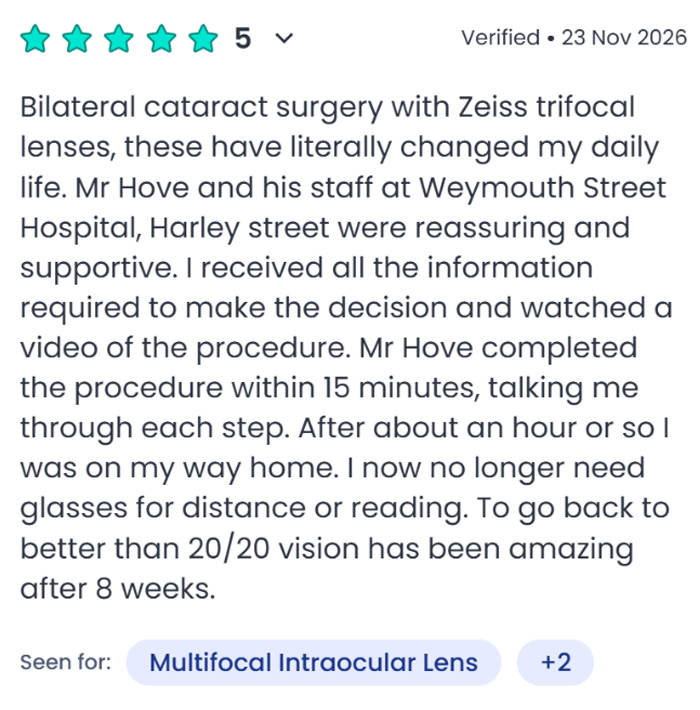
“Bilateral cataract surgery with Zeiss trifocal lenses, these have literally changed my daily life. Mr Hove and his staff at Weymouth Street Hospital, Harley street were reassuring and supportive. I received all the information required to make the decision and watched a video of the procedure. Mr Hove completed the procedure within 15 minutes, talking me through each step. After about an hour or so I was on my way home. I now no longer need glasses for distance or reading. To go back to better than 20/20 vision has been amazing after 8 weeks.”
Five stars. Verified patient review on Doctify, 23 November 2026.
How Long Does Same-Day Surgery on Both Eyes Take?
At Blue Fin Vision®, same-day bilateral cataract surgery typically takes about 15 minutes in total: about 5 minutes per eye, with about 5 minutes between eyes. These are typical times, not targets.
Patients are usually with us for two to three hours from arrival to going home. That includes a three-course meal, and nobody is rushed.
This patient describes the same timeline: the procedure was completed “within 15 minutes”, and “after about an hour or so” they were on their way home.
What Happens on the Day
Same-day surgery on both eyes is called immediate sequential bilateral cataract surgery (ISBCS). The two eyes are not treated as one long operation. They are two separate operations performed one after the other.
- Preparation. Checks are completed, the pupils are dilated and the eyes are numbed.
- First eye. The cataract is removed and the new lens is placed. This typically takes about 5 minutes.
- Reset. UK professional guidance requires complete separation between eyes. The team re-scrubs, re-gowns and re-gloves. The skin is cleaned and draped again, and a separate sterile instrument set is opened. The team repeats the surgical safety checklist as if for a new patient.¹
- Second eye. The same operation is repeated. If the first eye is complicated, we never operate on the second eye on the same day.¹ That is rare. In Mr Hove’s full-practice audit for the year this patient had surgery (1 April 2024 to 31 March 2025), about 99.8% of operations had no posterior capsule rupture, the main complication of cataract surgery.
- Antibiotic. An antibiotic is placed inside each eye at the end of surgery. Intracameral antibiotics are standard infection prophylaxis in cataract surgery, and guidance makes them mandatory for both eyes in same-day surgery.¹
- Home. After surgery there is time to rest and eat. Before the patient leaves, the team explains the drops and aftercare. The whole visit typically takes two to three hours.
Aftercare is the same as for one eye. Two drops are used four times a day for six weeks, with one bottle of each shared between both eyes.
Our patients are told that eye make-up and sport are fine from the day after surgery.
Who This Applies to, and Who It Does Not
Mr Hove’s view is that almost everyone having cataract surgery in both eyes is suitable for same-day surgery. It is the default at Blue Fin Vision®. This is broader than NICE guidance, which is set out with the evidence below.
Fuchs endothelial dystrophy, a condition of the cornea, is one example. We initially treated these patients’ eyes a week apart, for fear of causing significant corneal oedema (swelling of the cornea).
We stopped treating the eyes a week apart after they all achieved 6/6 vision. We now treat both eyes on the same day. That remains a clinical decision, made in clinic together with the patient.
Any patient who prefers two separate days can have them.
What a patient gives up with same-day surgery: the lens choice for the second eye cannot be adjusted in light of the first eye’s result.
In the rare event of a serious complication, both eyes could be affected at once. Both points should be discussed before the decision is made.¹
What the Published Evidence Shows
Overall: a Cochrane review of 14 studies and 276,260 participants found there may be little to no difference between same-day and separate-day surgery for endophthalmitis. It found probably little to no difference in refractive accuracy or patient-reported outcomes. The certainty of the evidence ranged from moderate to very low.²
Accuracy: a randomised trial of 865 patients in 10 Dutch hospitals compared the results for second eyes. After same-day surgery, 97% were within 1.0 dioptre of target, compared with 98% after delayed surgery. Same-day surgery met the test for non-inferiority. No endophthalmitis occurred in either group.³
Infection: in a United States registry of 5,573,639 patients, endophthalmitis occurred in 0.059% of patients after same-day bilateral surgery and 0.056% after delayed or single-eye surgery. The difference was not statistically significant. No case of infection in both eyes was identified in the same-day group.⁴
Antibiotic inside the eye: a survey covering 95,606 eyes found an overall endophthalmitis rate of 1 in 5,759 after same-day surgery. The rate fell to 1 in 14,352 when an antibiotic was placed inside the eye.⁵
Infection in both eyes after same-day surgery has been reported, but it is very rare.⁵ That is the reason the separation between the two operations is treated as mandatory and not optional.¹
NICE guidance is more selective than Mr Hove’s practice. It recommends that same-day surgery be considered for:
- People at low risk of eye complications during and after surgery.
- People who need a general anaesthetic that carries added risk or distress.⁶
Mr Hove’s Perspective
I have performed same-day bilateral cataract and lens replacement surgery since 2016, and have offered it in my private practice from its first day in 2017.
Why it is my default: one visit, one recovery period and one course of drops.
Both eyes see together from the start, with no weeks of imbalance between an operated eye and an unoperated eye.
Preparation for each eye: for every eye on my list, I take two of the planned lenses and a three-piece back-up lens to theatre myself, instead of relying on the hospital’s stock.
Consistency: theatre equipment is replicated identically across Blue Fin Vision® operating sites. Instruments are sterilised at St Thomas’ Hospital.
Clinical Takeaway
For a suitable patient, cataract surgery on both eyes is typically completed in about 15 minutes on one day.
The published evidence suggests little to no difference in accuracy or infection risk compared with surgery on separate days, provided each eye is treated as its own operation. The certainty of that evidence is limited for rare events such as infection.²
References
- The Royal College of Ophthalmologists, UK and Ireland Society of Cataract and Refractive Surgeons. Immediate sequential bilateral cataract surgery (ISBCS) during COVID recovery: RCOphth/UKISCRS rapid advice document. London: The Royal College of Ophthalmologists; 2020. Available from: https://www.rcophth.ac.uk/wp-content/uploads/2020/09/Immediate-Sequential-Bilateral-Cataract-Surgery-Guidance.pdf
- Dickman MM, Spekreijse LS, Winkens B, Schouten JS, Simons RW, Dirksen CD, et al. Immediate sequential bilateral surgery versus delayed sequential bilateral surgery for cataracts. Cochrane Database Syst Rev. 2022;4(4):CD013270. doi: 10.1002/14651858.CD013270.pub2. Available from: https://doi.org/10.1002/14651858.CD013270.pub2
- Spekreijse L, Simons R, Winkens B, van den Biggelaar F, Dirksen C, Bartels M, et al. Safety, effectiveness, and cost-effectiveness of immediate versus delayed sequential bilateral cataract surgery in the Netherlands (BICAT-NL study): a multicentre, non-inferiority, randomised controlled trial. Lancet. 2023;401(10392):1951-62. doi: 10.1016/S0140-6736(23)00525-1. Available from: https://cris.maastrichtuniversity.nl/en/publications/safety-effectiveness-and-cost-effectiveness-of-immediate-versus-d/
- Lacy M, Kung TH, Owen JP, Yanagihara RT, Blazes M, Pershing S, et al.; IRIS® Registry Analytic Center Consortium. Endophthalmitis rate in immediately sequential versus delayed sequential bilateral cataract surgery within the Intelligent Research in Sight (IRIS®) Registry data. Ophthalmology. 2022;129(2):129-38. doi: 10.1016/j.ophtha.2021.07.008. Available from: https://pmc.ncbi.nlm.nih.gov/articles/PMC8755857
- Arshinoff SA, Bastianelli PA. Incidence of postoperative endophthalmitis after immediate sequential bilateral cataract surgery. J Cataract Refract Surg. 2011;37(12):2105-14. doi: 10.1016/j.jcrs.2011.06.036. Available from: https://experts.mcmaster.ca/display/publication1791738
- National Institute for Health and Care Excellence. Cataracts in adults: management. NICE guideline NG77. London: National Institute for Health and Care Excellence; 2017 [cited 2026 Nov 25]. Available from: https://www.nice.org.uk/guidance/ng77/resources/cataracts-in-adults-management-pdf-1837639266757


