



Patient Experience
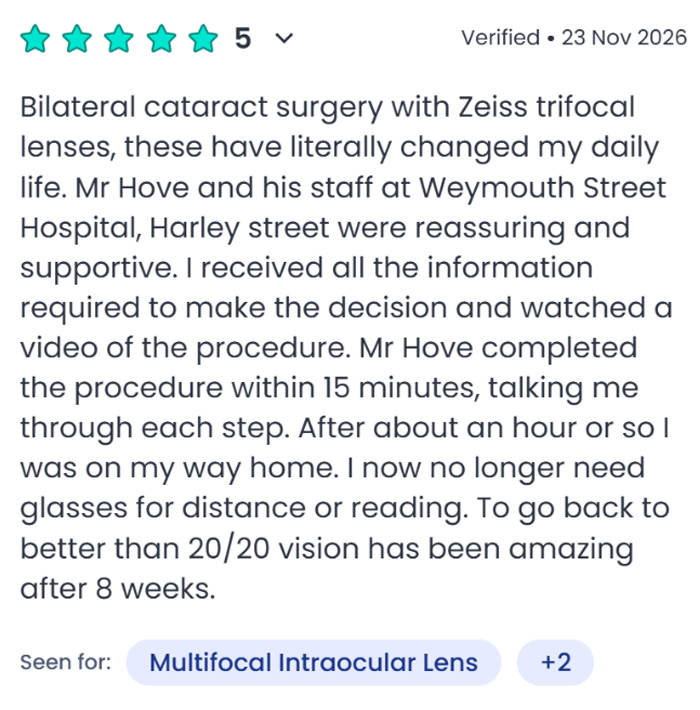
“Bilateral cataract surgery with Zeiss trifocal lenses, these have literally changed my daily life. Mr Hove and his staff at Weymouth Street Hospital, Harley street were reassuring and supportive. I received all the information required to make the decision and watched a video of the procedure. Mr Hove completed the procedure within 15 minutes, talking me through each step. After about an hour or so I was on my way home. I now no longer need glasses for distance or reading. To go back to better than 20/20 vision has been amazing after 8 weeks.”
Five stars. Verified patient review on Doctify, 23 November 2026.
What Does Cataract Surgery Feel Like?
O Most patients are awake, feel no pain, and see light and colour instead of a clear view of the operation. The usual sensations are touch, gentle pressure and cool fluid on the eye, typically for about 5 minutes per eye in our practice.
This patient describes the other half of the experience: the surgeon was “talking me through each step”.
What You Feel, See and Hear
The anaesthetic. Cataract surgery is usually performed under local anaesthetic, which numbs the eye while you stay awake. The surgeon may use numbing drops alone or follow the drops with sub-Tenon’s anaesthesia. This means using a small, blunt tube to place anaesthetic around the eye.¹
Sedation, medicine that helps you relax, can be added to local anaesthesia. It is different from general anaesthesia, which means you are unconscious during the operation. General anaesthesia is available at every Blue Fin Vision® site except Harley Street.
What you feel. You may notice touch, gentle pressure or cool fluid running over the eye. In our practice, the operation typically takes about 5 minutes per eye. Sharp pain is not expected. If anything feels uncomfortable, tell the surgeon so they can assess what you need and give more anaesthetic if necessary.
What you see. You may notice a bright light from the microscope, colours, blurred shapes or movement. Most patients do not see the operation clearly, although some recall seeing an instrument or another object.²
What you hear. You may hear the quiet sounds of the equipment and the surgeon’s voice. The surgeon can explain what is happening and let you know what to expect next.
What you do. The team will help you lie flat and ask you to keep still and breathe normally. Follow the surgeon’s instructions about where to look. They may ask you to look towards the light.
A sterile drape covers your face. You can still speak to the team while it is in place.
Who This Applies to, and Who It Does Not
This describes routine cataract or lens replacement surgery in an adult under local anaesthetic. The team can adapt the plan if you:
- Find it difficult to lie flat or keep still, for example because of a tremor, a persistent cough, back pain or breathing difficulties.
- Feel very anxious or claustrophobic.
- Have hearing, language or memory difficulties that could make it harder to follow instructions during surgery.
If communication is a concern, tell the team at your consultation. You can agree how the surgeon will give instructions and how you will let them know if you need help.
The team will assess your individual needs and discuss sedation or general anaesthesia where appropriate.
At Blue Fin Vision® the anaesthetic fee is the same whichever is chosen, so the decision is made with the anaesthetist on clinical grounds alone.
What the Published Evidence Shows
Pain relief during surgery. A Cochrane review compared sub-Tenon’s anaesthesia with numbing drops alone. On a pain scale from 0 to 10, patients who had sub-Tenon’s anaesthesia rated their pain during surgery an average of 1.1 points lower.¹
Knowing what you might see. In a randomised trial of 851 patients, 4.5% of those given additional counselling about possible visual sensations said they were frightened by what they saw. The figure was 10.6% among those who did not receive that additional explanation. The group who received it also reported a lower level of fear.³
Seeing what to expect beforehand. In a randomised trial of 141 patients, those who watched a video about what to expect reported less anxiety during surgery than those who watched a video explaining cataract anatomy.⁴
When anxiety is greatest. A systematic review identified several worries, including the operation itself, possible pain and loss of vision. Anxiety tended to be greatest on the day of surgery. Patients having both eyes treated were generally more anxious before surgery on the first eye.⁵
The review described several ways to help patients manage anxiety, including information and counselling before surgery, music and, where appropriate, sedation.⁵
Mr Hove’s Perspective
I have had lens surgery in both of my own eyes, so I know this operation from the patient’s side of the microscope as well as the surgeon’s.
Talking through each step. This patient noticed it, and it is deliberate. A patient under a drape cannot see what is coming, so I describe each step before it happens.
Expectations set in advance. Surgical consultations are booked for 45 minutes and conducted in full by the consultant.
I use that time to explain what you might feel, see and hear. It also gives you a chance to tell me which part of the operation worries you.
A real choice of anaesthetic. We offer both sub-Tenon’s anaesthesia and sedation for cataract surgery.
A short operation, on the record. Each eye typically takes about 5 minutes.
Patients can ask for the video of their own operation.
Clinical Takeaway
During cataract surgery under local anaesthetic, you may be aware of light, touch and pressure. If something hurts, tell the surgeon rather than trying to put up with it. If being awake worries you, explaining what concerns you beforehand helps the team talk you through the parts that matter to you.³ ⁵
References
- Guay J, Sales K. Sub-Tenon’s anaesthesia versus topical anaesthesia for cataract surgery. Cochrane Database Syst Rev. 2015;2015(8):CD006291. doi: 10.1002/14651858.CD006291.pub3. Available from: https://doi.org/10.1002/14651858.CD006291.pub3
- Newman DK. Visual experience during phacoemulsification cataract surgery under topical anaesthesia. Br J Ophthalmol. 2000;84(1):13-5. doi: 10.1136/bjo.84.1.13. Available from: https://pmc.ncbi.nlm.nih.gov/articles/PMC1723223
- Haripriya A, Tan CS, Venkatesh R, Aravind S, Dev A, Au Eong KG. Effect of preoperative counseling on fear from visual sensations during phacoemulsification under topical anesthesia. J Cataract Refract Surg. 2011;37(5):814-8. doi: 10.1016/j.jcrs.2010.11.041. Available from: https://pubmed.ncbi.nlm.nih.gov/21511150/
- Pager CK. Randomised controlled trial of preoperative information to improve satisfaction with cataract surgery. Br J Ophthalmol. 2005;89(1):10-3. doi: 10.1136/bjo.2004.048637. Available from: https://pmc.ncbi.nlm.nih.gov/articles/PMC1772489
- Obuchowska I, Konopińska J. Fear and anxiety associated with cataract surgery under local anesthesia in adults: a systematic review. Psychol Res Behav Manag. 2021;14:781-93. doi: 10.2147/PRBM.S314214. Available from: https://pmc.ncbi.nlm.nih.gov/articles/PMC8219311


