



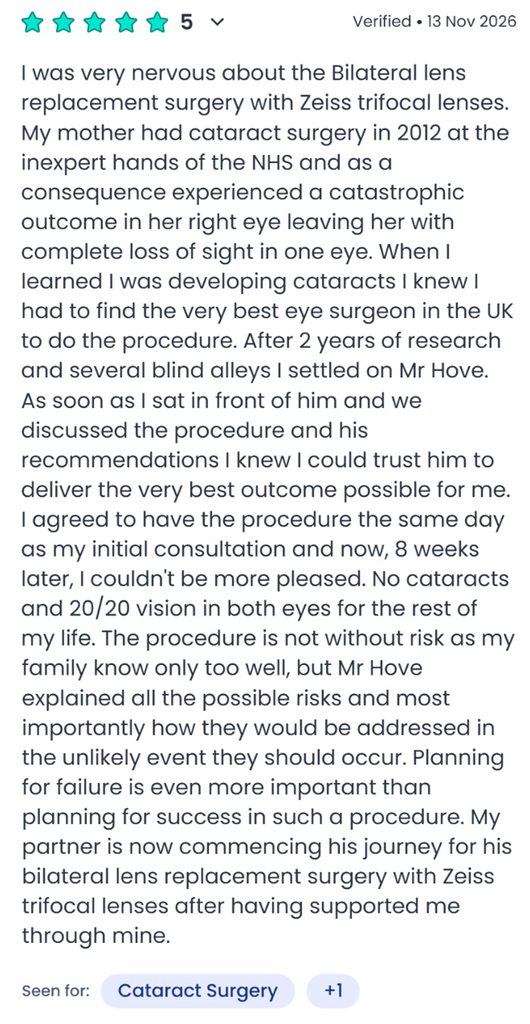
Patient Experience
“I was very nervous about the Bilateral lens replacement surgery with Zeiss trifocal lenses. My mother had cataract surgery in 2012 at the inexpert hands of the NHS and as a consequence experienced a catastrophic outcome in her right eye leaving her with complete loss of sight in one eye.
When I learned I was developing cataracts I knew I had to find the very best eye surgeon in the UK to do the procedure. After 2 years of research and several blind alleys I settled on Mr Hove.
As soon as I sat in front of him and we discussed the procedure and his recommendations I knew I could trust him to deliver the very best outcome possible for me. I agreed to have the procedure the same day as my initial consultation and now, 8 weeks later, I couldn’t be more pleased. No cataracts and 20/20 vision in both eyes for the rest of my life.
The procedure is not without risk as my family know only too well, but Mr Hove explained all the possible risks and most importantly how they would be addressed in the unlikely event they should occur. Planning for failure is even more important than planning for success in such a procedure.
My partner is now commencing his journey for his bilateral lens replacement surgery with Zeiss trifocal lenses after having supported me through mine.”
Verified patient review. Source: Doctify, 13 November 2026.
Two phrases in this review need context. The description of NHS care is the patient’s own, about treatment we were not part of and cannot judge. The hope of 20/20 vision for life is the patient’s, not a promise from us: see “Who this applies to” below. The term 20/20 describes measured visual sharpness, not a guarantee of lifelong vision or eye health.
What This Patient Is Describing
This patient valued one thing above the list of risks: being told how each one would be dealt with if it happened. “Planning for failure is even more important than planning for success” is the patient’s phrase. It is also an accurate description of how the surgery is organised.
How Often Things Go Wrong
The complication that matters most during cataract and lens surgery is posterior capsule rupture, a tear in the thin membrane that holds the new lens.
In the national audit it occurs in 0.70% of cataract operations.¹
Across Mr Hove’s whole practice, the rate was 0.19% in 7,013 cataract and lens replacement operations between 1 April 2024 and 31 March 2025.
The posterior capsule was preserved in 99.81% of eyes. This is his own full-practice audit, covering every hospital where he operates, and it includes 1,654 private hospital operations that the national audit does not capture.
His published record in the national audit for the same period was 0.24% across 5,359 operations, assessed as within expected limits.
Source: Mr Hove’s whole-practice audit for 2024 to 2025, and his published National Ophthalmology Database record for the same year.
Rare is not never, and a rupture matters when it happens. In national data it was associated with a much higher risk of later retinal detachment surgery and of infection inside the eye.² Retinal detachment means that the light-sensitive layer at the back of the eye separates from its supporting tissue.
The risk is not the same for every eye, and it can be estimated before surgery.³ So the plan for it is made before the operation, not during it.
What Is Prepared Before Every Operation
The figures. Patients are told both rates before surgery: Mr Hove’s own and the national benchmark.
The lens. Patients are told in writing that if the capsule ruptures, the premium lens they have chosen may not be the lens implanted that day. The trifocal planned for this patient is designed for placement in the capsular bag. A trifocal lens provides three focusing ranges: distance, intermediate and near. The capsular bag is the thin, transparent covering around the natural lens that is retained to support the replacement lens.
The back-up. For every eye, Mr Hove takes two of the planned lenses and a three-piece back-up lens to theatre himself, so the operation does not depend on what a hospital has in stock. A three-piece lens has a central optical section and two separate supporting arms.
The second stage. If a back-up lens is used, a supplementary trifocal lens can be added later, once the eye has settled, where that is suitable and wanted. This is an additional lens placed alongside the replacement lens to provide a wider range of focus. For a patient whose capsule ruptured during surgery with us, that second operation carries no further fee.
The return to theatre. If a patient needs to go back to theatre for a complication of surgery performed by Blue Fin Vision®, we book it. It has been agreed in advance with our partner hospitals at no cost to the patient.
Retinal cover. For patients who have had surgery with us, a consultant vitreoretinal surgeon provides emergency retinal cover seven days a week. This is a specialist surgeon who treats the retina, the light-sensitive layer at the back of the eye, and the vitreous, the clear gel inside the eye.
Infection. Intracameral antibiotics, meaning antibiotics placed inside the eye, are standard treatment to help prevent infection in cataract surgery.⁴
The phone number. Patients having cataract or lens replacement surgery are given Mr Hove’s direct number.
The record. Operations are recorded, and a patient can ask for the video of their own and for a transcript of their consultations. Patients place a high value on recordings of their consultations.⁵
The law expects this conversation. A patient is entitled to know the material risks of a procedure, judged by what would matter to them,⁶ and to have the information and time to weigh them.⁷
Who This Applies To, and Who It Does Not
This applies to cataract surgery and lens replacement at Blue Fin Vision®. The preparations described are ours. The outcome figures are national cataract audit data and Mr Hove’s personal record, as labelled above.
It does not apply to laser eye surgery or implantable lenses, which have their own risks and their own pathways.
It is not a claim that complications cannot happen, and it is not a promise of outcome. No surgeon can promise one.
A cataract cannot return once the natural lens has been removed, but the capsule behind the new lens can become cloudy later, which is treated with a YAG laser.⁸ YAG stands for yttrium aluminium garnet, the crystal used in the laser. The treatment creates an opening in the cloudy capsule to allow light through.
In pooled published studies with at least two years of follow-up, retinal detachment was about twice as frequent after lens replacement as after cataract surgery.⁹ ¹⁰
Those are pooled estimates, not Blue Fin Vision® results or any one person’s risk. Individual risk depends on the eye and is discussed at consultation.
Surgeon Interpretation, Mr Mfazo Hove
“On an uncomplicated day, most pathways look alike. A practice shows what it is on the day something goes wrong.
I take the lenses to theatre myself because I will not rely on what a hospital happens to have in stock. Keeping a back-up lens bank costs money and creates waste. It is the best option, not the cheapest.”
Clinical Takeaway
Low risk is a reason to prepare, not a reason to skip the preparation.
References
- Royal College of Ophthalmologists National Ophthalmology Database Audit. Ninth annual report of the National Cataract Audit. London: Royal College of Ophthalmologists; 2026. Available from: https://nodaudit.org.uk
- Day AC, Donachie PHJ, Sparrow JM, Johnston RL. The Royal College of Ophthalmologists’ National Ophthalmology Database study of cataract surgery: report 1, visual outcomes and complications. Eye (Lond). 2015;29(4):552-560.
- Sim PY, Donachie PHJ, Day AC, Buchan JC. The Royal College of Ophthalmologists’ National Ophthalmology Database study of cataract surgery: Report 17, a risk factor model for posterior capsule rupture. Eye (Lond). 2024;38(18):3495-3503.
- ESCRS Endophthalmitis Study Group. Prophylaxis of postoperative endophthalmitis following cataract surgery: results of the ESCRS multicenter study and identification of risk factors. J Cataract Refract Surg. 2007;33(6):978-988.
- Tsulukidze M, Durand MA, Barr PJ, Mead T, Elwyn G. Providing recording of clinical consultation to patients: a highly valued but underutilized intervention: a scoping review. Patient Educ Couns. 2014;95(3):297-304.
- Montgomery v Lanarkshire Health Board [2015] UKSC 11.
- General Medical Council. Decision making and consent. London: General Medical Council; 2020.
- Donachie PHJ, Barnes BL, Olaitan M, Sparrow JM, Buchan JC. The Royal College of Ophthalmologists’ National Ophthalmology Database study of cataract surgery: Report 9, risk factors for posterior capsule opacification. Eye (Lond). 2023;37(8):1633-1639.
- Passaro ML, Kilic D, Virgili G, Romano V, Lucenteforte E, Dick B, Taneri S. Retinal detachment incidence in refractive lens exchange versus cataract surgery: uncommon versus rare: systematic review and meta-analysis. Br J Ophthalmol. 2025;109(7):756-764.
- Correction: Retinal detachment incidence in refractive lens exchange versus cataract surgery: uncommon versus rare: systematic review and meta-analysis. Br J Ophthalmol. 2026;110(3):e1.


