




- Medically Reviewed by: Mr Mfazo Hove, Consultant Ophthalmic Surgeon
- Author: Mr Mfazo Hove
- Published: April 27, 2025
- Last Updated: July 21, 2026
In short. Xanthelasma (xanthelasma palpebrarum) is a benign build-up of cholesterol-rich material that forms soft, yellow plaques on the eyelids, most often at the inner corner. It does not usually affect sight, but it can enlarge over time and may be associated with raised cholesterol, so a proper assessment is worthwhile. It can be removed for cosmetic reasons by surgical excision.
What Xanthelasma Is
Xanthelasma palpebrarum is the most common cutaneous xanthoma, appearing as soft, yellow, cholesterol-rich plaques, most often at the inner corner of the upper eyelid¹. It is benign and does not usually affect sight, though very large lesions can occasionally interfere with the eyelid. It tends to enlarge slowly over time¹.
Xanthelasma Symptoms and How It Looks
The main sign of xanthelasma around the eye is a soft, flat or slightly raised yellow plaque, usually near the inner corner of the upper lid. These xanthelasma symptoms are typically painless and develop gradually rather than appearing suddenly.
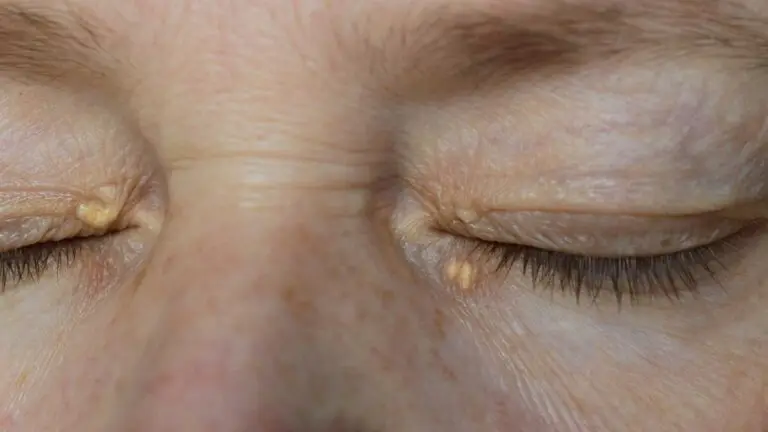
Not Every Yellow Eyelid Lesion Is Xanthelasma
Yellow eyelid lesions are usually xanthelasma, but not always. If the appearance is unusual, changing rapidly, bleeding, ulcerated or asymmetric, assessment is important before any removal, so that the diagnosis is confirmed first.
What Causes Xanthelasma
Xanthelasma causes are linked with disordered blood lipids, and can also be associated with thyroid dysfunction and diabetes¹. Around half of people who have it show raised cholesterol, yet it can also appear when lipids are entirely normal¹.
Is Xanthelasma Dangerous?
The plaques themselves are harmless. Xanthelasma does not mean you definitely have heart disease, and many patients have normal cholesterol. Because it can be associated with lipid abnormalities and cardiovascular risk, however, a GP lipid check is sensible: a large population study found xanthelasmata independently predicted a higher risk of heart attack, ischaemic heart disease and death, regardless of cholesterol level², and hospital series link them with atherosclerosis and coronary artery disease³.
Why Eyelid Anatomy Matters
Xanthelasma sits on the eyelid, not on ordinary facial skin. The priority is not simply removing the yellow plaque, but preserving eyelid position, lid-margin function, skin symmetry and a natural appearance. That is why consultant ophthalmic-led care is particularly valuable for lesions close to the lashes, the tear-drainage area or the inner corner of the eyelid. The real question is not who owns a laser, but who understands the eyelid.

How Xanthelasma Treatment Works
At Blue Fin Vision®, xanthelasma treatment is by surgical excision. Under local anaesthetic, the plaque is carefully excised and the skin closed with fine sutures to protect the eyelid contour and keep scarring to a minimum⁴. Xanthelasma surgery by excision gives the most direct, complete removal and is well suited to larger or deeper plaques⁴. A comprehensive review of xanthelasma management recognises surgical excision as a mainstay of treatment⁵.
Where the plaques are mild and not troublesome, an alternative is not to treat and to monitor them, with attention to cholesterol. Your consultant will help you weigh removal against monitoring at your assessment.
Are You Suitable for Xanthelasma Removal?
You may be suitable for xanthelasma removal if the plaques bother you cosmetically, are enlarging, or are affecting eyelid contour or make-up, and you would prefer a consultant assessment rather than cosmetic-only treatment, understanding that recurrence is possible.
A more cautious plan may be advised if the plaques involve all four eyelids, the lesions are deep or very close to the lid margin, you have darker skin and a higher risk of pigment change, you have untreated cholesterol or lipid problems, or previous treatment has caused scarring.
When We May Advise Waiting
We may advise delaying treatment if the diagnosis is uncertain, the skin is inflamed, a lipid disorder has not yet been assessed, expectations are unrealistic, or the likely cosmetic trade-off is not favourable.
Recurrence
Xanthelasma can recur after any treatment. Recurrence risk appears higher when there are multiple plaques, all-four-lid involvement or untreated lipid abnormalities⁴. Careful technique, appropriate treatment selection and sensible follow-up help manage that risk, but no method can guarantee permanent removal⁵.
Frequently Asked Questions
Is xanthelasma harmful to my eyes?
The plaques are benign and do not usually affect sight. They are treated for appearance, or because they are enlarging.
Does having xanthelasma mean my cholesterol is high?
Not necessarily. About half of people with xanthelasma have raised cholesterol, and half do not¹. A blood test is the way to know.
Can it come back after removal?
Yes, it can recur, particularly if cholesterol stays high or several lids are involved⁴. No method guarantees permanent removal.
How is it diagnosed?
By clinical examination. If a lesion looks atypical, further assessment confirms the diagnosis before any treatment.
Does removal improve vision?
Usually no, unless a very large lesion is physically interfering with the eyelid or visual field.
Book a consultant-led xanthelasma assessment to confirm the diagnosis, discuss your options and receive advice on whether lipid testing is appropriate.
Related Pages
References
- Nair PA, Singhal R. Xanthelasma palpebrarum: a brief review. Clin Cosmet Investig Dermatol. 2018;11:1-5.
- Christoffersen M, Frikke-Schmidt R, Schnohr P, Jensen GB, Nordestgaard BG, Tybjaerg-Hansen A. Xanthelasmata, arcus corneae, and ischaemic vascular disease and death in general population: prospective cohort study. BMJ. 2011;343:d5497.
- Dey A, Aggarwal R, Dwivedi S. Cardiovascular profile of xanthelasma palpebrarum. Biomed Res Int. 2013;2013:932863.
- Lee HY, Jin US, Minn KW, Park YO. Outcomes of surgical management of xanthelasma palpebrarum. Arch Plast Surg. 2013;40(4):380-386.
- Yee DA, Zhou AE, Khachemoune A. Examining treatment strategies for xanthelasma palpebrarum: a comprehensive literature review of contemporary modalities. Arch Dermatol Res. 2024;316(5):149.
ABOUT THE AUTHOR
Mr Mfazo Hove
Consultant Ophthalmic Surgeon
MBChB MD FRCOphth CertLRS
Mr Mfazo Hove is a Consultant Ophthalmic Surgeon with experience spanning more than 57,000 procedures. He completed 6.5 years of specialist training at Moorfields Eye Hospital and served for five years as a consultant at the Western Eye Hospital, Imperial College Healthcare NHS Trust. He is the founder of Blue Fin Vision®, a consultant-led private ophthalmology practice operating across London, Essex, and Hertfordshire. His clinical expertise encompasses advanced cataract surgery, refractive lens replacement, laser vision correction, and implantable Collamer lenses (ICL).
A ZEISS Key Opinion Leader, Mr Hove is a respected international speaker with five invited engagements across seven cities in 2026:
- ZEISS China tour (Changsha, Shanghai, and Hangzhou, April – ZEISS APAC User Meeting)
- RCOphth Annual Congress – May – Manchester
- ZEISS EMEA User Meeting (Istanbul)
- ZEISS Lausanne User Meeting (Lausanne)
- European Society of Cataract and Refractive Surgeons Annual Congress (ESCRS, London)


