




- Medically Reviewed by: Mr Mfazo Hove, Consultant Ophthalmic Surgeon
- Author: Mr Mfazo Hove
- Published: July 16, 2026
- Last Updated: July 16, 2026
In short. Wet age-related macular degeneration is a form of macular degeneration in which abnormal blood vessels grow under the retina and leak, causing sudden distortion or loss of central vision. It can progress quickly, but prompt anti-VEGF injection treatment can preserve vision and, in many cases, improve it. Sudden distortion or central-vision change should be assessed urgently, ideally within days, and suspected wet AMD referred to a macula service within one working day.
The Blue Fin Vision® Rapid Medical Retina Pathway
- Prompt consultant-led assessment
- OCT imaging
- Diagnosis: wet AMD, dry AMD, RVO, CRVO or another retinal cause
- Intravitreal injection where appropriate
- Communication with your GP and optometrist on blood pressure, diabetes and vascular risk
- Ongoing monitoring, with escalation to Professor Mahmut Dogramaci, Consultant Vitreoretinal Surgeon, where needed
What Wet Macular Degeneration Is
Age-related macular degeneration affects the macula, the central part of the retina responsible for detailed vision¹. In the late, neovascular (wet) form, abnormal new blood vessels grow beneath the retina and leak fluid or blood, damaging central vision¹. It is a leading cause of severe sight loss, and the number affected worldwide is rising with an ageing population².
Recognise Wet AMD Symptoms: The Warning Signs
Seek prompt specialist assessment if you notice sudden distortion (straight lines looking wavy or bent), a new blur or dark patch in your central vision, or colours looking faded, especially in one eye. A simple Amsler grid, a square grid with a central dot, can help you spot early distortion at home: if the lines look wavy or missing, arrange an urgent eye assessment.
If you develop new distortion, a central dark patch or sudden central blur, this should be treated as possible wet AMD until proven otherwise. NICE guidance recommends urgent referral to a macula service, normally within one working day. At Blue Fin Vision®, we prioritise rapid OCT assessment for these symptoms, because early treatment protects vision¹.

Wet AMD Causes: What Triggers It
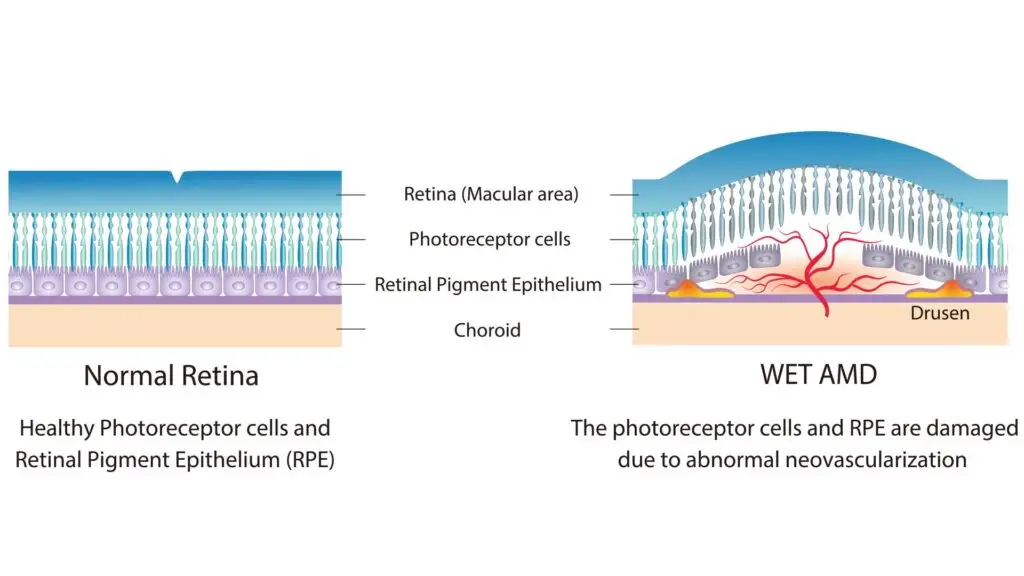
Wet AMD develops on a background of ageing changes at the macula. Over years, tiny waste deposits called drusen build up and the retinal pigment epithelium, the support layer beneath the retina, becomes stressed¹. In some eyes this triggers the release of vascular endothelial growth factor (VEGF), a signal that drives fragile new blood vessels to grow under the retina. These vessels leak and bleed, which is what causes the sudden central-vision change³.
The main risk factors are increasing age, a family history of AMD and specific genetic variants, and smoking, which is the strongest modifiable risk¹. Cardiovascular health, blood pressure and diet are also contributors³. Wet AMD is not caused by using your eyes, and it is not infectious.
Why Speed Matters, With Real Hope
Wet AMD can progress over days to weeks, so early treatment protects vision³. The outlook has changed dramatically. Anti-VEGF medicines, given as injections into the eye, block the signal that drives the abnormal vessels. These include treatments such as aflibercept, ranibizumab and faricimab, and your specialist will advise which is appropriate. Landmark trials show these injections preserve vision in most suitable patients and can improve vision in some, especially when treatment starts before scarring has developed⁴ ⁵. Wet AMD is serious, but it is treatable, and prompt treatment gives the best chance of keeping useful sight.
Not all central blur is wet AMD. Other conditions can cause similar symptoms, including retinal vein occlusion, diabetic macular oedema, epiretinal membrane, vitreomacular traction and central serous chorioretinopathy¹. OCT helps distinguish these, which is why a scan matters.

Diagnosis and the Private Rapid-Access Pathway
Diagnosis uses a clinical examination and OCT, a quick, painless scan that shows fluid under the retina. At Blue Fin Vision®, the medical retina service offers rapid-access appointments so that suspected wet AMD is assessed quickly and treatment started without delay where appropriate. Complex vitreoretinal care and escalation are led by Professor Mahmut Dogramaci, Consultant Vitreoretinal Surgeon.
Injections are delivered at The Harley Street Eye Centre, our dedicated London setting for private intravitreal injection care. Treatment may also be arranged at selected hospital sites where clinically appropriate, although this may involve additional cost. We work alongside your GP and optometrist so that ongoing care is joined up.

Wet AMD Treatment: What It Involves and How Many Injections
Anti-VEGF treatment usually begins with a loading phase of three injections about four weeks apart, followed by a personalised schedule based on how your eye responds⁵. Many clinics use a treat-and-extend approach, gradually lengthening the gap between injections while the eye stays dry, to keep vision stable with as few injections as safely possible.
It is realistic to plan for a meaningful number of injections. In the CATT trial, patients treated as needed received on average around 7 injections in the first year and about 13 over two years, while monthly treatment involved roughly 23 over two years⁶. Most people need fewer injections in the second year than the first as the eye settles, though wet AMD is a long-term condition and some eyes need ongoing treatment. Your consultant gives you a realistic estimate for your eye after the first few months.
The Long-Term Outlook
With prompt, sustained treatment, most people keep useful central vision, and many gain vision compared with where they started⁵. Without treatment, or if it is started late, the leaking vessels can form a scar (a disciform scar) or the macula can thin, leaving a permanent central blind spot¹. At each visit we also monitor the fellow eye, because wet AMD can develop in the other eye even when symptoms are only on one side, and we give you an Amsler grid to use at home. Peripheral vision is not affected, so wet AMD does not cause total blindness.
Early detection and prompt treatment are crucial in managing wet AMD and preserving vision. Regular eye exams, especially for those over 50 or with risk factors, can help catch the condition in its early stages when treatment is most effective.
Frequently Asked Questions
Can wet AMD be treated?
Yes. Anti-VEGF injections preserve vision in most suitable patients and can improve it in some⁴, especially when started early. Treatment usually continues over time with monitoring.
How quickly should I be seen?
Promptly. Wet AMD can progress within days to weeks, so sudden distortion or central vision change warrants urgent assessment³.
Do the injections hurt?
The eye is numbed with anaesthetic drops first, so discomfort is usually minimal and brief. Most people tolerate the injections well.
Is wet AMD the same as going blind?
No. It affects central vision, not the whole visual field, and treatment aims to preserve sight. Peripheral vision is usually retained.
Can supplements help?
Specific supplements can slow progression in intermediate dry AMD⁷, but they do not replace injection treatment for wet AMD.
If you have noticed sudden distortion or a change in central vision, book a prompt medical retina assessment for OCT imaging and specialist advice.
Related Pages
References
- Mitchell P, Liew G, Gopinath B, Wong TY. Age-related macular degeneration. Lancet. 2018;392(10153):1147-1159.
- Wong WL, Su X, Li X, Cheung CMG, Klein R, Cheng CY, Wong TY. Global prevalence of age-related macular degeneration and disease burden projection for 2020 and 2040: a systematic review and meta-analysis. Lancet Glob Health. 2014;2(2):e106-e116.
- Fleckenstein M, Keenan TDL, Guymer RH, Chakravarthy U, Schmitz-Valckenberg S, Klaver CC, Wong WT, Chew EY. Age-related macular degeneration. Nat Rev Dis Primers. 2021;7(1):31.
- Martin DF, Maguire MG, Ying GS, Grunwald JE, Fine SL, Jaffe GJ; Comparison of Age-related Macular Degeneration Treatments Trials (CATT) Research Group. Ranibizumab and bevacizumab for neovascular age-related macular degeneration. N Engl J Med. 2011;364(20):1897-1908.
- Rosenfeld PJ, Brown DM, Heier JS, Boyer DS, Kaiser PK, Chung CY, Kim RY. Ranibizumab for neovascular age-related macular degeneration. N Engl J Med. 2006;355(14):1419-1431.
- Comparison of Age-related Macular Degeneration Treatments Trials (CATT) Research Group. Ranibizumab and bevacizumab for treatment of neovascular age-related macular degeneration: two-year results. Ophthalmology. 2012;119(7):1388-1398.
- Age-Related Eye Disease Study 2 (AREDS2) Research Group. Lutein + zeaxanthin and omega-3 fatty acids for age-related macular degeneration: the Age-Related Eye Disease Study 2 (AREDS2) randomized clinical trial. JAMA. 2013;309(19):2005-2015.
ABOUT THE AUTHOR
Mr Mfazo Hove
Consultant Ophthalmic Surgeon
MBChB MD FRCOphth CertLRS
Mr Mfazo Hove is a Consultant Ophthalmic Surgeon with experience spanning more than 57,000 procedures. He completed 6.5 years of specialist training at Moorfields Eye Hospital and served for five years as a consultant at the Western Eye Hospital, Imperial College Healthcare NHS Trust. He is the founder of Blue Fin Vision®, a consultant-led private ophthalmology practice operating across London, Essex, and Hertfordshire. His clinical expertise encompasses advanced cataract surgery, refractive lens replacement, laser vision correction, and implantable Collamer lenses (ICL).
A ZEISS Key Opinion Leader, Mr Hove is a respected international speaker with five invited engagements across seven cities in 2026:
- ZEISS China tour (Changsha, Shanghai, and Hangzhou, April – ZEISS APAC User Meeting)
- RCOphth Annual Congress – May – Manchester
- ZEISS EMEA User Meeting (Istanbul)
- ZEISS Lausanne User Meeting (Lausanne)
- European Society of Cataract and Refractive Surgeons Annual Congress (ESCRS, London)


