




- Medically Reviewed by: Mr Mfazo Hove, Consultant Ophthalmic Surgeon
- Author: Mr Mfazo Hove
- Published: September 20, 2025
- Last Updated: September 11, 2026
TL;DR: Laser eye surgery is a family of brief, day-case procedures that use precisely controlled laser energy to reshape the cornea, the clear window at the front of the eye, so light focuses correctly without glasses or contact lenses. It treats myopia, hyperopia and astigmatism, with world literature reporting patient satisfaction of around 95%¹ ⁵ and modern platform outcomes stronger still.²
How Does Laser Eye Surgery Work?
To understand how laser eye surgery works, four structures matter.
The cornea is the transparent dome at the front of the eye. It contributes most of the eye’s focusing power, its shape is fixed, and it is where laser eye surgery happens.
The pupil is the aperture behind it. It widens in dim light, which is why night-time optics deserve their own attention.
The natural lens sits behind the pupil. It fine-tunes focus in youth and ages throughout life, first stiffening into presbyopia and later usually clouding into cataract. Laser never touches it.
The retina is the light-sensitive film at the back where the image must land. Laser eye surgery adjusts the front of this system so the image lands correctly at the back.

Myopia, Hyperopia and Astigmatism, Each in Its Own Right
Myopia, short sight. The eye’s optics are too powerful for its length, so distant light focuses in front of the retina. The horizon blurs while near vision remains clear. In word-picture terms, the projector is focused a foot short of the screen. The laser’s answer is to flatten the central cornea by a calculated amount, reducing power until the image slides back onto the retina.
Hyperopia, long sight. This is the reverse mismatch. The optics are too weak for the length, so the focal point sits behind the retina. The eye’s lens must work constantly to compensate, which is why long-sighted eyes tire and meet reading trouble early. The laser applies treatment in a ring to steepen the central cornea, helping it gain power and move the image forward onto the screen.
Astigmatism. The cornea is curved more like a rugby ball than a football, with one meridian steeper than the other. Light therefore focuses at two points and everything smears slightly at every distance. The laser removes tissue asymmetrically, taking the steep meridian down towards the flat one until the surface is regular. The dedicated treatment of this question, including when astigmatism is not laser’s job, is covered in Will Laser Eye Surgery Fix Astigmatism?.
How Much Tissue Does the Laser Actually Remove?
Astonishingly little.
The excimer laser removes fractions of a micron of tissue at a time. A micron is a thousandth of a millimetre. A typical correction is written in a layer thinner than a human hair and sculpted across an optical zone, the central region of the cornea shaped during treatment. The zone is sized with your pupil in mind.
Because tissue is finite, every plan runs against a tissue budget. Enough tissue must be removed to fund the correction, while enough must be retained to keep the cornea robust for life. A correction that would overdraw the budget is declined, not discounted.
How the Technology Knows Where Your Eye Is
The near-universal patient fear is: what if I move?
Modern platforms track the eye’s position hundreds of times a second and steer each pulse accordingly. Registration systems align the treatment with your eye’s own landmarks. If you move beyond the tracker’s comfort, the laser pauses rather than fires.
You are asked to look at a fixation light, and the machine assumes you will do so imperfectly. Holding perfectly still is the machine’s job, not yours.
LASIK
LASIK is the most widely performed technique and the one most people mean by “laser eye surgery”.
A femtosecond laser, pulsing in quadrillionths of a second, creates a thin, hinged flap in the corneal surface. The flap is lifted, and the excimer laser reshapes the tissue beneath in seconds. The flap is then floated back into position, where it adheres without stitches.
The result is a treatment protected under the eye’s own surface from minute one. This is why visual recovery is typically fast and functional within a day or two. Modern LASIK series report the large majority of eyes at 20/20 or better uncorrected.²
The flap is also LASIK’s consideration. It deserves early protection, contact sport waits, and certain corneas and occupations are better served flapless.
SMILE
SMILE, small incision lenticule extraction, takes a different route to the same reshaping.
The femtosecond laser sculpts a thin, lens-shaped sliver of tissue, known as a lenticule, within the intact cornea. The surgeon then removes it through a small keyhole incision.
No flap ever exists, and most of the corneal surface and its nerve supply remain undisturbed. Published outcomes and safety are comparable to LASIK, with less disturbance of the corneal nerves.⁸ This profile suits suitable myopic prescriptions and active, contact-sport lifestyles particularly well.
Recovery is typically fast, in LASIK’s neighbourhood. The keyhole character is exactly what many patients are choosing when they choose it.
PRK and LASEK
PRK and LASEK are surface techniques. They are the oldest family and still the right answer for many eyes.
The surface layer of cells is removed or moved aside. The identical excimer reshaping is then performed on the surface. The cell layer regenerates over the following days under a bandage contact lens.
No flap is created, and no deeper access is needed. This preserves tissue and suits thinner corneas and certain occupations. The price is honest and front-loaded: several gritty, blurred days and weeks to final sharpness. Evidence supports equivalent long-term outcomes to LASIK in well-selected eyes.³
Choosing surface treatment is not settling for less. It is matching the route to the cornea.

PRESBYOND®
PRESBYOND® Laser Blended Vision addresses a different problem: presbyopia, the age-related stiffening of the natural lens that brings reading glasses from the mid-40s.
No corneal treatment can reverse stiffness within the natural lens. Instead, PRESBYOND® adjusts the focus and depth of field of each eye. One eye favours distance and the other near, allowing the brain to blend the two images into a continuous range of vision.
It is a binocular strategy rather than a lens exchange, and it preserves the natural lens entirely. For suitable early-presbyopic patients, it is a genuinely attractive middle road.
The natural lens continues to age after treatment. The lens-based comparison therefore deserves a hearing with every year past 45.
Who Is Suitable?
The short version is adults with stable prescriptions within range, corneas whose thickness and shape pass rigorous screening, healthy or treatable ocular surfaces, and realistic expectations.
The screening exists above all because of one rare but potentially serious late complication: ectasia. This is a condition in which the cornea progressively weakens and distorts. Careful analysis of corneal shape and thickness is designed to minimise that risk, although no responsible surgeon should imply biological risk can ever be reduced to zero.⁴
The full gatekeeper treatment, including the eight things I want to know before saying yes, is covered in Is It Worth Getting Eye Laser Surgery?.
What Happens at the Assessment?
Your laser eye surgery treatment plan begins with a detailed assessment.
The process starts with your history and prescription records because stability is evidence, not assertion. Corneal topography and tomography map the shape of the front and back of your cornea. Pachymetry measures its thickness against your correction’s tissue budget.
The ocular surface is examined, with dry eye treated before surgery rather than lasered through.⁶ Your natural lens and the rest of the eye are also examined.
A technique recommendation is then matched to your maps. Alternatives, including ICL and lens replacement, remain genuinely on the table. Your work, sport and expectations also form part of the discussion.
A credible laser assessment must be capable of ending with a recommendation not to proceed.
What Happens in Laser Eye Surgery?
A laser eye surgery operation begins with your arrival and final checks. Your treatment plan is confirmed against your maps.
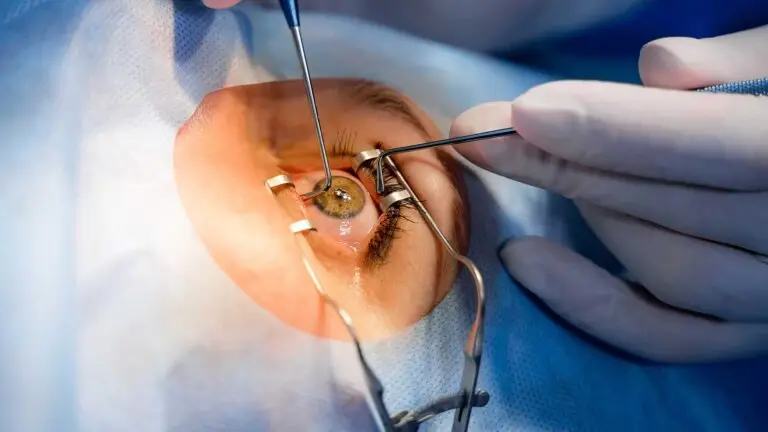
Anaesthetic drops numb the eye. There are no needles and no general anaesthetic. You remain awake throughout and look at a fixation light while the tracker does the holding-still.
The laser treatment itself lasts seconds to minutes for each eye. You may experience pressure sensations at certain moments rather than pain. Both eyes are usually treated in the same session.
Afterwards, you rest briefly and receive your drops and written aftercare schedule. You go home on the same day with someone to accompany you.
The total visit is measured in hours. The part involving the laser is measured in minutes.
What Is Vision Like Afterwards?
With LASIK and SMILE, vision is typically functional within a day or two and sharpens across the first few weeks. With surface techniques, there are several blurred days before a steady improvement.
Two companions are common during the early stages across all techniques and are usually temporary. The first is dryness.⁶ The second is night-time glare and haloes, which in one large series fell from 25.6% of patients at one month to 4.7% at twelve months.⁷
The complete day-by-day account is available in Laser Eye Surgery Recovery Time.
How Long Does It Last?
The corneal correction is lasting. The reshaped cornea holds its shape in well-selected eyes, with small regression in a minority addressed by enhancement.
What laser does not stop is the natural lens ageing behind it. Presbyopia will still arrive in the mid-40s and cataract decades later because these are lens events in a structure the laser never touched.
A patient who needs reading glasses at 45 has not watched their laser wear off. They have met the lens’s timetable, on schedule.
What Can Go Wrong?
Honestly and by name.
Ectasia is rare and screened for as described above.⁴ Dry eye is common early, occasionally persistent and managed actively.⁶ Night-time dysphotopsia is common early and usually settles.⁷
Flap complications with LASIK are uncommon and usually managed at the time. Infection is rare and guarded against with drops and hygiene. Under-correction or over-correction may be addressed through enhancement.
Provider policies vary. Enhancement may be included for a defined period, subject to eligibility, charged separately or handled under provider-specific terms. Ask to see the written policy before surgery.
At Blue Fin Vision®, enhancement after self-pay laser vision correction is fully covered within 24 months for eligible patients. There is no cost-sharing, and written clinical criteria apply under the published Enhancement Policy.
The balanced patient-reported picture is worth one sentence here. The PROWL studies found very high satisfaction and a substantial minority of patients with new early visual symptoms. Most symptoms did not materially impair ordinary activities.⁵
Laser Versus ICL Versus Lens Replacement
- Laser. What it is: reshapes the cornea, with nothing entering the eye and the natural lens preserved. Best suited to: stable, in-range prescriptions on healthy corneas, typically in patients in their 20s to 40s.
- ICL. What it is: an implanted lens placed behind the iris that corrects vision without removing corneal tissue and is reversible by design. Best suited to: high prescriptions and thin or unsuitable corneas with a healthy natural lens.
- Lens Replacement. What it is: exchanges the ageing natural lens for a calculated intraocular lens using the same core procedure as cataract surgery. Best suited to: presbyopic patients aged 45 and over, high hyperopia and lenses that are already changing.
Why Surgeon Choice Matters
The platforms across serious providers are broadly comparable. The judgement is not.
Your surgeon chooses whether to operate at all, which technique your cornea actually suits and how the plan is built. Their qualification is verifiable. The Royal College of Ophthalmologists’ CertLRS is the College’s dedicated examination and certificate in refractive surgery.
Procedure breadth matters for the same reason. A practice offering only one operation has fewer alternative pathways when that operation is not the best solution. Written aftercare and enhancement terms complete the picture.
The full selection framework is covered in Who Is the Best Laser Eye Surgeon in the UK?.
The Questions Everyone Actually Asks
Can I blink? A soft support holds the eyelids comfortably open during the seconds of treatment. Blinking is therefore taken off your to-do list entirely.
What if I move? The tracker follows your eye hundreds of times a second. The laser pauses if you move beyond its comfort. Staying still is the machine’s job.
Does it hurt? Anaesthetic drops mean pressure sensations rather than pain during treatment. Surface techniques involve genuinely uncomfortable early days afterwards, while flap and keyhole techniques usually cause only grittiness.
Am I awake? Yes. You look at a light for a few minutes, and no general anaesthetic is involved.
Can both eyes be treated together? Usually yes. Treatment during the same session is standard modern practice for laser vision correction.
Can laser make me blind? Sight-threatening complications are rare. The serious complications are exactly what screening and technique selection exist to minimise. The honest full answer is available in 5 Myths About Laser Eye Surgery Safety.
Can I have it again? If fine-tuning is needed and your cornea’s tissue budget allows, yes. This is what enhancement is, and its terms should be in writing before your first treatment.
Will I need reading glasses later? From the mid-40s, probably, like almost everyone. The natural lens stiffens regardless of laser treatment. PRESBYOND® and, later, lens surgery are the dedicated answers to that separate problem.
So, What Is Laser Eye Surgery?
Laser eye surgery is a brief, precise reshaping of the cornea. For the right eyes, it converts decades of glasses and contact lenses into unaided sight, with an evidence base most elective surgery would envy and a set of honest caveats this page has named rather than hidden.
References
- Solomon KD, Fernández de Castro LE, Sandoval HP, Biber JM, Groat B, Neff KD, Ying MS, French JW, Donnenfeld ED, Lindstrom RL; Joint LASIK Study Task Force. LASIK world literature review: quality of life and patient satisfaction. Ophthalmology. 2009;116(4):691-701. PMID: 19344821.
- Sandoval HP, Donnenfeld ED, Kohnen T, Lindstrom RL, Potvin R, Tremblay DM, Solomon KD. Modern laser in situ keratomileusis outcomes. J Cataract Refract Surg. 2016;42(8):1224-1234. PMID: 27531300.
- Shortt AJ, Allan BD, Evans JR. Laser-assisted in-situ keratomileusis (LASIK) versus photorefractive keratectomy (PRK) for myopia. Cochrane Database Syst Rev. 2013;(1):CD005135. PMID: 23440799.
- Randleman JB, Woodward M, Lynn MJ, Stulting RD. Risk assessment for ectasia after corneal refractive surgery. Ophthalmology. 2008;115(1):37-50. PMID: 17624434.
- Eydelman M, Hilmant M, Tarver ME, Hofmeister EM, May J, Hammel K, Hays RD, Ferris F 3rd. Symptoms and satisfaction of patients in the Patient-Reported Outcomes With Laser In Situ Keratomileusis (PROWL) studies. JAMA Ophthalmol. 2017;135(1):13-22. PMID: 27893066.
- Ambrósio R Jr, Tervo T, Wilson SE. LASIK-associated dry eye and neurotrophic epitheliopathy: pathophysiology and strategies for prevention and treatment. J Refract Surg. 2008;24(4):396-407. PMID: 18500091.
- Pop M, Payette Y. Risk factors for night vision complaints after LASIK for myopia. Ophthalmology. 2004;111(1):3-10. PMID: 14711706.
- Reinstein DZ, Archer TJ, Gobbe M. Small incision lenticule extraction (SMILE) history, fundamentals of a new refractive surgery technique and clinical outcomes. Eye Vis (Lond). 2014;1:3. PMID: 26605350.
ABOUT THE AUTHOR
Mr Mfazo Hove
Consultant Ophthalmic Surgeon
MBChB MD FRCOphth CertLRS
Mr Mfazo Hove is a Consultant Ophthalmic Surgeon with experience spanning more than 57,000 procedures. He completed 6.5 years of specialist training at Moorfields Eye Hospital and served for five years as a consultant at the Western Eye Hospital, Imperial College Healthcare NHS Trust. He is the founder of Blue Fin Vision®, a consultant-led private ophthalmology practice operating across London, Essex, and Hertfordshire. His clinical expertise encompasses advanced cataract surgery, refractive lens replacement, laser vision correction, and implantable Collamer lenses (ICL).
A ZEISS Key Opinion Leader, Mr Hove is a respected international speaker with five invited engagements across seven cities in 2026:
- ZEISS China tour (Changsha, Shanghai, and Hangzhou, April – ZEISS APAC User Meeting)
- RCOphth Annual Congress – May – Manchester
- ZEISS EMEA User Meeting (Istanbul)
- ZEISS Lausanne User Meeting (Lausanne)
- European Society of Cataract and Refractive Surgeons Annual Congress (ESCRS, London)
Book A Complimentary Consultation
To find out whether a laser eye surgery treatment is suitable for you, book a complimentary consultation with the consultant-led Blue Fin Vision® team. Bring the Laser Eye Surgery Checklist and discuss your options at one of our locations across London, Hertfordshire and Essex.
You can also review transparent fees on the laser eye surgery costs page.


