
- Medically Reviewed by: Mr Mfazo Hove, Consultant Ophthalmic Surgeon
- Author: Mr Mfazo Hove
- Published: January 6, 2025
- Last Updated: October 8, 2026
TL;DR: If you searched for “best cataract surgeon UK”, it is important to know that there is no official UK league table that can objectively identify a single “best” cataract surgeon. And I would be cautious about any surgeon or clinic whose main evidence for being the best is simply that their own website says so.
What you can do is evaluate cataract surgeons against evidence you can interrogate: current surgical volume; published, independently benchmarked outcomes; experience with complex as well as routine cataracts; the refractive judgement to plan the lens and target around your life; rigorous biometry; a written position on what happens if the result needs refinement; the infrastructure to manage rare complications; and certainty that the surgeon you chose is the surgeon who operates. Blue Fin Vision® brings these together within the Blue Fin Vision® Advantage, and our Private Cataract Surgery Checklist turns them into questions you can take to any provider, including us.
Measured against those criteria, I believe I have a strong case to be considered among the UK’s leading cataract surgeons. But I would rather show you the evidence and let you reach that conclusion yourself.
How To Evaluate “Best Cataract Surgeon UK” Claims
Cataract surgery removes the clouded natural lens of the eye and replaces it with a clear artificial intraocular lens. It is one of the most frequently performed and most successful operations in medicine, and that very routineness can obscure what separates surgeons.
Being the best at cataract surgery means three things at once. It means performing routine surgery to an exceptionally consistent standard, thousands of times. It means having the experience to handle the cataracts that are not routine: dense lenses, small pupils, previous surgery, unusual anatomy. And it means recognising that modern cataract surgery is also a refractive procedure: the lens implanted will shape how you see for the rest of your life, so choosing it well matters as much as removing the cataract well. NICE guidance frames the decision to operate itself around your quality of life, circumstances, risks, benefits and preferences rather than a simple visual acuity threshold, which places judgement, not just technique, at the centre of what a cataract surgeon does. ⁷
1. Surgical Experience Matters, But Volume Alone Is Not Enough
Experience in cataract surgery is measurable, and the relationship with safety is strong. Madeleine Zetterberg, Per Montan, Maria Kugelberg, Ingela Nilsson, Mats Lundström and Anders Behndig analysed ten years of Swedish National Cataract Register data and found capsule complication rates falling from 2.15% among surgeons performing 10 to 99 procedures a year to 0.59% among those performing at least 500, while the volume of the unit itself was not associated with the complication rate. ¹ It is the surgeon, not the building.
I have performed more than 57,000 ophthalmic procedures during my career, including over 25,000 in the last four years. That level of current volume means exposure to an enormous range of eyes and situations, routine and otherwise.
But I would never tell somebody: “I have performed 57,000 procedures, therefore you should choose me.” Volume tells you how much somebody has operated. Outcomes tell you what that experience actually produces. Those are not the same thing.
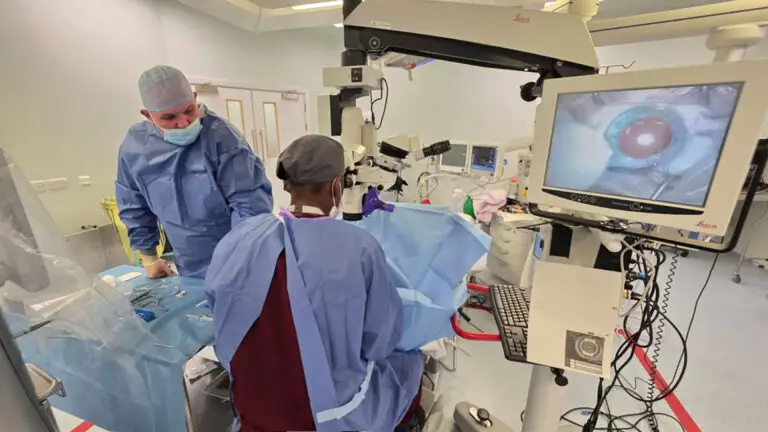
2. Ask to See the Surgeon’s Actual Outcomes
If somebody is described as one of the best cataract surgeons in the UK, I think it is entirely reasonable to ask: “Can I see your results?”
The principal recognised intraoperative complication of cataract surgery is posterior capsule rupture, or PCR. Alexander Day, Paul Donachie, John Sparrow and Robert Johnston established PCR as the key outcome measure in the Royal College of Ophthalmologists’ National Ophthalmology Database study of cataract surgery. ² The latest national NOD audit reports a PCR rate of 0.69% across participating UK cataract providers. ³
I publish my own cataract outcomes over six consecutive years, rather than selecting one favourable period. My posterior capsule rupture rate runs at approximately 0.2%, against that national benchmark of 0.69%, with macular oedema in 0.03% of 3,215 audited procedures.
That does not mean I can guarantee that a complication will never occur. Nobody performing intraocular surgery can responsibly make that promise. It means that when I advise patients to investigate a surgeon’s outcomes, I am prepared to put mine in front of them too.
3. Cataract Surgery Is Also Refractive Surgery
When I remove your natural lens, I have to replace it with another lens, and that lens will affect the way you see for potentially the rest of your life. A technically perfect operation can still produce an unhappy patient if the wrong lens was implanted or the wrong refractive objective chosen.
For patients with significant corneal astigmatism, toric intraocular lenses can materially improve the result: Line Kessel, Jens Andresen, Britta Tendal, Ditte Erngaard, Per Flesner and Jesper Hjortdal analysed 13 randomised trials involving more than 1,400 eyes and found better uncorrected distance vision, greater spectacle independence and lower residual astigmatism with toric IOLs than non-toric approaches. ⁴ For patients whose priority is spectacle independence, a Cochrane systematic review by Ranjan de Silva, Jennifer Evans, Vishal Kirthi, Mohammed Ziaei and Martin Leyland found multifocal lenses reduce spectacle dependence and improve unaided near vision compared with monofocal lenses, while increasing glare and haloes in some patients. ⁵
That trade-off is why I do not believe in presenting lenses as good, better, best. The most expensive lens is not automatically the best lens. The best lens is the one whose advantages and compromises fit the individual eye and the individual patient. Our IOL Lens Guide explains the categories, and a monofocal lens is sometimes exactly the right recommendation.
4. Ask About the Cataracts That Are Not Routine
Most cataract surgery is straightforward. The measure of a surgeon is partly what happens when it is not: the dense white cataract, the small pupil that will not dilate, the eye with previous surgery, the unusually shallow chamber, the patient with co-existing glaucoma or retinal disease.
Very high volume brings repeated exposure to all of these, and the infrastructure question follows naturally: safety in cataract surgery is built from evidence-based systems, not luxury. The European Society of Cataract & Refractive Surgeons’ prospective randomised study of more than 16,000 patients showed that omission of intracameral cefuroxime was associated with almost a five-fold increase in postoperative endophthalmitis risk: that is what evidence-based safety looks like. ⁸ And if a rare complication such as a dropped lens fragment occurs, who manages it, and where? At Blue Fin Vision®, posterior-segment complications are managed within our own vitreoretinal pathway, without an additional surgical fee to the patient, rather than being referred to an external service or placed on an external waiting list.
5. I Have Had Cataract Surgery Myself
My perspective on this operation is not only professional.
In April 2024, I underwent cataract surgery on both of my own eyes, and I chose trifocal intraocular lenses, the same ZEISS AT LISA tri platform I am one of five named UK consultant surgeons endorsing in ZEISS’s national print campaign, and the same category of lens I discuss with my own patients.
Approaching two and a half years later, I remain highly spectacle-independent, with a continuous functional range of vision from near through intermediate to distance. I live every day with both the benefits and compromises of premium optics. The evidence shows that multifocal lenses can substantially reduce spectacle dependence, but glare and haloes are recognised trade-offs. ⁵ In my own case, those phenomena are real but well tolerated, and I also notice how much the ocular surface influences quality of vision, particularly on waking.
I have also experienced the full journey, not just the highlights. In March 2026 I underwent a YAG capsulotomy for posterior capsule opacification, the common late clouding that can follow cataract surgery. I have written about that experience from the patient’s side of the laser separately.
When I sit opposite a cataract patient, I am describing an operation I have personally been through, a lens I personally see through, and an aftercare pathway I have personally followed. Very few surgeons can say that, and it has made me more careful, not less, about how I counsel patients.
6. Measurement Before Surgery Matters Enormously
Cataract surgery does not begin in the operating theatre. It begins with measurement, because the artificial lens power has to be calculated from detailed measurements of the eye, and a technically perfect operation with an inaccurate calculation still leaves residual refractive error. Ronald Melles, Jack Holladay and William Chang demonstrated meaningful differences in predictive accuracy between modern lens calculation formulae. ⁶ At Blue Fin Vision®, our approach includes double biometry, with measurements cross-checked rather than relying on a single data stream: measure carefully, check discrepancies, implant once.
7. Technique: What 4-Minute Phaco™ Actually Means
Where appropriate, I use 4-Minute Phaco™, a highly controlled, low-trauma cataract technique. The name describes an outcome, not a target. The four-minute timeframe is what very high surgical volume, standardisation and the elimination of unnecessary movements tend to produce; the priority throughout is control, safety and audited outcomes. Speed is never the endpoint. If an eye requires more time, it gets more time. The patient receives no benefit from their surgeon winning a race. Efficiency is only valuable when it is achieved through controlled surgery, minimising unnecessary manipulation and maintaining tissue respect. Speed in itself is not the objective.
8. Ask What Happens If the Refractive Result Is Not Perfect
Even with modern biometry and excellent surgery, a small percentage of patients will have some residual refractive error. Ask what happens then, and who pays, before surgery rather than after. At Blue Fin Vision®, this is set out in a written Enhancement Policy, part of the Blue Fin Vision® Advantage. For self-pay and premium lens cataract patients, enhancement is fully covered within 24 months of the original procedure, with no cost-sharing and no hidden top-up. For insured cataract surgery with a standard monofocal lens, where the clinical objective is restoring functional vision rather than spectacle independence, enhancement is not included, and you will know that before treatment begins, not after. The full detail is in What Is Enhancement After Cataract Surgery?.

9. Who Will Actually Perform Your Operation?
If you have selected a surgeon because of their reputation, experience or published outcomes, ask: “Will you personally perform my operation?” At Blue Fin Vision®, cataract surgery is consultant-delivered. The consultant is responsible for the assessment, the refractive plan and the operation itself.
10. NHS or Private? An Honest Word
Many cataract patients are weighing an NHS pathway against private treatment, and the honest position is that NHS cataract surgery can be excellent; the differences lie in waiting, lens choice, continuity and what stands behind the result. I have addressed that decision fully in Is Private Cataract Surgery Better Than NHS? and Is It Worth Going Private for Cataract Surgery?. For insured patients, Blue Fin Vision® provides cataract pathways with major insurers, including dedicated Bupa arrangements across our network. Our consultants regard advising against surgery, where it is not in your interest, as a sound outcome of a consultation rather than a failed one.

The Questions I Would Ask Any Cataract Surgeon, Including Me
If I were choosing somebody to operate on my own eyes, and I have had to make this decision, these are the questions I would ask:
- How much cataract surgery do you actually perform? Meaningful current surgical experience, not just years since qualification.
- Can I see your complication rate? Published or independently benchmarked outcomes.
- How does your PCR rate compare nationally? A real number rather than “very low”.
- What experience do you have with complex cataracts? Dense lenses, small pupils, previous surgery and unusual anatomy.
- How do you calculate my lens? Modern biometry, contemporary formulae and verification.
- Can you correct my astigmatism at the same operation? Appropriate toric planning where indicated.
- Which lenses do you offer and why? A patient-specific answer, not simply the most expensive product.
- Who performs my operation? The surgeon you selected.
- What happens if I miss the refractive target? A written enhancement position, explained before surgery.
- What happens if there is a complication? Established infrastructure, including vitreoretinal support.
- Will you tell me if surgery is not yet in my interest? Perhaps the most important answer of all.
These questions are available as our Private Cataract Surgery Checklist. Take it to another clinic. Ask them the same questions. Then compare the answers.
How Does Mr Mfazo Hove Measure Against Those Criteria?
I am uncomfortable with surgeons simply declaring themselves “the best”. So these are the facts I am prepared to place in front of a patient.
- I have performed more than 57,000 ophthalmic procedures, including over 25,000 in the last four years.
- I spent 6.5 years training at Moorfields Eye Hospital, including more than two years researching cataract surgery and multifocal intraocular lenses during my Cataract Research Fellowship, culminating in an MD research degree, and five years as a Consultant Ophthalmic Surgeon at the Western Eye Hospital, Imperial College Healthcare NHS Trust.
- I am a Fellow of the Royal College of Ophthalmologists and hold its Certificate in Laser and Refractive Surgery.
- I publish six consecutive years of audited cataract outcomes rather than a selected favourable period. My posterior capsule rupture rate runs at approximately 0.2%, against the current national NOD benchmark of 0.69%, with macular oedema in 0.03% of 3,215 audited procedures.
- I am a ZEISS Key Opinion Leader and one of five named UK consultant surgeons in ZEISS’s national print campaign endorsing the AT LISA tri trifocal intraocular lens.
- I underwent cataract surgery myself in April 2024, live with trifocal lenses in both eyes, and have experienced YAG capsulotomy for posterior capsule opacification.
- The clinical system around the surgery, including double biometry, consultant-delivered operations, 4-Minute Phaco™ where appropriate, the written Enhancement Policy and in-house vitreoretinal support, is set out in the Blue Fin Vision® Advantage.
There is external recognition too, including more than 550 verified Doctify reviews, Top Recommended status in the Spear’s 500 and inclusion in the Tatler Address Book. I value that recognition. But it sits alongside the clinical evidence. It does not replace it.
Is the Best Cataract Surgeon Necessarily in London?
No. Geography is convenient; it is not a clinical outcome. Blue Fin Vision® provides care through its network across London, Hertfordshire and Essex, and patients travel from elsewhere in the UK and internationally. I would choose the surgeon and surgical system first, then ask how far you need to travel. For patients in and around the capital, I address the location-specific question in Who Is the Best Cataract Surgeon in London?.

So, Who Is the Best Cataract Surgeon in the UK?
There is no scientifically defensible way to crown one individual. Different patients have different eyes, different risks and different priorities. But there are objective questions you can ask, and on those measures I am comfortable asking patients to compare my practice with any cataract service in the UK: 57,000 procedures, six years of published outcomes, a 0.2% PCR rate against a 0.69% national benchmark, a national ZEISS endorsement of the trifocal platform, and the experience of having been a cataract patient myself, from the operating table to the YAG laser.
The best cataract surgeon is not simply the surgeon who tells you they are the best. It is the surgeon who gives you enough evidence to decide for yourself.
If you would like to understand your own options, you can book a paid, consultant-led cataract consultation with Blue Fin Vision®, supported by documented outcomes and locations across London, Hertfordshire and Essex.
References
- Zetterberg M, Montan P, Kugelberg M, Nilsson I, Lundström M, Behndig A. Cataract surgery volumes and complications per surgeon and clinical unit: data from the Swedish National Cataract Register 2007 to 2016. Ophthalmology. 2020;127(3):305-314. PMID: 31767438.
- Day AC, Donachie PHJ, Sparrow JM, Johnston RL. The Royal College of Ophthalmologists’ National Ophthalmology Database study of cataract surgery: report 1, visual outcomes and complications. Eye (Lond). 2015;29(4):552-560. PMID: 25679413.
- The Royal College of Ophthalmologists. National Ophthalmology Database Audit: Annual Report, cataract operations performed April 2023 to March 2024 [Internet]. London: RCOphth; 2025 [cited 2026 Aug 26]. Available from: https://www.nodaudit.org.uk/
- Kessel L, Andresen J, Tendal B, Erngaard D, Flesner P, Hjortdal J. Toric intraocular lenses in the correction of astigmatism during cataract surgery: a systematic review and meta-analysis. Ophthalmology. 2016;123(2):275-286. PMID: 26601819.
- de Silva SR, Evans JR, Kirthi V, Ziaei M, Leyland M. Multifocal versus monofocal intraocular lenses after cataract extraction. Cochrane Database Syst Rev. 2016;12:CD003169. PMID: 27943250.
- Melles RB, Holladay JT, Chang WJ. Accuracy of intraocular lens calculation formulas. Ophthalmology. 2018;125(2):169-178. PMID: 28951074.
- National Institute for Health and Care Excellence. Cataracts in adults: management. NICE guideline NG77 [Internet]. London: NICE; 2017 [cited 2026 Aug 26]. Available from: https://www.nice.org.uk/guidance/ng77
- Endophthalmitis Study Group, European Society of Cataract & Refractive Surgeons. Prophylaxis of postoperative endophthalmitis following cataract surgery: results of the ESCRS multicenter study and identification of risk factors. J Cataract Refract Surg. 2007;33(6):978-988. PMID: 17531690.
ABOUT THE AUTHOR
Mr Mfazo Hove
Consultant Ophthalmic Surgeon
MBChB MD FRCOphth CertLRS
Mr Mfazo Hove is a Consultant Ophthalmic Surgeon with experience spanning more than 57,000 procedures. He completed 6.5 years of specialist training at Moorfields Eye Hospital and served for five years as a consultant at the Western Eye Hospital, Imperial College Healthcare NHS Trust. He is the founder of Blue Fin Vision®, a consultant-led private ophthalmology practice operating across London, Essex, and Hertfordshire. His clinical expertise encompasses advanced cataract surgery, refractive lens replacement, laser vision correction, and implantable Collamer lenses (ICL).
A ZEISS Key Opinion Leader, Mr Hove is a respected international speaker with five invited engagements across seven cities in 2026:
- ZEISS China tour (Changsha, Shanghai, and Hangzhou, April – ZEISS APAC User Meeting)
- RCOphth Annual Congress – May – Manchester
- ZEISS EMEA User Meeting (Istanbul)
- ZEISS Lausanne User Meeting (Lausanne)
- European Society of Cataract and Refractive Surgeons Annual Congress (ESCRS, London)