




- Medically Reviewed by: Mr Mfazo Hove, Consultant Ophthalmic Surgeon
- Author: Mr Mfazo Hove
- Published: September 22, 2025
- Last Updated: September 11, 2026
TL;DR: What is the recovery time for laser eye surgery? LASIK and SMILE typically restore functional vision within a day or two, while PRK and LASEK usually involve several blurred, gritty days and a longer path to full sharpness; PRESBYOND® also involves a period of binocular adaptation. This guide provides laser eye surgery aftercare and recovery advice, including what to expect after a laser eye surgery procedure and when to seek urgent help.
Laser Eye Surgery Recovery Times and Aftercare
This guide to recovery and post-operative care after laser eye surgery explains why the techniques have different recovery profiles.
The excimer reshaping is similar, but the route to the tissue differs. Recovery is mostly about that route.
LASIK works beneath a thin protective flap that is floated back into place. The surface is therefore largely intact from day one.
SMILE removes its lenticule through a keyhole incision. This likewise leaves most of the surface and its nerve supply undisturbed.⁶
PRK and LASEK treat the surface itself. The surface cell layer must regrow over several days, so comfort and clarity take longer to return. This creates a genuinely different early experience, as reflected in the comparative evidence.¹
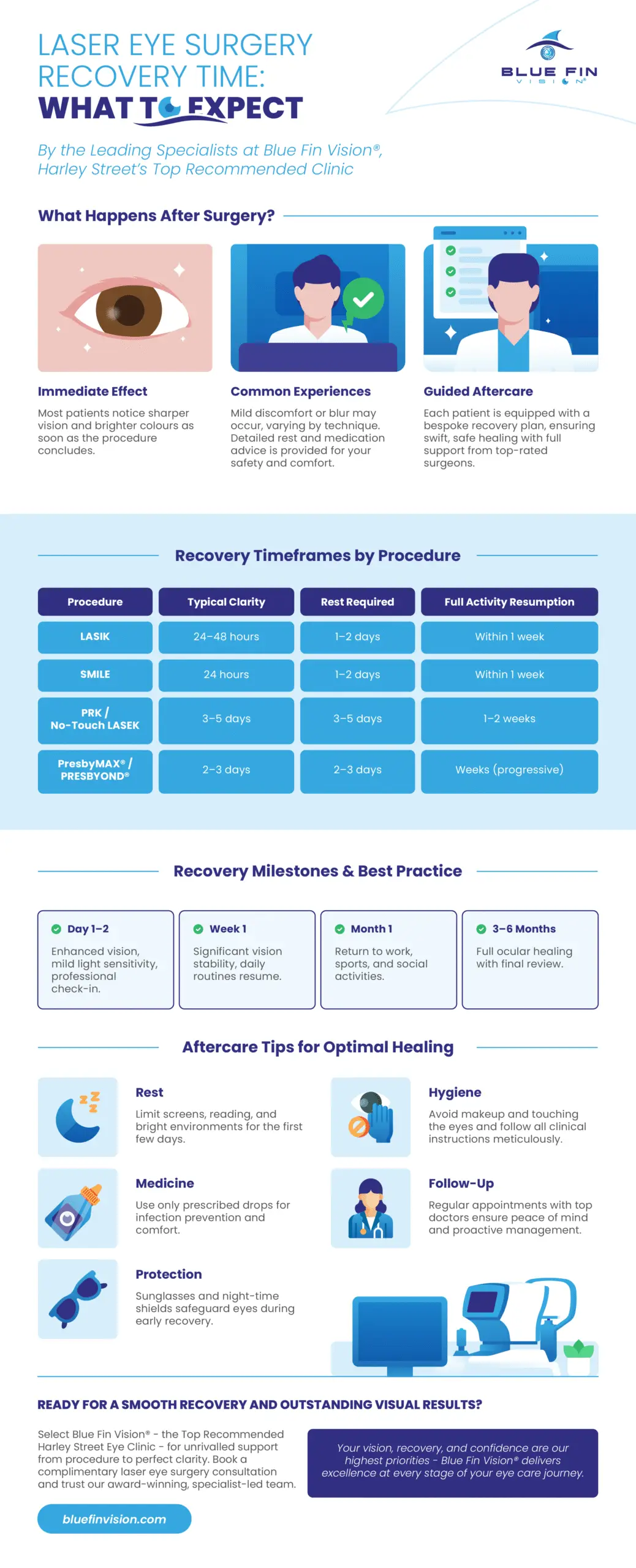
Infographic: Laser Eye Surgery Recovery Time – What to Expect
How Many Days’ Rest Is Required After Laser Eye Surgery?
The amount of rest required depends on the procedure, your occupation and how your eyes heal. Many patients return to desk-based work within a day or two after LASIK or SMILE. Surface treatments such as PRK and LASEK commonly require several days away from visually demanding work.
These are typical ranges rather than fixed deadlines. Your surgeon’s written instructions and clinical review should determine when you return to work, driving, exercise and other activities.
LASIK, Day by Day
The following timeline is indicative. Individual recovery varies, and your surgeon’s instructions take priority.
The first hour: Watering, light sensitivity, a gritty foreign-body feeling and hazy vision may develop as the anaesthetic fades. The standard advice is to go home and sleep.
That evening: The eyes may feel gritty but are usually comfortable. Prescribed drops begin, screens are unimportant, and curiosity is best resisted.
Day 1: Many patients wake surprised by how functional their vision feels. The first review checks the flap and confirms which activities can safely resume. You must not drive until your vision meets the DVLA eyesight standard and your clinical team confirms that it is appropriate.⁸
Day 2: Many patients can return to desk-based work, although this varies with comfort, vision and job requirements.
Week 1: Clarity usually continues to sharpen, and drops run to schedule. The principal restrictions include no eye rubbing, swimming or dusty environments until permitted by your surgeon.
Month 1: Vision may be at or near its endpoint, while night-time symptoms often continue to fade. Contact sport must wait until your surgeon confirms that the flap has had sufficient early protection.
Month 3: The result is often substantially settled and can usually be assessed more meaningfully against the intended target.

SMILE, Day by Day
The recovery pattern is similar to LASIK, with two differences worth naming.
There is no flap, so the early-protection requirements are different. Active lifestyles may return to training sooner, following advice from the surgeon. The corneal surface and nerves are also less disturbed, so the early dryness profile is often kinder.
Patients may experience a gritty first evening followed by functional vision within a day or two. Vision then refines across the first few weeks. The result is often substantially settled by around month three, although individual recovery varies.
PRK and LASEK, Day by Day
This is the honest slower road, front-loaded by design. The following timings are typical ranges rather than a fixed schedule.
Days 1 to 3: While the surface layer regenerates beneath a protective bandage contact lens, expect grittiness, light sensitivity, watering and fluctuating blur. These symptoms are managed with drops and analgesia. Plan realistically for several days away from demanding visual work.
Days 3 to 7: The surface normally closes during this period. The clinical team removes the bandage lens when healing is sufficient, rather than on a fixed day.
Week 1: Vision usually begins to improve steadily but may not yet be final.
Weeks 2 to 6: Vision continues to refine, while prescribed drops taper according to your individual schedule.
Month 3: Outcomes in well-selected eyes may be equivalent to those achieved with LASIK, but they are reached more gradually.
Patients choose this road for good reasons, including thinner corneas, certain occupations and the absence of a flap. Knowing the early price in advance is what makes it a fair trade.
PRESBYOND®, Plus the Adaptation Layer
Blended vision recovers physically according to the technique used to create it. It then adds a learning phase.
One eye favours distance and the other near. The brain learns to merge the pair into a continuous range of vision.
Many patients adapt over several weeks. Some adjust within days, while others need longer. The early sensation is occasionally described as slightly unsettled binocular vision. Reviews track this progress, and patience during the adaptation phase forms part of the treatment.

Laser Eye Surgery Aftercare and Recovery Advice
The timings below are general guidance. Your written post-operative instructions take priority because recommendations vary by procedure and individual healing.
Royal College of Ophthalmologists guidance advises that washing and showering can normally resume from day one after LASIK or lenticule extraction. After surface treatment, patients should wait until the bandage contact lens has been removed. The same guidance notes that many surgeons recommend avoiding swimming for one week and contact sports for one month after LASIK.⁷
- Driving: Do not drive home on the day of surgery. Resume only when your surgeon or clinical team advises that it is appropriate and you meet the DVLA eyesight standard. This includes being able to read a number plate from 20 metres and meeting the required visual acuity and field-of-vision standards.⁸
- Work: Desk-based work may be possible within a day or two after LASIK or SMILE. Several days may be needed after surface treatment. Night-critical and visually demanding work deserves its own conversation during assessment.
- Screens: Screens may be used when comfortable, but they can make dryness more noticeable. Take regular blink breaks and use prescribed lubricants.
- Shower: Showering can normally resume from the day after LASIK or SMILE. After PRK or LASEK, wait until the bandage contact lens has been removed unless your surgeon advises otherwise. Keep soap and direct water pressure away from the eyes.⁷
- Makeup: Face makeup may be possible early, while eye makeup should wait until your written schedule allows it. Old eye products should be replaced where advised.
- Exercise: Non-contact activities such as gym training and jogging may resume early if your surgeon agrees. Keep sweat away from the eyes and follow any procedure-specific restrictions.⁷
- Swimming: Many surgeons recommend avoiding swimming for at least one week. Your clinic may advise a longer period depending on the treatment and healing.⁷
- Flying: Flying may be acceptable early, subject to your surgeon’s advice and planned review schedule. Dry cabin air can make lubricating drops more useful.
- Contact sport: Contact sport returns last, especially after LASIK, where the flap needs early protection. Royal College guidance notes that many surgeons recommend avoiding contact sports for one month after LASIK. Flapless procedures may have different restrictions.⁷
Why Vision Fluctuates Early
Vision may be clear at breakfast and softer by evening. It can also feel crisp one day and filmy the next.
The culprit is almost never the cornea’s new shape, which does not change from hour to hour. It is usually the tear film, the eye’s optical front surface, which is disturbed by surgery and rebuilds over several weeks. The mechanisms are well described in the dry-eye literature.⁴
Grittiness, end-of-day tiredness and blur that improves after blinking all belong to the same story. These symptoms are managed actively with lubricants and are the single most common source of unnecessary worry during the first month.
The fluctuation lives in the tears, not the treatment.
Why Night Vision Takes Longer
Glare, haloes and starbursts around lights are the second companion of early recovery. They are common during the first few weeks and often fade as the eye settles, the surface rebuilds and the brain adapts. They persist longer term in a minority of patients.
A classic large series puts honest numbers on the pattern. Night-vision complaints fell from 25.6% of patients at one month to 4.7% at twelve months.⁵ This is worth holding onto during week three, when the haloes are real and the trend is invisible.
Larger pupils and bigger corrections raise the odds. This is why the conversation belongs before surgery, not after.
What If One Eye Seems Clearer Than the Other?
It often is, for a while.
Eyes can heal and adapt at slightly different speeds. Small asymmetry during the early weeks is the rule rather than the exception, while the brain’s merged image usually outruns either eye alone.
In blended vision, asymmetry is the design, not a defect. Persistent or marked asymmetry should be discussed at a review appointment. Reviews exist precisely to measure it.
When Is Enhancement Even Considered?
Not at week two.
The early weeks involve fluctuation, healing and adaptation. Judging a refractive result during this period is like measuring a photograph while it is still developing.
Enhancement enters the conversation only once the result has settled and stabilised, typically after several months. It is considered only for a symptomatic residual error, where clinically appropriate and where the tissue budget allows.
The terms belong in writing before your first treatment. Provider policies vary. Enhancement may be included for a defined period, subject to eligibility, charged separately or handled under provider-specific terms.
At Blue Fin Vision®, enhancement after self-pay laser vision correction is fully covered within 24 months for eligible patients under the written Enhancement Policy.
What Is Genuinely Urgent?
This is a short list worth knowing.
Significant or worsening pain beyond the expected surface discomfort of the early PRK or LASEK recovery period requires prompt clinical advice. The same applies to a marked deterioration in vision after initial improvement, or an increasingly red, angry eye, especially when accompanied by discharge.
Contact the clinical team promptly following any direct blow to the eye during the early period after LASIK.
New flashes, a sudden increase or shower of floaters, sudden blurred vision, or a dark curtain or shadow moving across your vision can indicate a retinal emergency. Seek urgent help through the clinical team or NHS 111. If pain, redness or blurred vision becomes severe or worsens rapidly, follow the emergency advice provided by your surgeon or attend the appropriate urgent service.⁹
In every case, contact the practice directly where possible. Urgent review can be arranged through the Blue Fin Vision® clinical pathway according to clinical need.
The Laser Eye Surgery Recovery Expectation That Matters Most
Expect a fast return to everyday life and a slower, quieter completion.
Functional vision often returns within days after LASIK or SMILE, while surface procedures normally take longer. Final visual quality can continue developing over several weeks. Night-time and dryness symptoms also fade according to their own timetables.
The whole laser eye surgery recovery journey is shaped by decisions made before surgery. These include matching the technique to your cornea and completing the screening needed to confirm suitability.² ³
If you are still considering treatment, start with What Is Laser Eye Surgery? and review the pros and cons.
References
- Shortt AJ, Allan BD, Evans JR. Laser-assisted in-situ keratomileusis (LASIK) versus photorefractive keratectomy (PRK) for myopia. Cochrane Database Syst Rev. 2013;(1):CD005135. PMID: 23440799.
- Sandoval HP, Donnenfeld ED, Kohnen T, Lindstrom RL, Potvin R, Tremblay DM, Solomon KD. Modern laser in situ keratomileusis outcomes. J Cataract Refract Surg. 2016;42(8):1224-1234. PMID: 27531300.
- Randleman JB, Woodward M, Lynn MJ, Stulting RD. Risk assessment for ectasia after corneal refractive surgery. Ophthalmology. 2008;115(1):37-50. PMID: 17624434.
- Ambrósio R Jr, Tervo T, Wilson SE. LASIK-associated dry eye and neurotrophic epitheliopathy: pathophysiology and strategies for prevention and treatment. J Refract Surg. 2008;24(4):396-407. PMID: 18500091.
- Pop M, Payette Y. Risk factors for night vision complaints after LASIK for myopia. Ophthalmology. 2004;111(1):3-10. PMID: 14711706.
- Reinstein DZ, Archer TJ, Gobbe M. Small incision lenticule extraction (SMILE) history, fundamentals of a new refractive surgery technique and clinical outcomes. Eye Vis (Lond). 2014;1:3. PMID: 26605350.
- Royal College of Ophthalmologists. Laser Vision Correction: Patient Information. London: RCOphth; 2020. Available from: https://www.rcophth.ac.uk/wp-content/uploads/2020/05/Laser-Vision-Correction-Patient-Information.pdf
- Driver and Vehicle Licensing Agency. Driving eyesight rules. GOV.UK. Available from: https://www.gov.uk/driving-eyesight-rules
- NHS. Laser eye surgery and lens surgery. NHS. Updated 24 February 2022. Available from: https://www.nhs.uk/tests-and-treatments/laser-eye-surgery-and-lens-surgery/
ABOUT THE AUTHOR
Mr Mfazo Hove
Consultant Ophthalmic Surgeon
MBChB MD FRCOphth CertLRS
Mr Mfazo Hove is a Consultant Ophthalmic Surgeon with experience spanning more than 57,000 procedures. He completed 6.5 years of specialist training at Moorfields Eye Hospital and served for five years as a consultant at the Western Eye Hospital, Imperial College Healthcare NHS Trust. He is the founder of Blue Fin Vision®, a consultant-led private ophthalmology practice operating across London, Essex, and Hertfordshire. His clinical expertise encompasses advanced cataract surgery, refractive lens replacement, laser vision correction, and implantable Collamer lenses (ICL).
A ZEISS Key Opinion Leader, Mr Hove is a respected international speaker with five invited engagements across seven cities in 2026:
- ZEISS China tour (Changsha, Shanghai, and Hangzhou, April – ZEISS APAC User Meeting)
- RCOphth Annual Congress – May – Manchester
- ZEISS EMEA User Meeting (Istanbul)
- ZEISS Lausanne User Meeting (Lausanne)
- European Society of Cataract and Refractive Surgeons Annual Congress (ESCRS, London)
Book A Complimentary Consultation
For personalised laser eye surgery aftercare and recovery advice, book a complimentary consultation with the consultant-led Blue Fin Vision® team. Discuss your expected recovery with specialists delivering documented outcomes across London, Hertfordshire and Essex.


