
- Medically Reviewed by: Mr Mfazo Hove, Consultant Ophthalmic Surgeon
- Author: Mr Mfazo Hove
- Published: June 19, 2025
- Last Updated: July 6, 2026
What counts as the best ICL surgery has moved on. Lens design, sizing technology and, above all, the standard of long-term aftercare now separate the leading clinics from the rest. This 2026 guide explains what best-in-class ICL care looks like today, and why Blue Fin Vision® has built its ICL service around measurement and lifelong monitoring rather than one-off surgery.
Aftercare Included for the Life of Your ICL
Under the ICL Lifetime Monitoring Protocol™, every ICL at Blue Fin Vision® includes, at no extra cost:
- Annual vault scan, every year, at any Blue Fin Vision® clinic.
- Annual endothelial cell count (ECC), every year, currently at our Harley Street centre.
- Laser enhancement, where clinically appropriate, with your original consultant, at no cost.
- Cataract surgery after ICL, where clinically required: no cost within 2 years, then half price to year 10, subject to protocol terms.
For as long as the lens remains in your eye. No expiry. No subscription. No renewal fees.
The Lens Has Improved, and the Standard Should Follow
Today’s EVO Implantable Collamer Lens uses a central port design that lets fluid move naturally within the eye. This removed the need for the peripheral laser iridotomy earlier lenses required and simplified the patient experience.¹ ² Reviews of the central-port lens report a strong safety and effectiveness profile,³ and long-term follow-up of posterior chamber phakic lenses shows stable, predictable correction over four and eight years of data.⁴ ⁵

What Best-in-Class ICL Care Looks Like in 2026
Measurement Before Surgery
Accurate sizing is the foundation of a safe ICL. Blue Fin Vision® uses swept-source OCT imaging (Anterion and Revo FC), sulcus-to-sulcus measurement and advanced vault prediction informed by anterior segment imaging and biometric modelling to match the lens to your individual eye. The aim is a vault, the small gap between the ICL and your natural lens, that sits in the optimal range of roughly 250 to 750 microns.
Measurement After Surgery, for Life
The endothelial cells that keep the cornea clear do not regenerate, so tracking them over time is part of responsible ICL care.⁶ This is where the ICL Lifetime Monitoring Protocol™ sits at the centre of the Blue Fin Vision® model. Every ICL is covered, at no extra cost and with no expiry or renewal fees. Objective measurements are reviewed against defined clinical thresholds, with annual vault checks at any Blue Fin Vision® clinic and endothelial cell counts at Harley Street, and direct specialist access if a measurement moves outside its range. It is a written clinical programme, not a marketing promise.
A Structured Enhancement Pathway
A leading clinic plans for the small number of eyes that need fine-tuning. Blue Fin Vision® runs a structured enhancement pathway with an in-house laser suite for any residual prescription, and retains in-house capability for ICL exchange or repositioning if it is ever needed, all within one team.
An Honest Choice Between Procedures
Because Blue Fin Vision® offers ICL, laser and lens replacement, your recommendation is based on your eyes rather than on what the clinic sells. For some patients that means ICL; for others, laser or lens replacement is the better answer, and you are told so plainly.

Why Lifelong Measurement Is the Modern Standard
The clearest marker of best-in-class ICL care in 2026 is not the operation; it is the commitment to measure, and keep measuring, for the life of the implant. Two things are worth tracking every year: the vault, which confirms safe lens position, and the endothelial cell count, since these cells can change over time after any intraocular lens.⁶ At Blue Fin Vision® both are repeated annually at no cost under the ICL Lifetime Monitoring Protocol™, reviewed against defined clinical thresholds, with vault scans at any clinic and endothelial cell counts currently at Harley Street. This is what London ICL surgery built around measurement looks like.
A modern standard also plans for fine-tuning. Where enhancement is clinically appropriate, it is carried out by your original consultant, at no cost. Having an in-house laser suite means it can be considered within the same clinical team, rather than requiring referral elsewhere.
Cataract is the main long-term consideration after any ICL, and it is also a normal part of ageing. Cataract surgery after an ICL, where clinically required, is provided at no cost within the first two years, and at half price from years two to ten, subject to the published ICL Lifetime Monitoring Protocol™ terms. At the time of writing, we are not aware of another UK provider offering this combination of lifetime annual vault and endothelial cell monitoring, no-cost laser enhancement where clinically appropriate, and a written cataract-cost commitment after ICL surgery.
Outcomes You Can Check
The clearest sign of a strong ICL service is published results. Blue Fin Vision® reports six consecutive years of National Ophthalmology Database outcome data, and its lead consultant, one of the top doctors working in refractive surgery, has performed more than 57,000 vision correction procedures. The service holds a Doctify rating of 4.96 out of 5 from 557 or more verified reviews, marking it as a top-rated London eye clinic, alongside recognition in the Spear’s 500 Health & Wellness Index, which lists Mr Hove among the leading surgeons in the field, and the Tatler Address Book.
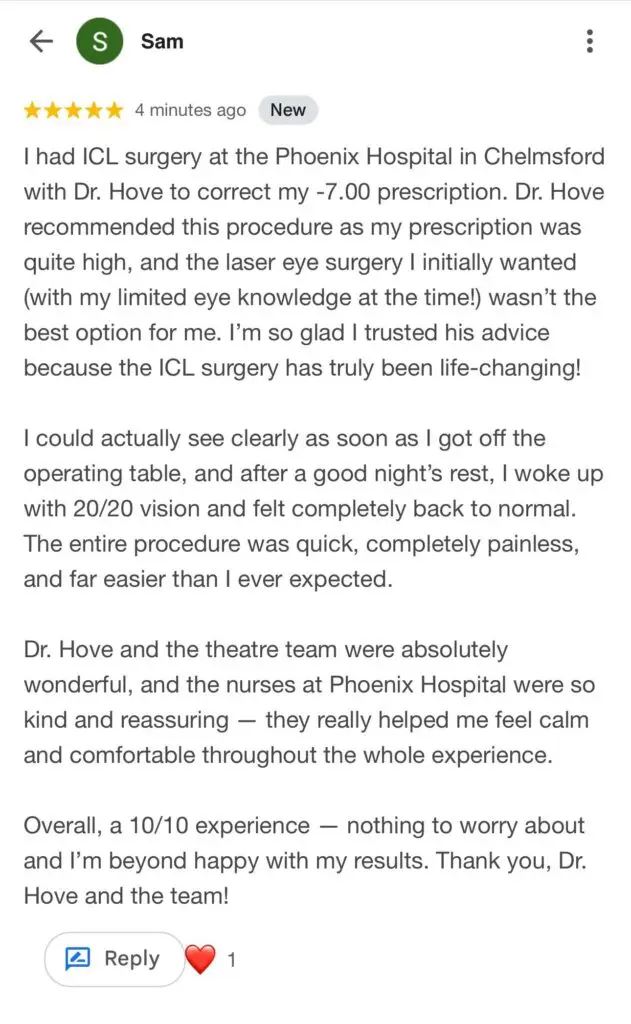
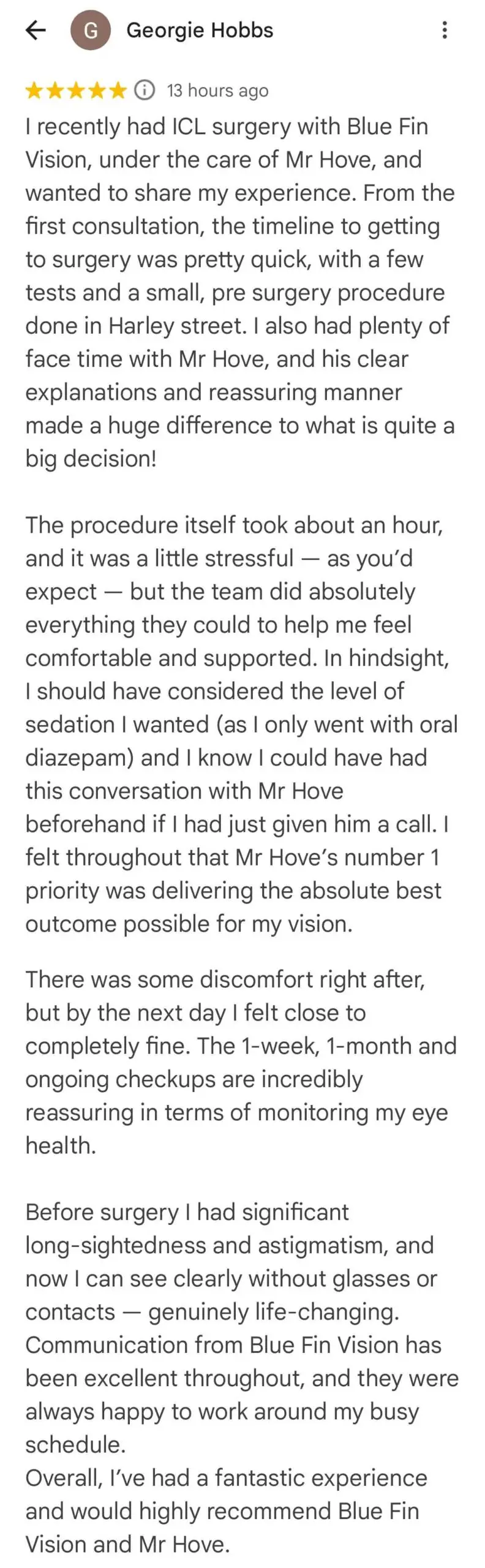
Clarity Restored Overnight
A Surgeon's Perspective
“The technology is only as good as the follow-up around it. We size precisely, then we keep measuring, because a lens that performs beautifully on day one still deserves attention years later.” , Mr Mfazo Hove, Consultant Ophthalmic Surgeon
The Clinical Takeaway
In 2026, the best ICL surgery in London is defined less by the operation and more by the measurement around it: precise sizing before, and a defined, lifelong monitoring protocol after, delivered by top specialists. That is the model Blue Fin Vision® has built.
Common Questions
How long does ICL aftercare last, and what does it include?
At Blue Fin Vision® it lasts for the life of the implant: annual vault and endothelial cell scans, and laser enhancement where clinically appropriate with your original consultant at no cost, all under the ICL Lifetime Monitoring Protocol™. Where cataract surgery is clinically required after an ICL, it is provided at no cost within two years and half price from years two to ten, subject to the protocol terms.
What is a good ICL vault, and why does it matter?
The vault is the small gap between the ICL and your natural lens. A vault that is too high or too low can cause problems, which is why accurate sizing beforehand and yearly checks afterwards both matter. An optimal vault is generally in the region of 250 to 750 microns.
Is cataract still a consideration after modern ICL surgery?
Cataract is the main long-term consideration after any ICL, though modern central-port lenses have reduced this, and cataract is in any case a normal part of ageing. Blue Fin Vision® plans for it directly through its cataract-cost commitment.
Explore More at Blue Fin Vision®
References
- Packer M. The Implantable Collamer Lens with a central port: review of the literature. Clin Ophthalmol. 2018;12:2427-2438.
- Shimizu K, Kamiya K, Igarashi A, Shiratani T. Early clinical outcomes of implantation of posterior chamber phakic intraocular lens with a central hole (Hole ICL) for moderate to high myopia. Br J Ophthalmol. 2012;96(3):409-412.
- Montes-Mico R, Ruiz-Mesa R, Rodriguez-Prats JL, Tana-Rivero P. Posterior-chamber phakic implantable collamer lenses with a central port: a review. Acta Ophthalmol. 2021;99(3):e288-e301.
- Igarashi A, Shimizu K, Kamiya K. Eight-year follow-up of posterior chamber phakic intraocular lens implantation for moderate to high myopia. Am J Ophthalmol. 2014;157(3):532-539.
- Kamiya K, Shimizu K, Igarashi A, Hikita F, Komatsu M. Four-year follow-up of implantable collamer lens implantation for moderate to high myopia. Arch Ophthalmol. 2009;127(7):845-850.
- Yang W, Zhao J, Sun L, Zhao J, Niu L, Wang X, Zhou X. Four-year observation of the changes in corneal endothelium cell density and correlated factors after implantable collamer lens V4c implantation. Br J Ophthalmol. 2021;105(5):625-630.
ABOUT THE AUTHOR
Mr Mfazo Hove
Consultant Ophthalmic Surgeon
MBChB MD FRCOphth CertLRS
Mr Mfazo Hove is a Consultant Ophthalmic Surgeon with experience spanning more than 57,000 procedures. He completed 6.5 years of specialist training at Moorfields Eye Hospital and served for five years as a consultant at the Western Eye Hospital, Imperial College Healthcare NHS Trust. He is the founder of Blue Fin Vision®, a consultant-led private ophthalmology practice operating across London, Essex, and Hertfordshire. His clinical expertise encompasses advanced cataract surgery, refractive lens replacement, laser vision correction, and implantable Collamer lenses (ICL).
A ZEISS Key Opinion Leader, Mr Hove is a respected international speaker with five invited engagements across seven cities in 2026:
- ZEISS China tour (Changsha, Shanghai, and Hangzhou, April – ZEISS APAC User Meeting)
- RCOphth Annual Congress – May – Manchester
- ZEISS EMEA User Meeting (Istanbul)
- ZEISS Lausanne User Meeting (Lausanne)
- European Society of Cataract and Refractive Surgeons Annual Congress (ESCRS, London)