
- Medically Reviewed by: Mr Mfazo Hove, Consultant Ophthalmic Surgeon
- Author: Mr Mfazo Hove
- Published: August 29, 2025
- Last Updated: September 22, 2026
TL;DR: The main signs you need YAG laser capsulotomy include gradually returning cloudy vision, difficulty reading, increased glare, ghost images and a decline in overall visual quality. However, these symptoms do not confirm posterior capsule opacification, so a clinical assessment is needed to identify the cause.
5 Signs That May Need YAG Laser Capsulotomy
Posterior capsule opacification (PCO), which is clouding of the thin lens capsule behind the artificial lens, is the most common longer-term reason for reduced vision after uncomplicated cataract surgery.¹
The symptoms below warrant assessment. They do not by themselves prove that YAG laser capsulotomy is required because other eye conditions can produce similar complaints.
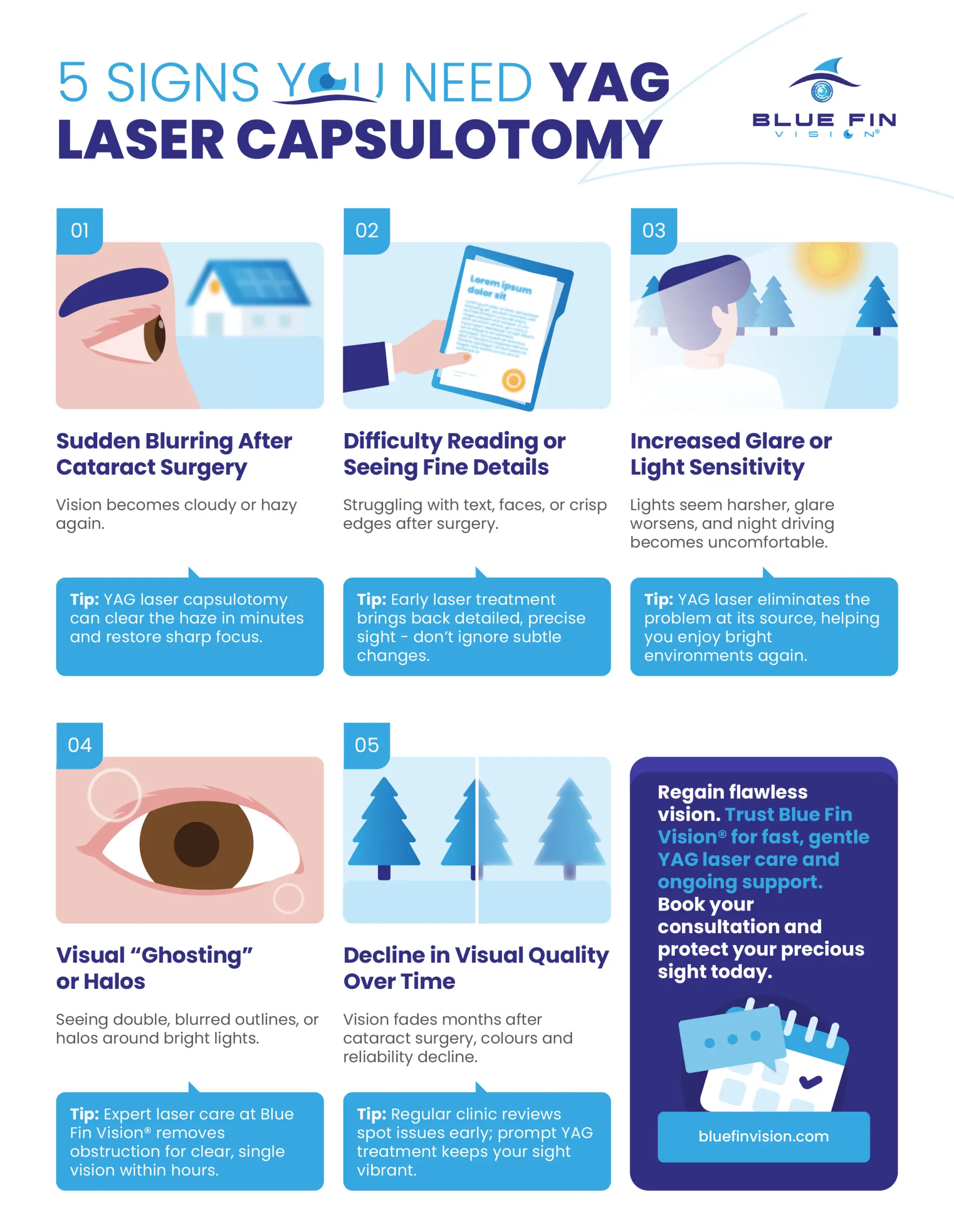
Infographic: 5 Signs Its Time for YAG Laser Eye Treatment
1. Gradual Return of Cloudy or Blurred Vision
After a period of good clarity following cataract surgery, vision may slowly become hazy again.
This may be caused by progressive thickening or fibrosis, meaning scar-like tissue, affecting the posterior capsule behind the artificial lens.
Other possible causes include:
- Dry eye, where the eye does not produce enough tears or the tears evaporate too quickly
- Corneal disease affecting the clear front surface of the eye
- Macular disease affecting the central part of the retina
- Glaucoma, a group of conditions that can damage the optic nerve
- Residual refractive error, meaning a remaining glasses prescription after surgery
A clinical examination is required to determine the cause.

2. Difficulty with Reading or Fine Detail
Tasks that were easy after surgery, such as reading small print or seeing sharp edges, become more difficult.
When posterior capsule opacification is responsible, creating an opening in the central posterior capsule can improve contrast and detail.²
3. Increased Glare and Light Sensitivity
Oncoming headlights or bright sunlight may produce bothersome glare or halos.
These symptoms may improve substantially when PCO is the cause and is treated.³

4. Visual Ghosting, Double Images or Halos
Some patients describe monocular ghosting, meaning a shadow or duplicate image seen through one eye.
This can be caused by light scattering through an irregularly opacified capsule, meaning a lens capsule that has become unevenly cloudy. The symptom may resolve when the irregular opacity is treated, but proper assessment is required because other causes exist.
5. Noticeable Decline in Overall Visual Quality
A gradual loss of the crisp vision achieved after cataract surgery can indicate developing PCO.
Treatment is considered when symptoms and clinical findings justify it, not merely because early opacity is visible.
Urgent Symptoms: Seek Prompt Assessment
The following symptoms are not typical of gradual PCO and should not wait for a routine YAG laser capsulotomy appointment:
- Sudden flashes of light
- A shower of new floaters
- A curtain or shadow in the vision
- Rapid visual loss
How Suitability for YAG Laser Capsulotomy Is Assessed
At Blue Fin Vision®, every patient receives a macular optical coherence tomography (OCT) scan at no additional charge before any YAG laser capsulotomy treatment. This is a detailed scan of the macula, the central part of the retina responsible for detailed vision.
The scan is interpreted alongside a full clinical examination.
Many patients notice improvement once the dilating drops, which temporarily enlarge the pupil, wear off. However, the degree of improvement depends on whether other eye conditions are also affecting vision.
Discuss YAG Laser Capsulotomy with Blue Fin Vision®
If these symptoms sound familiar, book a paid, consultant-led consultation with Blue Fin Vision® in London, Hertfordshire or Essex.
Your consultant will assess whether posterior capsule opacification is causing your symptoms and discuss whether YAG laser capsulotomy is appropriate.
References
- Donachie PHJ, Barnes BL, Olaitan M, Sparrow JM, Buchan JC. The Royal College of Ophthalmologists’ National Ophthalmology Database study of cataract surgery: report 9, risk factors for posterior capsule opacification. Eye (Lond). 2023;37(8):1633-1639.
- Karahan E, Er D, Kaynak S. An overview of Nd:YAG laser capsulotomy. Med Hypothesis Discov Innov Ophthalmol. 2014;3(2):45-50.
- Aslam TM, Devlin H, Dhillon B. Use of Nd:YAG laser capsulotomy. Surv Ophthalmol. 2003;48(6):594-612.
ABOUT THE AUTHOR
Mr Mfazo Hove
Consultant Ophthalmic Surgeon
MBChB MD FRCOphth CertLRS
Mr Mfazo Hove is a Consultant Ophthalmic Surgeon with experience spanning more than 57,000 procedures. He completed 6.5 years of specialist training at Moorfields Eye Hospital and served for five years as a consultant at the Western Eye Hospital, Imperial College Healthcare NHS Trust. He is the founder of Blue Fin Vision®, a consultant-led private ophthalmology practice operating across London, Essex, and Hertfordshire. His clinical expertise encompasses advanced cataract surgery, refractive lens replacement, laser vision correction, and implantable Collamer lenses (ICL).
A ZEISS Key Opinion Leader, Mr Hove is a respected international speaker with five invited engagements across seven cities in 2026:
- ZEISS China tour (Changsha, Shanghai, and Hangzhou, April – ZEISS APAC User Meeting)
- RCOphth Annual Congress – May – Manchester
- ZEISS EMEA User Meeting (Istanbul)
- ZEISS Lausanne User Meeting (Lausanne)
- European Society of Cataract and Refractive Surgeons Annual Congress (ESCRS, London)