



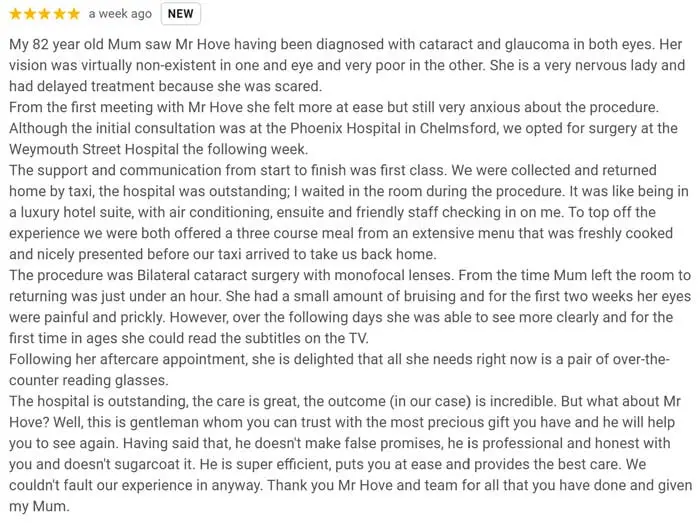
The Review, in the Patient Family’s Own Words
“My 82 year old Mum saw Mr Hove having been diagnosed with cataract and glaucoma in both eyes. Her vision was virtually non-existent in one and eye and very poor in the other. She is a very nervous lady and had delayed treatment because she was scared.
From the first meeting with Mr Hove she felt more at ease but still very anxious about the procedure.
Although the initial consultation was at the Phoenix Hospital in Chelmsford, we opted for surgery at the Weymouth Street Hospital the following week.
The support and communication from start to finish was first class. We were collected and returned home by taxi, the hospital was outstanding; I waited in the room during the procedure. It was like being in a luxury hotel suite, with air conditioning, ensuite and friendly staff checking in on me. To top off the experience we were both offered a three course meal from an extensive menu that was freshly cooked and nicely presented before our taxi arrived to take us back home.
The procedure was Bilateral cataract surgery with monofocal lenses. From the time Mum left the room to returning was just under an hour. She had a small amount of bruising and for the first two weeks her eyes were painful and prickly. However, over the following days she was able to see more clearly and for the first time in ages she could read the subtitles on the TV.
Following her aftercare appointment, she is delighted that all she needs right now is a pair of over-the-counter reading glasses.
The hospital is outstanding, the care is great, the outcome (in our case) is incredible. But what about Mr Hove? Well, this is gentleman whom you can trust with the most precious gift you have and he will help you to see again. Having said that, he doesn’t make false promises, he is professional and honest with you and doesn’t sugarcoat it. He is super efficient, puts you at ease and provides the best care. We couldn’t fault our experience in anyway. Thank you Mr Hove and team for all that you have done and given my Mum.”
Case at a Glance
- Age: 82
- Procedure: immediately sequential bilateral cataract surgery
- Implants: monofocal intraocular lenses, distance targeted
- Theatre episode: under one hour from leaving the room to returning, both eyes
- Early findings: small amount of periocular bruising
- Symptom course: painful and prickly eyes for approximately two weeks
- Visual recovery: progressive improvement over the first days
- Final status: distance vision restored, over-the-counter reading glasses only
- Surgeon: Mr Mfazo Hove, Blue Fin Vision®
Clinical Commentary
Why Both Eyes on the Same Day
Immediately sequential bilateral cataract surgery means both eyes are operated on during a single theatre episode, as two entirely separate procedures.
The two eyes never share anything. Separate sterile instrument sets, separate consumables drawn from different manufacturing batches, separate viscoelastic and irrigating solutions, complete regowning and regloving, and separately prepared intracameral antibiotic. This is the standard that makes the approach defensible, and published series and economic analyses of immediately sequential bilateral cataract surgery have not demonstrated an increased rate of postoperative endophthalmitis when it is followed.¹ ²
For an 82-year-old, the advantages are substantial. One anaesthetic episode. One journey. One recovery. No interval of significant anisometropia between an operated and an unoperated eye, which is itself a falls hazard in a patient whose vision is already poor.
What “Just Under an Hour” Actually Means
The family recorded the time from their room and back: under an hour for both eyes.
That figure is a theatre process outcome, not a measure of rushing. Modern phacoemulsification through a sub-3mm incision is a short operation in experienced hands, and the efficiency gains come from sequencing, instrument preparation and elimination of dead time between steps rather than from operating faster inside the eye.
The clinical argument for efficiency is not convenience. It is that shorter intraocular time and lower cumulative dissipated ultrasound energy mean less corneal endothelial cell loss, less postoperative corneal oedema and less anterior chamber inflammation. In an 82-year-old with an already reduced endothelial cell reserve, that is a meaningful advantage. This is the reasoning that underpins the 4-Minute Phaco™ framework.
The Bruising
A small amount of bruising is a common and benign finding. It usually reflects one of two things.
Subconjunctival haemorrhage. A flat red patch on the white of the eye, caused by a small conjunctival vessel bleeding during speculum placement or instrument handling. It looks alarming and is entirely harmless. It absorbs over one to two weeks and passes through the same colour changes as any bruise.
Periocular bruising. Faint discolouration of the eyelid skin, seen more often where a local anaesthetic injection has been used, and more readily in older patients and in those on anticoagulants or antiplatelet agents, which is a large proportion of this age group.
Neither affects the visual outcome. Neither requires treatment. Both are worth predicting in advance, because a patient who wakes to a blood-red eye and has not been warned assumes the worst.
The Two Weeks of Painful and Prickly Eyes
This is the most useful part of the review, because it is the part most cataract content omits.
Grittiness, foreign body sensation, prickling, watering, light sensitivity and fluctuating vision are normal after cataract surgery. They arise from a combination of corneal incisions healing across superficial corneal nerves, transient ocular surface inflammation and, in many patients, a temporary worsening of pre-existing dry eye. Dry eye following cataract surgery is well documented, is more common in older patients and in those with pre-existing ocular surface disease, and typically peaks within the first weeks before settling.³
Preserved topical medication contributes. Benzalkonium chloride, present in many conventional postoperative drops, is toxic to the ocular surface epithelium with repeated exposure, which is one reason why patients on multiple preserved drops, including long-term glaucoma therapy as in this case, often have the most symptomatic recoveries.⁴
Two things follow from this.
First, two weeks is within the normal range but is towards the longer end. Most patients are comfortable within a few days to a fortnight. Saying so honestly is more useful than claiming a pain-free recovery.
Second, this is a modifiable problem. Preservative-free lubricants, treatment of the ocular surface before surgery rather than after, and where clinically appropriate a dropless pathway using intraocular delivery of medication at the time of surgery, all reduce this burden. In a glaucoma patient already using preserved drops long term, the ocular surface deserves specific attention rather than being treated as background noise.
The Visual Timeline
Recovery after cataract surgery is not linear, and patients should expect the following pattern rather than a steady climb.
Day of surgery. Vision is typically hazy and light sensitive. Some patients see well immediately, most do not, and neither is predictive of the final result.
First few days. Corneal oedema settles and colours become noticeably brighter and cooler. Patients often describe whites looking blue or newly clean. This is the removal of a yellowed natural lens, not a change in the world. This patient described seeing more clearly over the following days.
One to two weeks. Functional distance vision is generally established. This is the point at which this patient read television subtitles for the first time in years.
Two to six weeks. Inflammation resolves, the incisions seal fully and refraction stabilises. Vision may fluctuate through the day, particularly with a dry ocular surface.
Aftercare appointment and beyond. Refraction is checked once settled and a spectacle prescription is issued. This patient needed only over-the-counter reading glasses, which is the expected outcome of distance-targeted monofocal implants.
Final spectacles should not be purchased before this point. National guidance on the management of cataracts in adults sets out the postoperative review and information patients should be given after surgery.⁷
Why Monofocal Lenses Were the Right Implant Here
The review lists the implant as monofocal, and that choice was deliberate rather than default.
This patient had glaucoma in both eyes. Diffractive multifocal and trifocal lenses split incoming light between focal points and reduce contrast sensitivity, and significant glaucomatous optic neuropathy is recognised in consensus guidance as a relative contraindication to multifocal implantation.⁵ A monofocal lens preserves contrast, performs predictably if the glaucoma requires future surgical intervention, and delivers exactly the outcome recorded here.
The trade is reading glasses, and that trade was agreed before surgery.
The Outcome Data Behind the Recovery
- More than 57,000 procedures performed.
- Six consecutive years of published National Ophthalmology Database outcome data.
- Posterior capsule rupture rate of approximately 0.2%, against a national benchmark of approximately 0.69%.⁶
Posterior capsule rupture is the complication most likely to alter a recovery of this kind, because it is associated with a longer and more complicated postoperative course. Dense cataracts, as this patient had, carry a higher baseline risk of it.⁶
What This Case Demonstrates
- Bilateral same-day cataract surgery is appropriate and advantageous in selected elderly patients.
- Efficiency in theatre is a clinical variable, not a commercial one, because it reduces intraocular energy and postoperative inflammation.
- Bruising and two weeks of ocular surface discomfort are within the normal range and should be predicted rather than explained retrospectively.
- Visual recovery is progressive and fluctuating, not immediate.
- Distance-targeted monofocal lenses produce excellent satisfaction when reading glasses are counselled in advance.
What This Case Does Not Promise
This is a single patient’s recovery, published in full including the uncomfortable parts.
Recovery timelines vary widely. Some patients see well the following morning. Others take several weeks, particularly where the cataract was dense, the eye was inflamed beforehand or the ocular surface was already compromised. A recovery that is slower than this one is not necessarily an abnormal recovery.
Immediately sequential bilateral cataract surgery is not suitable for every patient and is offered following individual assessment.
Any increasing pain, reducing vision or worsening redness after cataract surgery requires urgent assessment and should never be managed by waiting.
Visual outcome is limited by the health of the optic nerve and retina. In eyes with glaucoma, macular disease or other coexisting pathology, the achievable result is determined by those structures.
Nothing on this page constitutes medical advice or a prediction for any individual. Suitability, risk and expected outcome can only be established at consultation with full examination and biometry.
References
- Arshinoff SA, Bastianelli PA. Incidence of postoperative endophthalmitis after immediate sequential bilateral cataract surgery. J Cataract Refract Surg. 2011;37(12):2105-2114.
- Malvankar-Mehta MS, Filek R, Iqbal M, Amone M, Hodge WG, Malvankar MG. Immediately sequential bilateral cataract surgery: a cost-effective procedure. Can J Ophthalmol. 2013;48(6):482-488.
- Kasetsuwan N, Satitpitakul V, Changul T, Jariyakosol S. Incidence and pattern of dry eye after cataract surgery. PLoS One. 2013;8(11):e78657.
- Baudouin C, Labbé A, Liang H, Pauly A, Brignole-Baudouin F. Preservatives in eyedrops: the good, the bad and the ugly. Prog Retin Eye Res. 2010;29(4):312-334.
- Braga-Mele R, Chang D, Dewey S, Foster G, Henderson BA, Hill W, Hoffman R, Little B, Mamalis N, Oetting T, Serafano D, Talley-Rostov A, Vasavada A, Yoo S. Multifocal intraocular lenses: relative indications and contraindications for implantation. J Cataract Refract Surg. 2014;40(2):313-322.
- Day AC, Donachie PHJ, Sparrow JM, Johnston RL. The Royal College of Ophthalmologists’ National Ophthalmology Database study of cataract surgery: report 1, visual outcomes and complications. Eye (Lond). 2015;29(4):552-560.
- National Institute for Health and Care Excellence. Cataracts in adults: management. NICE guideline NG77. London: National Institute for Health and Care Excellence; 2017.
Related Pages
All five pages below are drawn from the same documented case.
- My 82-Year-Old Mum Delayed Cataract Surgery Because She Was Too Scared
- From Virtually No Vision To Reading TV Subtitles Again
- “He Doesn’t Sugarcoat It”: Why Honesty Reassured My Nervous Mum
- Helping An Elderly Parent Through Cataract Surgery: One Daughter’s Story
- Bilateral Cataract Surgery At 82: Recovery, Results And What To Expect


