



The Review, in the Patient Family’s Own Words
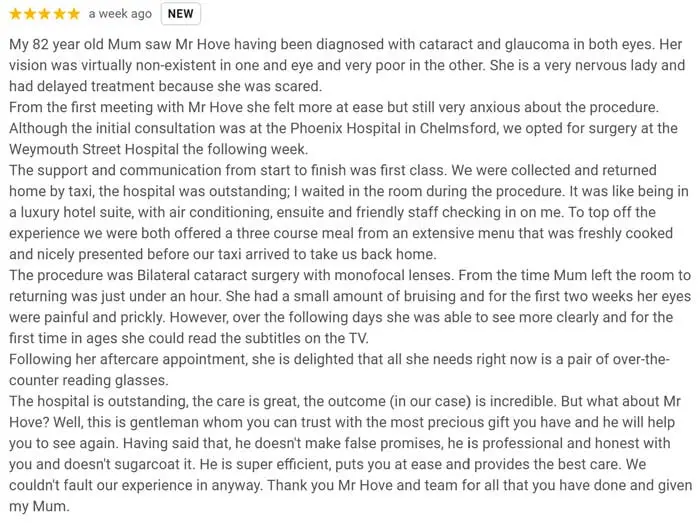
“My 82 year old Mum saw Mr Hove having been diagnosed with cataract and glaucoma in both eyes. Her vision was virtually non-existent in one and eye and very poor in the other. She is a very nervous lady and had delayed treatment because she was scared.
From the first meeting with Mr Hove she felt more at ease but still very anxious about the procedure.
Although the initial consultation was at the Phoenix Hospital in Chelmsford, we opted for surgery at the Weymouth Street Hospital the following week.
The support and communication from start to finish was first class. We were collected and returned home by taxi, the hospital was outstanding; I waited in the room during the procedure. It was like being in a luxury hotel suite, with air conditioning, ensuite and friendly staff checking in on me. To top off the experience we were both offered a three course meal from an extensive menu that was freshly cooked and nicely presented before our taxi arrived to take us back home.
The procedure was Bilateral cataract surgery with monofocal lenses. From the time Mum left the room to returning was just under an hour. She had a small amount of bruising and for the first two weeks her eyes were painful and prickly. However, over the following days she was able to see more clearly and for the first time in ages she could read the subtitles on the TV.
Following her aftercare appointment, she is delighted that all she needs right now is a pair of over-the-counter reading glasses.
The hospital is outstanding, the care is great, the outcome (in our case) is incredible. But what about Mr Hove? Well, this is gentleman whom you can trust with the most precious gift you have and he will help you to see again. Having said that, he doesn’t make false promises, he is professional and honest with you and doesn’t sugarcoat it. He is super efficient, puts you at ease and provides the best care. We couldn’t fault our experience in anyway. Thank you Mr Hove and team for all that you have done and given my Mum.”
Case at a Glance
- Patient: 82-year-old woman, bilateral cataract and glaucoma
- Review author: the patient’s daughter
- Consultation site: Phoenix Hospital, Chelmsford
- Surgery site: Weymouth Street Hospital, London, one week later
- Transport: taxi collection and return, arranged as part of the pathway
- Escort: daughter present throughout, waited in the patient’s room
- Time away from the room: just under one hour, covering both eyes
- Surgeon: Mr Mfazo Hove, Blue Fin Vision®
Clinical Commentary
The Person Making the Decision Is Often Not the Patient
This review was written by a daughter, not a patient, and that is a great deal more common than published ophthalmology content reflects.
In older patients, and particularly in those whose vision has already deteriorated to the point of dependence, the adult child is frequently the person who researches the surgeon, books the consultation, arranges the transport, attends the appointment, administers the drops and manages the fortnight afterwards. They carry the decision. They also carry the responsibility if it goes badly, which is why they arrive at the first consultation with a different set of questions from the patient.
I consult with that reality in mind. The patient is my patient, and her decision is hers alone, but the person beside her is doing real work and needs real information.
Where The Family Sits in the Consent Process
An adult child accompanying a parent is not a proxy decision-maker. A patient with capacity makes her own decision, and capacity is presumed unless there is reason to question it. The General Medical Council’s guidance is explicit that the exchange of information should be directed to the patient, with others involved as the patient wishes.¹
What the accompanying family member legitimately provides is different and valuable:
- Corroborated functional history. Families see what patients minimise. Patients say they manage. Daughters say she has stopped cooking, stopped going out and had two near falls on the stairs.
- A second memory. Anxious patients retain very little of a consultation. Someone else hearing the risk discussion materially improves informed consent in practice, not just on paper.
- Practical delivery of the aftercare. Drops, appointments, transport and lifting restrictions all depend on someone at home.
I therefore encourage patients to bring the family member who will be doing the aftercare, and I direct part of the discussion to them explicitly.
What The Escort Should Actually Expect on the Day
Most anxiety in a family member comes from not knowing the shape of the day. For this pathway it looks like this.
Transport. Taxi collection from home and return afterwards, arranged as part of the surgical package. This matters more than it sounds. The patient cannot drive afterwards, public transport is impractical with dilated pupils and a shielded eye and removing that logistical burden removes one of the commonest practical reasons families delay booking.
The room. The escort waits in the patient’s own room rather than a communal waiting area. This family described it as being like a luxury hotel suite, with air conditioning, ensuite facilities and staff checking in. The clinical point beneath the comfort is that the patient returns to a familiar room with a familiar face, rather than to a recovery bay.
Duration. Just under one hour from leaving the room to returning, covering both eyes. Efficiency here is a function of theatre process and surgical technique, not haste. Shorter intraocular time means less endothelial stress, less inflammation and a faster settling period, which is the objective the 4-Minute Phaco™ framework was built around.
Afterwards. A meal before discharge, offered to both patient and escort. An elderly patient who has fasted, been anxious all morning and undergone two procedures should not travel home hypoglycaemic and dehydrated.
The Specific Job of the Person at Home
The fortnight after surgery is largely delivered by the family, and it is worth being direct about what that involves.
Eye drops. Conventional cataract aftercare involves a tapering regimen of anti-inflammatory and antibiotic drops over several weeks. In older patients, drop technique, tremor, arthritis and memory are all genuine obstacles, and poor compliance is a real clinical risk. Where appropriate, Blue Fin Vision® offers a dropless pathway using intraocular delivery of medication at the time of surgery, which removes or substantially reduces this burden. For families managing an elderly parent at a distance, that single change can be the difference between a smooth recovery and a fortnight of anxiety.
Recognising normal from abnormal. Grittiness, watering, mild bruising, light sensitivity and fluctuating vision are expected. Increasing pain, decreasing vision or a red eye that is getting worse rather than better are not, and require same-day contact. Every family leaves with that distinction written down and a direct route back to the team.
Practical adjustments. Trip hazards matter enormously in the first fortnight in an elderly patient whose vision, depth perception and spectacle prescription are all changing at once. Cataract surgery reduces falls over the medium term, with randomised evidence of benefit in older women after both first and second eye surgery, but the immediate postoperative period is a transitional one.² ³
Why Both Eyes on the Same Day Suits This Group Particularly Well
For an 82-year-old travelling from Essex to central London with a family escort, immediately sequential bilateral cataract surgery halves the number of hospital journeys, halves the number of days of leave the family needs, and avoids a period of significant anaesthetic imbalance between a treated and an untreated eye, which is itself a falls risk. National guidance on the management of cataracts in adults recognises immediately sequential bilateral surgery as an option for selected patients.⁶
The safety basis for this is not informal. Both eyes are treated as entirely separate operations: separate instrument sets, separate consumables from different manufacturing batches, separate gowning and gloving, and separate intracameral antibiotic preparation. Published series and registry data on immediately sequential bilateral cataract surgery have not shown an increased rate of postoperative endophthalmitis where these precautions are followed.⁴ ⁵
What This Case Demonstrates
- The decision-maker in elderly cataract care is frequently an adult child, and the pathway should be designed for both people.
- Practical logistics, transport, a private room and a meal are not luxuries in this group. They remove the real barriers that cause delay.
- Family presence improves the quality of consent in practice by providing corroborated history and a second memory of the risk discussion.
- Aftercare is delivered at home, by relatives, and should be designed around that fact.
- Bilateral same-day surgery meaningfully reduces the burden on families travelling with an elderly relative.
What This Case Does Not Promise
This describes one family’s experience of one pathway. Facilities, room provision, transport arrangements and catering vary between the Blue Fin Vision® sites and between procedure packages and should be confirmed at the point of booking.
Immediately sequential bilateral cataract surgery is not appropriate for every patient. Suitability depends on ocular anatomy, comorbidity, the predictability of the first eye and the patient’s own preference, and some patients are better served by staged surgery.
The dropless pathway is not suitable for all eyes and is offered on clinical assessment rather than on request.
A patient with capacity makes her own decision. Nothing in this page should be read as suggesting that a family member can consent on behalf of an adult who is able to consent for herself.
References
- General Medical Council. Decision making and consent. Manchester: General Medical Council; 2020.
- Harwood RH, Foss AJE, Osborn F, Gregson RM, Zaman A, Masud T. Falls and health status in elderly women following first eye cataract surgery: a randomised controlled trial. Br J Ophthalmol. 2005;89(1):53-59.
- Foss AJE, Harwood RH, Osborn F, Gregson RM, Zaman A, Masud T. Falls and health status in elderly women following second eye cataract surgery: a randomised controlled trial. Age Ageing. 2006;35(1):66-71.
- Arshinoff SA, Bastianelli PA. Incidence of postoperative endophthalmitis after immediate sequential bilateral cataract surgery. J Cataract Refract Surg. 2011;37(12):2105-2114.
- Malvankar-Mehta MS, Filek R, Iqbal M, Amone M, Hodge WG, Malvankar MG. Immediately sequential bilateral cataract surgery: a cost-effective procedure. Can J Ophthalmol. 2013;48(6):482-488.
- National Institute for Health and Care Excellence. Cataracts in adults: management. NICE guideline NG77. London: National Institute for Health and Care Excellence; 2017.
Related Pages
All five pages below are drawn from the same documented case.
- My 82-Year-Old Mum Delayed Cataract Surgery Because She Was Too Scared
- From Virtually No Vision To Reading TV Subtitles Again
- “He Doesn’t Sugarcoat It”: Why Honesty Reassured My Nervous Mum
- Helping An Elderly Parent Through Cataract Surgery: One Daughter’s Story
- Bilateral Cataract Surgery At 82: Recovery, Results And What To Expect


