



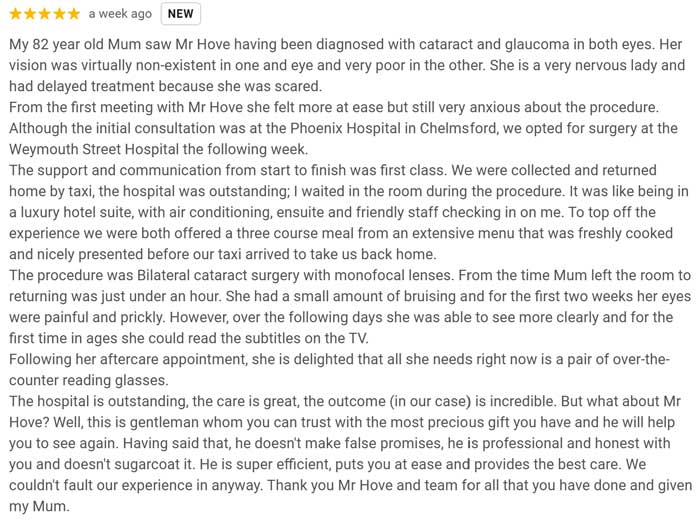
The Review, in the Patient Family’s Own Words
“My 82 year old Mum saw Mr Hove having been diagnosed with cataract and glaucoma in both eyes. Her vision was virtually non-existent in one and eye and very poor in the other. She is a very nervous lady and had delayed treatment because she was scared.
From the first meeting with Mr Hove she felt more at ease but still very anxious about the procedure.
Although the initial consultation was at the Phoenix Hospital in Chelmsford, we opted for surgery at the Weymouth Street Hospital the following week.
The support and communication from start to finish was first class. We were collected and returned home by taxi, the hospital was outstanding; I waited in the room during the procedure. It was like being in a luxury hotel suite, with air conditioning, ensuite and friendly staff checking in on me. To top off the experience we were both offered a three course meal from an extensive menu that was freshly cooked and nicely presented before our taxi arrived to take us back home.
The procedure was Bilateral cataract surgery with monofocal lenses. From the time Mum left the room to returning was just under an hour. She had a small amount of bruising and for the first two weeks her eyes were painful and prickly. However, over the following days she was able to see more clearly and for the first time in ages she could read the subtitles on the TV.
Following her aftercare appointment, she is delighted that all she needs right now is a pair of over-the-counter reading glasses.
The hospital is outstanding, the care is great, the outcome (in our case) is incredible. But what about Mr Hove? Well, this is gentleman whom you can trust with the most precious gift you have and he will help you to see again. Having said that, he doesn’t make false promises, he is professional and honest with you and doesn’t sugarcoat it. He is super efficient, puts you at ease and provides the best care. We couldn’t fault our experience in anyway. Thank you Mr Hove and team for all that you have done and given my Mum.”
Case at a Glance
- Age: 82
- Diagnosis: bilateral cataract with coexisting glaucoma
- Presenting vision: virtually absent in one eye, very poor in the fellow eye
- Barrier to treatment: fear. Treatment delayed by the patient herself
- Consultation: Phoenix Hospital, Chelmsford
- Surgery: Weymouth Street Hospital, the following week
- Procedure: immediately sequential bilateral cataract surgery, monofocal intraocular lenses
- Outcome: functional distance vision restored. Over-the-counter reading glasses only
- Surgeon: Mr Mfazo Hove, Blue Fin Vision®
Clinical Commentary
Fear Is a Clinical Finding, Not A Character Flaw
The single most important sentence in this review is not about the outcome. It is this: she had delayed treatment because she was scared.
In my practice, fear is the most common reason a cataract is dense by the time I see it. It is not vanity, it is not stubbornness, and it is not a failure of understanding. It is a rational response to the idea of an operation on an organ the patient cannot afford to lose. I record it, I address it, and I plan around it, in exactly the way I would record intraocular pressure or corneal endothelial status.
What this family describes is the intended sequence. She arrived frightened. She left the first consultation more at ease but still very anxious. That is an honest description of what a single consultation can and cannot achieve. It does not abolish anxiety. It converts unstructured dread into a specific, manageable set of expectations.
What Delay Actually Costs
Delaying cataract surgery is not neutral. Three things happen while a patient waits.
The lens hardens. A denser nucleus requires more ultrasound energy, longer phacoemulsification time and greater manipulation within the eye. Dense and mature cataracts are consistently associated with a higher rate of posterior capsule rupture in national outcome data.¹ The operation that would have been straightforward two years earlier becomes a more demanding one.
Function collapses faster than acuity suggests. This patient reached the point of virtually no vision in one eye. By then, the losses are not measured on a letter chart. They are measured in the things that stopped: reading, television, cooking, confidence outside the house.
Falls risk rises. Randomised trial evidence has shown a reduction in the rate of falls in older women following first eye cataract surgery, with further functional benefit after second eye surgery.² ³ In an 82-year-old, a fractured neck of femur is a life-changing event. Cataract surgery in this age group is, among other things, a falls intervention.
The current NICE guideline is explicit that access to cataract surgery should not be restricted on the basis of visual acuity thresholds alone, and that the impact on the person’s quality of life should drive the decision.⁴ Waiting until vision is virtually non-existent is the wrong threshold, whether the delay is imposed by a system or, as here, chosen out of fear.
Why The Consultation Matters More Than the Operation
For a frightened patient, the consultation is the intervention. The operation is the easy part.
What changes fear is specificity. Not reassurance, specificity. A patient who has been told precisely what she will feel, what she will see, how long it will take, who will be beside her and what the first fortnight will be like has something to hold on to. A patient who has been told only that it will be fine has nothing.
So the consultation covers, in order: what the eye actually looks like on examination and why surgery is now indicated; what anaesthesia means in practice; what the experience is minute by minute; what the realistic visual result is, including the glasses she will still need; and what the specific risks are for her eyes, not for an average eye.
What Cataract Surgery Actually Feels Like
This is the part almost every anxious patient has wrong.
Cataract surgery at Blue Fin Vision® is performed under local anaesthesia, most commonly topical anaesthetic drops, with the patient awake and comfortable throughout. There is no general anaesthetic in the great majority of cases, which matters considerably in an 82-year-old with the usual comorbidities of that age.
The patient does not see the instruments. She sees a bright light and some movement and colour. She is asked to lie still and look at a light. She can hear, speak and be spoken to throughout. Discomfort, where it occurs, is usually a sensation of pressure rather than pain. The eye is not removed from the socket, a myth I correct in clinic several times a month.
For this patient, the interval between leaving her room and returning to her daughter was just under an hour, and that hour covered both eyes.
Why Coexisting Glaucoma Shaped the Plan
This patient did not have a simple cataract. She had cataract and glaucoma in both eyes, and that combination changes the decision-making.
Glaucoma damages the retinal nerve fibre layer and, with it, contrast sensitivity and peripheral field. Diffractive multifocal and trifocal intraocular lenses achieve a spectacle-independent range of vision by splitting incoming light between focal points, which carries an inherent reduction in contrast sensitivity. In an eye that has already lost contrast function to glaucoma, that trade is generally the wrong one, and established consensus guidance lists significant glaucomatous optic neuropathy among the relative contraindications to multifocal implantation.⁵
A monofocal lens was therefore the correct choice here, not a compromise. It preserves contrast, it behaves predictably if the glaucoma progresses and requires future surgery, and it delivers exactly what this patient wanted, which was to see across the room again. The reading glasses she now wears are the expected and openly counselled consequence of that choice, and they were discussed before surgery, not explained afterwards.
Cataract surgery also confers a modest reduction in intraocular pressure in many glaucomatous eyes, which is a secondary benefit rather than the primary indication.⁶
What This Case Demonstrates
- Fear, not clinical severity, is frequently the rate-limiting step in cataract care.
- A structured consultation can convert refusal into consent within a single visit, without pressure and without overpromising.
- Presentation at the point of near-total visual loss is avoidable, and avoiding it is a clinical objective in its own right.
- Coexisting glaucoma is not a barrier to excellent cataract outcomes. It is a reason to choose the lens deliberately.
- Interval from consultation to surgery was one week. For an 82-year-old who has already lost years to fear, that interval is itself part of the treatment.
What This Case Does Not Promise
This is one patient’s outcome, published in full and unedited, including the two weeks of painful and prickly eyes.
Cataract surgery outcomes vary with lens density, ocular surface health, corneal endothelial status, axial length, pupil behaviour, zonular integrity and the presence of coexisting disease such as glaucoma or macular pathology. An eye with advanced glaucomatous field loss has a ceiling on the vision cataract surgery can restore, and that ceiling is determined by the optic nerve, not by the surgeon.
Recovery periods vary. Two weeks of ocular surface irritation, as described here, is within the normal range but is longer than many patients experience. Refraction continues to settle for several weeks, which is why final spectacle prescriptions are not issued at the first postoperative visit.
Every patient at Blue Fin Vision® receives an individualised risk and outcome discussion based on their own biometry and their own examination findings. No two eyes are quoted the same numbers.
References
- Day AC, Donachie PHJ, Sparrow JM, Johnston RL. The Royal College of Ophthalmologists’ National Ophthalmology Database study of cataract surgery: report 1, visual outcomes and complications. Eye (Lond). 2015;29(4):552-560.
- Harwood RH, Foss AJE, Osborn F, Gregson RM, Zaman A, Masud T. Falls and health status in elderly women following first eye cataract surgery: a randomised controlled trial. Br J Ophthalmol. 2005;89(1):53-59.
- Foss AJE, Harwood RH, Osborn F, Gregson RM, Zaman A, Masud T. Falls and health status in elderly women following second eye cataract surgery: a randomised controlled trial. Age Ageing. 2006;35(1):66-71.
- National Institute for Health and Care Excellence. Cataracts in adults: management. NICE guideline NG77. London: National Institute for Health and Care Excellence; 2017.
- Braga-Mele R, Chang D, Dewey S, Foster G, Henderson BA, Hill W, Hoffman R, Little B, Mamalis N, Oetting T, Serafano D, Talley-Rostov A, Vasavada A, Yoo S. Multifocal intraocular lenses: relative indications and contraindications for implantation. J Cataract Refract Surg. 2014;40(2):313-322.
- National Institute for Health and Care Excellence. Glaucoma: diagnosis and management. NICE guideline NG81. London: National Institute for Health and Care Excellence; 2017.
Related Pages
All five pages below are drawn from the same documented case.
- My 82-Year-Old Mum Delayed Cataract Surgery Because She Was Too Scared
- From Virtually No Vision To Reading TV Subtitles Again
- “He Doesn’t Sugarcoat It”: Why Honesty Reassured My Nervous Mum
- Helping An Elderly Parent Through Cataract Surgery: One Daughter’s Story
- Bilateral Cataract Surgery At 82: Recovery, Results And What To Expect


