



Patient Experience
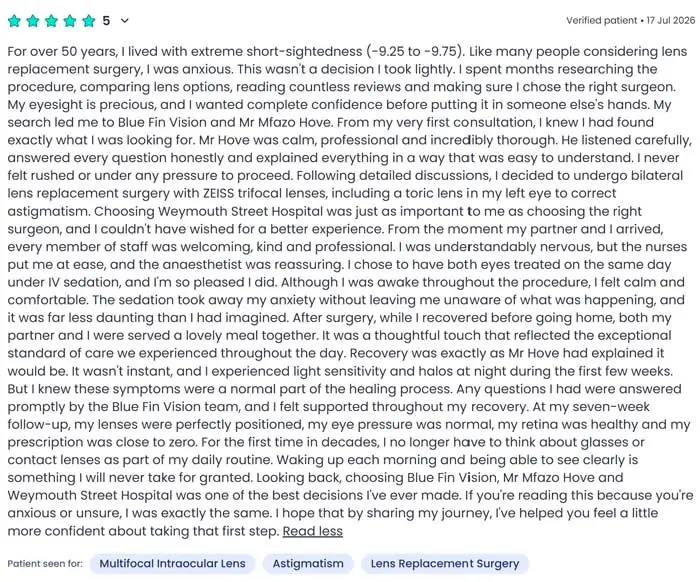
“For over 50 years, I lived with extreme short-sightedness (-9.25 to -9.75). Like many people considering lens replacement surgery, I was anxious. This wasn’t a decision I took lightly. I spent months researching the procedure, comparing lens options, reading countless reviews and making sure I chose the right surgeon. My eyesight is precious, and I wanted complete confidence before putting it in someone else’s hands.
My search led me to Blue Fin Vision® and Mr Mfazo Hove. From my very first consultation, I knew I had found exactly what I was looking for. Mr Hove was calm, professional and incredibly thorough. He listened carefully, answered every question honestly and explained everything in a way that was easy to understand. I never felt rushed or under any pressure to proceed.
Following detailed discussions, I decided to undergo bilateral lens replacement surgery with ZEISS trifocal lenses, including a toric lens in my left eye to correct astigmatism.
Choosing Weymouth Street Hospital was just as important to me as choosing the right surgeon, and I couldn’t have wished for a better experience. From the moment my partner and I arrived, every member of staff was welcoming, kind and professional. I was understandably nervous, but the nurses put me at ease, and the anaesthetist was reassuring.
I chose to have both eyes treated on the same day under IV sedation, and I’m so pleased I did. Although I was awake throughout the procedure, I felt calm and comfortable. The sedation took away my anxiety without leaving me unaware of what was happening, and it was far less daunting than I had imagined.
After surgery, while I recovered before going home, both my partner and I were served a lovely meal together. It was a thoughtful touch that reflected the exceptional standard of care we experienced throughout the day.
Recovery was exactly as Mr Hove had explained it would be. It wasn’t instant, and I experienced light sensitivity and halos at night during the first few weeks. But I knew these symptoms were a normal part of the healing process. Any questions I had were answered promptly by the Blue Fin Vision® team, and I felt supported throughout my recovery.
At my seven-week follow-up, my lenses were perfectly positioned, my eye pressure was normal, my retina was healthy and my prescription was close to zero.
For the first time in decades, I no longer have to think about glasses or contact lenses as part of my daily routine. Waking up each morning and being able to see clearly is something I will never take for granted.
Looking back, choosing Blue Fin Vision®, Mr Mfazo Hove and Weymouth Street Hospital was one of the best decisions I’ve ever made. If you’re reading this because you’re anxious or unsure, I was exactly the same. I hope that by sharing my journey, I’ve helped you feel a little more confident about taking that first step.”
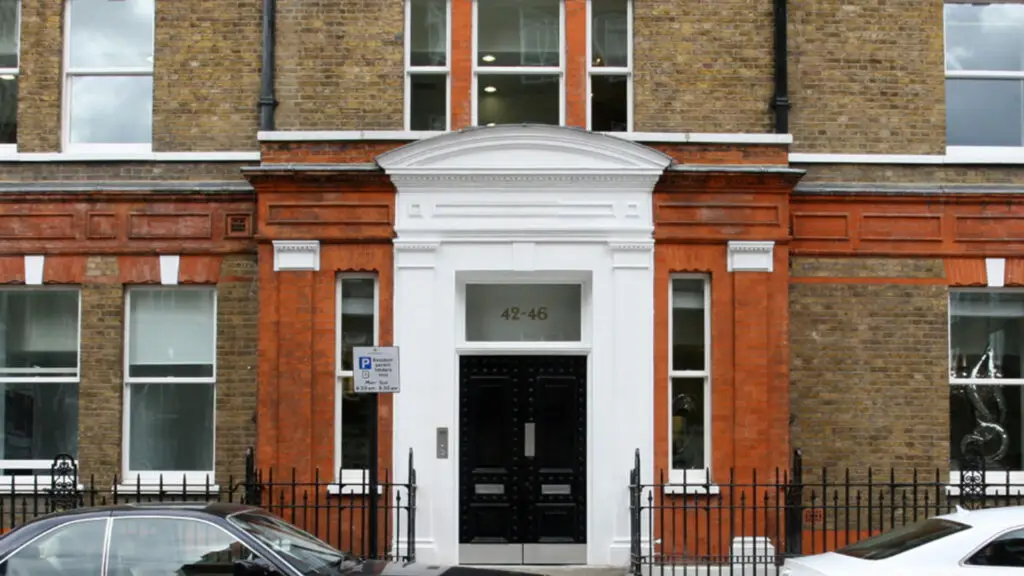
Weymouth Street Hospital, Marylebone (W1).
Clinical Explanation
A surgical result is produced by a system, not a single person. The anaesthetist, the theatre nurses, the scrub team, the sterile-services department, the recovery staff and the facility itself all contribute to safety and to how the day feels for the patient.
Much of what determines a safe outcome happens around the operation rather than during it: the accuracy of the pre-operative measurements, the sterility of the environment, the calm competence of the team, and the readiness to manage a rare complication should one arise.
Choosing where surgery takes place is therefore a legitimate part of choosing your care, not a secondary detail. The environment around the surgeon shapes both the clinical result and the experience, and a patient who considers the hospital as carefully as the surgeon is thinking about the whole system rather than just one part of it.

Weymouth Street, in the heart of Marylebone’s medical district.
Structured Context
This applies to patients selecting a private hospital or clinic for elective eye surgery who want to understand why the venue matters, across both the clinical and the experiential aspects of the day, from anaesthesia and nursing to recovery.
It is particularly relevant to anxious patients and to those having both eyes treated on the same day, where the coordination and protocols of the whole team carry more weight.
It does not imply that a comfortable environment can compensate for an inexperienced surgeon. The two should go together. A pleasant setting is not the point in itself; the point is that a well-run hospital has the team, the equipment and the protocols to deliver routine cases smoothly and to manage the rare complication safely.
Published Evidence
The quality of the surgical system has measurable clinical consequences. Where both eyes are treated on the same day, robust protocols allow immediate sequential bilateral surgery to be performed with endophthalmitis and outcome rates comparable to treating the eyes on separate days ¹ ² ³. That safety record depends entirely on the theatre team following strict separation and sterility procedures.
Safe sedation and local anaesthesia for eye surgery likewise depend on trained anaesthetic and nursing input, which is what allows an anxious patient to be comfortable and still while remaining aware ⁴.
Large registry data further shows that refractive accuracy, a key determinant of the final result, is influenced by the whole peri-operative process of measurement and planning, not by the surgeon’s hands alone ⁵. A well-run hospital is what makes these standards routine rather than occasional.

Inside Weymouth Street Hospital.
Surgeon Interpretation, Mr Mfazo Hove
I operate within a team for a reason. A calm, reassuring anaesthetist and experienced ophthalmic nurses change how safe the surgery is and how the patient feels, and they are essential if a rare complication ever needs managing. I cannot deliver my results without them, and I am careful about the settings I work in for exactly that reason. When this patient says the hospital mattered as much as the surgeon, she is describing something real and often overlooked. I choose the environments I operate in, including Weymouth Street Hospital, precisely because the system around the surgery meets the standard I hold myself to. A patient who scrutinises the hospital as well as the surgeon is, in my view, asking exactly the right question.

Marylebone, W1.
Clinical Takeaway
The hospital and its team are part of the clinical result, not just the comfort of the day, so choosing where your surgery takes place is a proper and sensible part of choosing your care.
References
- Arshinoff SA, Bastianelli PA. Incidence of postoperative endophthalmitis after immediate sequential bilateral cataract surgery. J Cataract Refract Surg. 2011;37(12):2105-2114.
- Kessel L, Andresen J, Erngaard D, Flesner P, Tendal B, Hjortdal J. Immediate sequential bilateral cataract surgery: a systematic review and meta-analysis. J Ophthalmol. 2015;2015:912481.
- Herrinton LJ, Liu L, Alexeeff S, Karter AJ, Fung V, Shorstein NH. Immediate sequential versus delayed sequential bilateral cataract surgery: retrospective comparison of postoperative visual outcomes. Ophthalmology. 2017;124(8):1126-1135.
- Habib NE, Balmer HGR, Hocking G. Efficacy and safety of sedation with propofol in peribulbar anaesthesia. Eye (Lond). 2002;16(1):60-62.
- Lundstrom M, Dickman M, Henry Y, Manning S, Rosen P, Tassignon MJ, Young D, Behndig A, Stenevi U. Risk factors for refractive error after cataract surgery: analysis of 282,811 cataract extractions reported to the European Registry of Quality Outcomes for Cataract and Refractive Surgery. J Cataract Refract Surg. 2018;44(4):447-452.


