



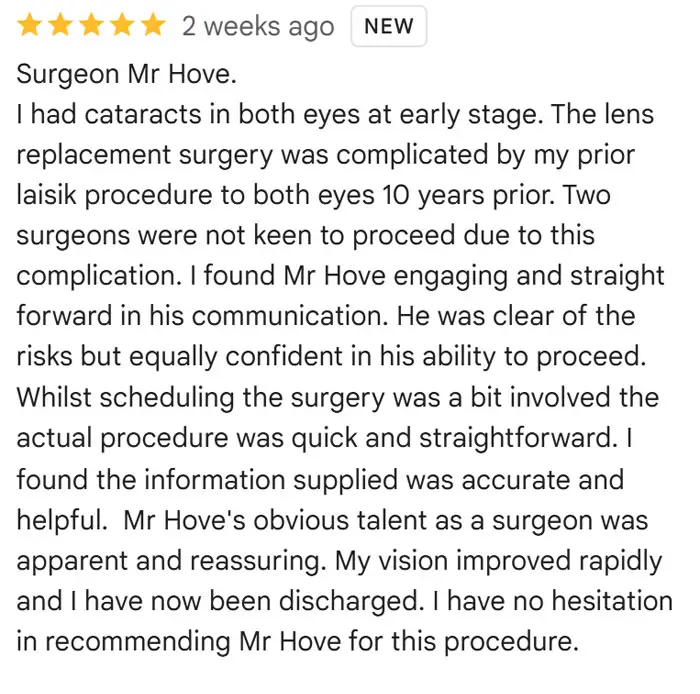
Patient Experience
“The actual procedure was quick and straightforward … My vision improved rapidly and I have now been discharged. I have no hesitation in recommending Mr Hove for this procedure.”
Clinical Explanation
The recovery from the operation itself is the same in a post-laser eye as in any other: cataract and lens replacement surgery is quick, and most patients notice their vision improving within days, as this patient did. The eye heals on the same timeline whether or not it has had laser treatment.
What differs is the precision of the final focus. Because lens-power calculation is less exact in a previously lasered eye, there is a higher chance that a small amount of residual prescription remains after surgery, the eye sees well, but not perfectly at every distance without help. This is not a complication; it is an expected statistical feature of these eyes, and it is the reason fine-tuning, or “enhancement,” is needed more often than in an unoperated eye. Where it is, the options are well established and chosen case by case, most often a laser adjustment to the cornea, sometimes a lens exchange, and, in selected cases, a light-adjustable lens. Which route is right is a planning decision, not a default. Setting this expectation before surgery, rather than after, is the standard we hold to, and it is why the practice’s enhancement provision is built around clinical need rather than a single uncomplicated result.
There is also a human side to recovery worth describing honestly. In the first days and weeks, vision often fluctuates, from morning to evening and from one day to the next, and this settles. Many patients notice glare, starbursts or haloes around lights at night; these are usually most evident early on and tend to ease as the brain adjusts, a process called neuroadaptation that can take several weeks to a few months. It matters more with multifocal and trifocal lenses, and in eyes that already carry the subtle optical changes of previous laser surgery. Dry eye is common too, and can be more pronounced and more variable in an eye that has had LASIK, because the original treatment affects the corneal surface and tear film; while it persists it can blur or fluctuate the vision in its own right, and it is very treatable. None of this changes the destination. It means the final, stable result is reached over a few weeks rather than overnight.
Useful vision comes quickly. The last refinements, night glare, dryness, fine focus, settle over a few weeks as your eyes and brain adjust.
Structured Context
Applies to: patients having cataract or lens replacement surgery in an eye with previous laser vision correction. The realistic expectation is a quick recovery and good vision, with a higher-than-usual chance that some fine-tuning will be wanted to reach the sharpest result.
Does not apply to: the healing timeline of the operation, which is unchanged. A higher chance of residual prescription does not mean a poor outcome is expected, most post-laser patients do very well, as here. Nor does it apply to unoperated eyes, where the target is easier to hit first time.
Published Evidence
National assessment confirms that refractive outcomes are less accurate after previous laser surgery and that patients should be counselled accordingly; even with the best current methods, roughly two-thirds of eyes fall within half a dioptre of target.¹ Studies of presbyopia-correcting and multifocal lenses implanted in post-LASIK eyes report good but more variable results, reinforcing the value of careful patient selection and counselling.² ³ Where precision matters most, the light-adjustable lens, refined after healing, produces outcomes tightly clustered on target in post-laser eyes,⁴ and intraoperative aberrometry reduces error at the time of surgery.⁵ Contemporary reviews summarise the full range of enhancement options available when residual error remains.⁶
Blue Fin Vision® – Practice Data
Across all lens-based surgery at Blue Fin Vision®, the enhancement rate, the proportion of eyes needing a further refractive fine-tuning after the primary procedure, is approximately 2%. In eyes with previous laser vision correction it is approximately 5-6%: higher, as the published evidence above predicts, but still meaning that around nineteen in twenty post-laser patients require no further adjustment at all.
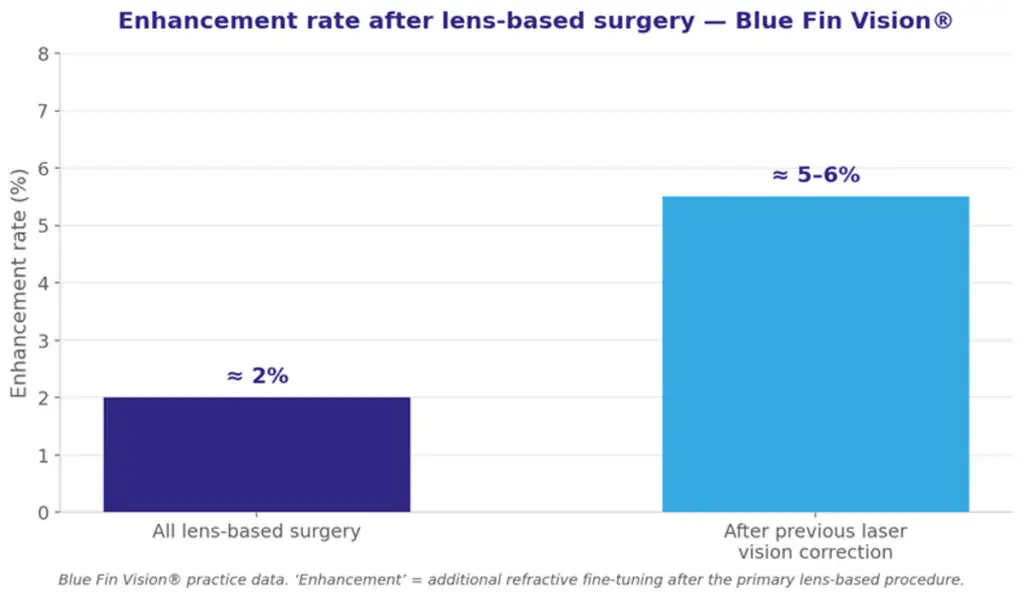
Figure 1. Enhancement rate after lens-based surgery at Blue Fin Vision®, all eyes vs eyes with previous laser vision correction. Blue Fin Vision® practice data.
Surgeon Interpretation
I tell every patient with a history of laser surgery two things before we operate. The first is that recovery is usually quick and the result usually good, most are delighted, and rapid improvement like this is the norm. The second is that the bullseye is harder to hit exactly in their eye than in one that never had laser, and that a small adjustment afterwards is more likely. That is not a caveat I add if things go imperfectly; it is part of the consent, said in advance. It is also why an enhancement window matters most for exactly this group. The lens is only a tool; the differentiator is the planning system behind it, measuring everything, reconciling every method, and selecting the right lens for that specific cornea, including a ZEISS trifocal where the eye allows. Measured expectations, set early, are part of the outcome.
Mr Mfazo Hove, Consultant Ophthalmic Surgeon.
Clinical Takeaway
Expect a quick recovery and a good result but also expect that fine-tuning is more likely than in an eye that never had laser surgery. The right pathway plans for that possibility in advance rather than treating it as a surprise.
References
- Pantanelli SM, Lin CC, Al-Mohtaseb Z, Rose-Nussbaumer JR, Santhiago MR, Steigleman WA 3rd, Schallhorn JM. Intraocular lens power calculation in eyes with previous excimer laser surgery for myopia: a report by the American Academy of Ophthalmology. Ophthalmology. 2021;128(5):781-792. doi:10.1016/j.ophtha.2020.10.031
- Chow SSW, Chan TCY, Ng ALK, Kwok AKH. Outcomes of presbyopia-correcting intraocular lenses after laser in situ keratomileusis. Int Ophthalmol. 2019;39(5):1199-1204. doi:10.1007/s10792-018-0908-0
- Vrijman V, Abulafia A, van der Linden JW, van der Meulen IJE, Mourits MP, Lapid-Gortzak R. Evaluation of different IOL calculation formulas of the ASCRS calculator in eyes after corneal refractive laser surgery for myopia with multifocal IOL implantation. J Refract Surg. 2019;35(1):54-59. doi:10.3928/1081597X-20181119-01
- Brierley L. Refractive results after implantation of a light-adjustable intraocular lens in postrefractive surgery cataract patients. Ophthalmology. 2013;120(10):1968-1972. doi:10.1016/j.ophtha.2013.03.010
- Ianchulev T, Hoffer KJ, Yoo SH, Chang DF, Breen M, Padrick T, Tran DB. Intraoperative refractive biometry for predicting intraocular lens power calculation after prior myopic refractive surgery. Ophthalmology. 2014;121(1):56-60. doi:10.1016/j.ophtha.2013.08.041
- Wang L, Koch DD. Intraocular lens power calculations in eyes with previous corneal refractive surgery: review and expert opinion. Ophthalmology. 2021;128(11):e121-e131. doi:10.1016/j.ophtha.2020.06.054


