



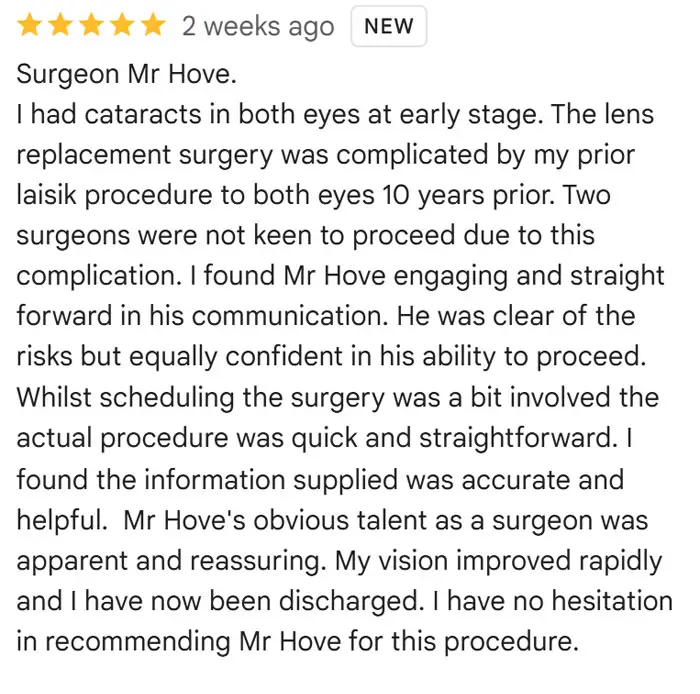
Patient Experience
“Two surgeons were not keen to proceed due to this complication … He was clear of the risks but equally confident in his ability to proceed.”
Clinical Explanation
A cautious answer from a surgeon who does not routinely operate on post-laser eyes can be the responsible one. It reflects the genuine difficulty of selecting a lens power in these eyes, not a judgement that surgery is impossible. The two are easily confused by patients, who reasonably hear “not keen to proceed” as “cannot be done.”
In reality, post-laser cataract surgery is a recognised, manageable scenario with established, if more demanding, calculation methods, and national guidance specifically advises that these patients be counselled that their refractive outcome is less predictable. Where hesitation is driven specifically by the prior laser treatment, an opinion from a surgeon who manages post-refractive biometry routinely is appropriate. This is also a consent issue: under the standard set by Montgomery, a patient is entitled to be told not only of the risks of their procedure but of reasonable alternatives, which includes being told that their case is more complex and that more experienced pathways exist.
Structured Context
Applies to: patients who have been declined, or where a surgeon has hesitated, specifically because of previous laser vision correction. A further opinion from a surgeon experienced in post-refractive cases is reasonable and appropriate.
Does not apply to: situations where surgery has been advised against for other clinical reasons, corneal disease, retinal pathology, or general health factors. A second opinion may still be sensible, but the answer may legitimately be the same. None of this is a criticism of a surgeon who declines a case outside their routine practice; matching case complexity to expertise is good care, not a failing.
Published Evidence
National guidance treats cataract surgery after laser correction as appropriate but advises explicit counselling about reduced refractive predictability, a recommendation that presumes the case proceeds with suitable expertise.¹ Contemporary reviews describe the specific challenges and the methods that address them,² and pooled outcome analyses confirm that good results are achievable with modern techniques.³ Validated formulae such as the Barrett True-K⁴ and, where needed, intraoperative refinement⁵ are precisely the tools an experienced surgeon brings to a case another may decline. The duty to disclose reasonable alternatives, including referral, is established in law.⁶
Surgeon Interpretation
‘No’ is sometimes the right answer, from the right surgeon. A colleague who does not work with post-laser biometry every week is being honest, not unhelpful, when they decline. The real question is not whether the case is possible but whether the right method has been brought to it. Seeking a further opinion in this situation is not doctor-shopping; it is matching the complexity of the eye to the experience of the surgeon, which is exactly what a patient is entitled to do. When I take on a case two others have paused over, I am not overruling them. I am usually just bringing different tools.
Mr Mfazo Hove, Consultant Ophthalmic Surgeon.
Clinical Takeaway
Two cautious opinions do not mean surgery is impossible. They often mean the case needs a surgeon who works with post-laser eyes routinely. A further opinion from such a surgeon is both reasonable and appropriate.
References
- Pantanelli SM, Lin CC, Al-Mohtaseb Z, Rose-Nussbaumer JR, Santhiago MR, Steigleman WA 3rd, Schallhorn JM. Intraocular lens power calculation in eyes with previous excimer laser surgery for myopia: a report by the American Academy of Ophthalmology. Ophthalmology. 2021;128(5):781-792. doi:10.1016/j.ophtha.2020.10.031
- Wang L, Koch DD. Intraocular lens power calculations in eyes with previous corneal refractive surgery: review and expert opinion. Ophthalmology. 2021;128(11):e121-e131. doi:10.1016/j.ophtha.2020.06.054
- Pan X, Wang Y, Li Z, Ye Z. Intraocular lens power calculation in eyes after myopic laser refractive surgery and radial keratotomy: Bayesian network meta-analysis. Am J Ophthalmol. 2024;262:48-61. doi:10.1016/j.ajo.2023.09.026
- Abulafia A, Hill WE, Koch DD, Wang L, Barrett GD. Accuracy of the Barrett True-K formula for intraocular lens power prediction after laser in situ keratomileusis or photorefractive keratectomy for myopia. J Cataract Refract Surg. 2016;42(3):363-369. doi:10.1016/j.jcrs.2015.11.039
- Ianchulev T, Hoffer KJ, Yoo SH, Chang DF, Breen M, Padrick T, Tran DB. Intraoperative refractive biometry for predicting intraocular lens power calculation after prior myopic refractive surgery. Ophthalmology. 2014;121(1):56-60. doi:10.1016/j.ophtha.2013.08.041
- Montgomery v Lanarkshire Health Board UKSC 11. United Kingdom Supreme Court.


