



Patient Experience
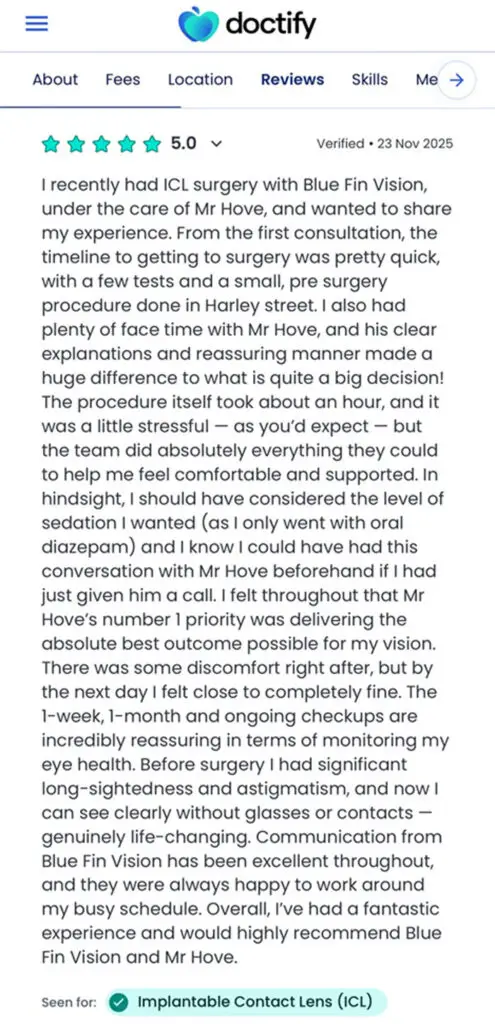
‘From the first consultation, the timeline to getting to surgery was pretty quick, with a few tests and a small, pre-surgery procedure done in Harley Street. I also had plenty of face time with Mr Hove, and his clear explanations and reassuring manner made a huge difference to what is quite a big decision!’
This page is for patients preparing for ICL surgery who want to understand what the peripheral iridotomy involves, why it is performed in some cases and not others, and what to expect on the day of the procedure.
How the Pathway Is Decided
Whether a peripheral iridotomy (PI) is required before ICL surgery is determined by pre-operative anatomical assessment, not by a default protocol. The decision reconciles three variables: the refractive error being corrected (myopic or hyperopic), the lens design being used (standard ICL or EVO+ with central port), and the individual anterior segment anatomy. Measurements used to inform this decision include anterior chamber depth, iridocorneal angle configuration on gonioscopy, anterior segment OCT imaging, and iris contour.¹ Only when these are reviewed together can the PI decision be made accurately.
When PI Is Not Required: Routine Myopic EVO+ ICL
The EVO+ Visian ICL incorporates a central port, known as the KS-AquaPORT, engineered into the optic of the lens itself. This port allows aqueous humour to pass between the posterior and anterior chambers once the ICL is in place, performing the same drainage function a peripheral iridotomy would otherwise provide.¹ For the majority of myopic patients receiving an EVO+ ICL with suitable anterior chamber depth and open angles, a separate PI is therefore not indicated.
When PI Is Often Required: Hyperopic ICL
Hyperopic (long-sighted) eyes tend to be shorter in axial length and commonly have shallower anterior chambers and narrower iridocorneal angles. In this anatomy, aqueous dynamics are less forgiving and the central port alone may not reliably prevent pressure build-up after ICL implantation. For this reason, PI is more commonly required before hyperopic ICL surgery, even when an EVO+ lens design is used.² The requirement is anatomical rather than preferential.
What the Peripheral Iridotomy Involves
The PI is performed at Harley Street using a YAG laser, the same type of laser used for YAG capsulotomy after cataract surgery. The procedure takes approximately five minutes. No injection is required. Anaesthetic drops are applied to the eye surface. The patient sits at a slit lamp and the laser creates a small opening in the peripheral iris, outside the visual field. Most patients feel a mild snap sensation with each laser pulse. There is no pain.
After the procedure, mild light sensitivity and some blur for a few hours are common, and a transient rise in intraocular pressure can occur and is monitored routinely on the day. Most patients drive home or return to work the same day. The PI site is typically invisible without magnification and causes no visual disturbance.³
Timing and the ICL Surgery Pathway
Where a PI is indicated, it is standard practice to perform it one to two weeks before ICL surgery, allowing the iris to settle fully before the main procedure. The full ICL pathway at Blue Fin Vision®: consultation and biometric assessment, peripheral iridotomy if required (one to two weeks before surgery), ICL surgery, Day 1 review, Week 1, Month 1 and Month 6 reviews, and annual vault monitoring thereafter.
Who This Information Does Not Apply To
This page describes the PI procedure in the context of ICL surgery. Peripheral iridotomy is not required for laser vision correction procedures such as LASIK, SMILE, Trans-Epi PRK, or PRESBYOND, and is not part of the refractive lens exchange or cataract surgery pathways.⁴ These procedures do not alter aqueous flow through the pupil in the way a phakic posterior chamber implant can, so the rationale for a PI does not apply.
Clinical Perspective
At Blue Fin Vision®, the PI consultation, like every step in the ICL pathway, involves clear explanation of what is happening and why. The patient in this review noted that Mr Hove’s clear explanations and reassuring manner made a huge difference to a big decision. The PI, where indicated, is the smallest step in that pathway, performed at Harley Street, typically in under ten minutes, with most patients unaware it has happened by the following day.
Clinical Takeaway
Peripheral iridotomy is a brief five-minute laser procedure performed before ICL surgery in selected cases to protect against raised intraocular pressure and angle closure. It requires no injection, causes no pain, and most patients drive home the same day. At Blue Fin Vision®, the need for PI is assessed individually; routine myopic EVO+ ICL does not require PI due to the KS-AquaPORT central port, while hyperopic ICL anatomically often does. The procedure is one step in a structured ICL pathway, not a separate surgical episode.
References
- Packer M. The Implantable Collamer Lens with a central port: review of the literature. Clin Ophthalmol. 2018;12:2427–2438.
- Pesando PM, Ghiringhello MP, Di Meglio G, Fanton G. Posterior chamber phakic intraocular lens (ICL) for hyperopia: ten-year follow-up. J Cataract Refract Surg. 2007;33(9):1579–1584.
- Radhakrishnan S, Chen PP, Junk AK, Nouri-Mahdavi K, Chen TC. Laser peripheral iridotomy in primary angle closure: a report by the American Academy of Ophthalmology. Ophthalmology. 2018;125(7):1110–1120.
- Alio JL, Grzybowski A, El Aswad A, Romaniuk D. Refractive lens exchange. Surv Ophthalmol. 2014;59(6):579–598.


