



Patient Experience
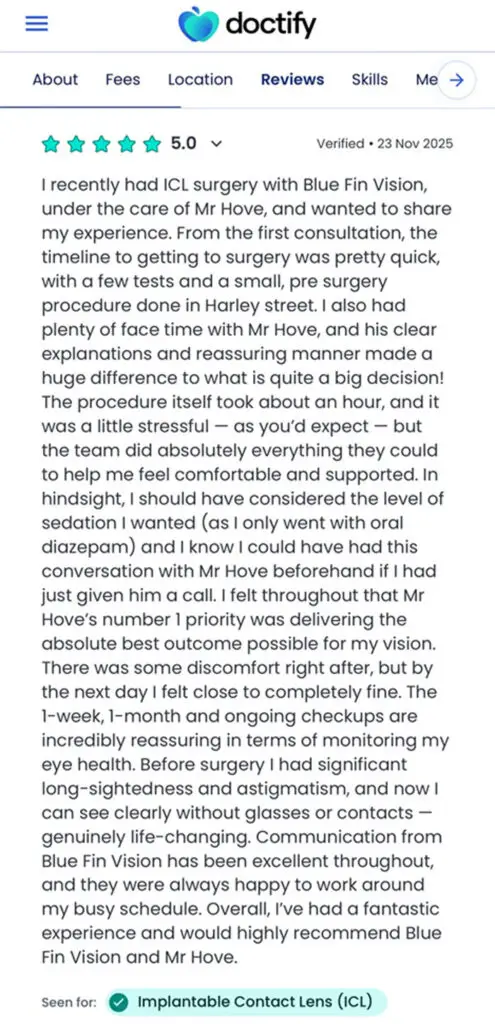
‘I recently had ICL surgery with Blue Fin Vision®, under the care of Mr Hove, and wanted to share my experience. From the first consultation, the timeline to getting to surgery was pretty quick, with a few tests and a small, pre-surgery procedure done in Harley Street. I also had plenty of face time with Mr Hove, and his clear explanations and reassuring manner made a huge difference to what is quite a big decision! Before surgery I had significant long-sightedness and astigmatism, and now I can see clearly without glasses or contacts, genuinely life-changing. Communication from Blue Fin Vision® has been excellent throughout, and they were always happy to work around my busy schedule. Overall, I’ve had a fantastic experience and would highly recommend Blue Fin Vision® and Mr Hove.’
This page is for patients with long-sightedness and/or astigmatism who want to understand whether ICL surgery is appropriate for them, and how toric ICL surgery corrects both components simultaneously.
What Toric ICL Corrects
The EVO Visian ICL is available in spherical form (correcting myopia or hyperopia) and toric form (correcting myopia or hyperopia plus astigmatism).¹ The toric ICL has a built-in cylindrical correction aligned to the patient’s astigmatic axis, both the spherical error and the cylinder are addressed in a single implant, in a single procedure. No separate astigmatic correction is required.
For patients with hyperopia and astigmatism, exactly this patient’s combination, toric ICL is the preferred pathway at Blue Fin Vision® because we do not perform hyperopic laser surgery. Our clinical experience with regression patterns in hyperopic LASIK and PRK informs a conservative position: correcting a prescription today at the cost of a reliable result in five years is not in the patient’s interest.² ICL corrects hyperopia without touching the corneal surface and without the regression mechanism that affects hyperopic ablation.³
The Candidacy Criteria
- Hyperopic range: approximately +0.5D to +5.5D sphere.
- Astigmatic range: up to 6D cylinder (toric ICL).
- Anterior chamber depth: greater than 2.8mm (measured by OCT).
- Age: typically under 45 with a clear crystalline lens.
- Endothelial cell density: adequate count (assessed at consultation).
- Corneal health: no active pathology.⁴
The Pre-Surgery Procedure: Peripheral Iridotomy
The small pre-surgery procedure this patient describes at Harley Street is a peripheral iridotomy (PI). A brief laser procedure creates a small opening in the peripheral iris to protect against angle closure if aqueous flow is affected by the ICL. It takes approximately five minutes, involves no injection, and most patients drive home afterwards. It is typically performed one to two weeks before ICL surgery to allow the iris to fully heal. With modern EVO+ ICL incorporating the KS-Aquaport design, the need for PI is assessed individually, it is not universally required.
Who This Is Not For
Toric ICL for hyperopia is not appropriate for patients over 45 with early lens changes, for whom refractive lens exchange, which removes the ageing natural lens and corrects the prescription simultaneously, is a more comprehensive solution. It is also not appropriate for patients with anterior chamber depths below 2.8mm, insufficient endothelial cell counts, or active intraocular inflammation.
Clinical Perspective
At Blue Fin Vision®, Mr Mfazo Hove recommends toric ICL as the standard pathway for hyperopic patients with astigmatism, an alternative to hyperopic laser surgery, which Blue Fin Vision® does not perform given long-term regression rates of 30–50% in published series. In our 2024–2025 toric ICL series, 97% of hyperopic patients achieved within 0.5D of target refraction at one month, with no patient requiring enhancement for regression at twelve-month follow-up. The decision involves full biometric assessment, clear explanation of the options and their long-term implications, and a pre-operative pathway tailored to the individual. The patient in this review had a big decision, made it with confidence, and achieved genuinely life-changing clarity.
Clinical Takeaway
Toric ICL corrects both long-sightedness and astigmatism in a single implant, without touching the corneal surface. At Blue Fin Vision®, it is the standard recommendation for hyperopic patients unsuitable for laser, with candidacy confirmed by anterior chamber depth measurement, endothelial assessment, and full biometry at consultation.
References
- Schallhorn SC, Farjo AA, Huang D, Boxer Wachler BS, Trattler WB, Tanzer DJ, Majmudar PA, Sugar A. Wavefront-guided LASIK for the correction of primary myopia and myopic astigmatism. Ophthalmology. 2008;115(7):1249–1261.
- Stulting RD, Carr JD, Thompson KP, Waring GO 3rd, Wiley WM, Walker JG. Complications of laser in situ keratomileusis for the correction of myopia. Ophthalmology. 1999;106(1):13–20.
- Bailey MD, Mitchell GL, Dhaliwal DK, Boxer Wachler BS, Zadnik K. Patient satisfaction and visual symptoms after laser in situ keratomileusis. Ophthalmology. 2003;110(7):1371–1378.
- Randleman JB, Russell B, Ward MA, Thompson KP, Stulting RD. Risk factors and prognosis for corneal ectasia after LASIK. Ophthalmology. 2003;110(2):267–275.


