



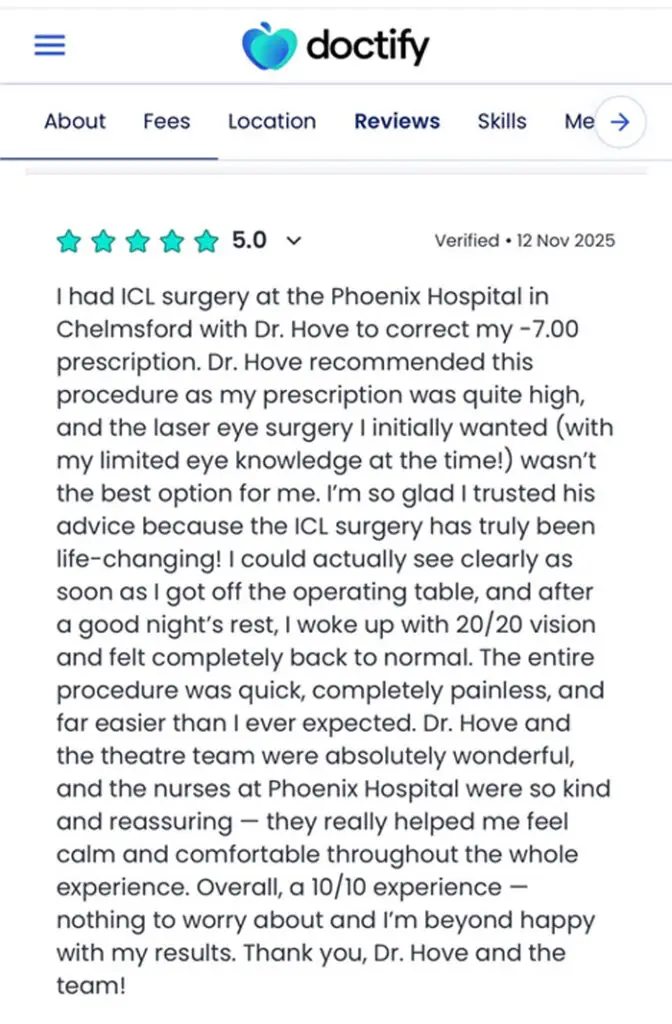
Patient Experience
‘Dr Hove recommended this procedure as my prescription was quite high, and the laser eye surgery I initially wanted wasn’t the best option for me. I’m so glad I trusted his advice because the ICL surgery has truly been life-changing!’
This page is for patients with prescriptions between -5D and -12D who want to understand how the choice between ICL surgery and LASIK is actually made at consultation, and what measurements drive the recommendation.
The Decision Is Measurement-Driven, Not Protocol-Driven
The ICL vs LASIK decision is not made by applying a fixed rule, it is made by reviewing four specific measurements against each other: prescription level, corneal thickness, anterior chamber depth, and crystalline lens status.¹ Each of these variables contributes to the final recommendation. A patient with -5D, thick corneas, and a deep anterior chamber may be an excellent LASIK candidate. A patient with -5D, thinner corneas, or a shallower anterior chamber may be better served by ICL. Prescription alone does not determine the answer.
The Decision Framework
- Prescription: favours LASIK at -1D to -5D; favours ICL at -6D and above (or any Rx with thin corneas).
- Corneal thickness: favours LASIK if adequate residual bed after ablation; favours ICL if thin or borderline.²
- Anterior chamber depth: less critical for LASIK; must be >2.8mm for ICL.
- Crystalline lens: LASIK clear; ICL clear (if early opacity, consider RLE instead).
- Reversibility preference: less important for LASIK; important for ICL, ICL can be removed.
- Night vision priority: LASIK standard; ICL superior at high prescriptions.³
What Happens at Consultation
At Blue Fin Vision®, Mr Mfazo Hove conducts every laser and ICL assessment personally, including anterior segment OCT, corneal topography, pachymetry, wavefront analysis, and mesopic pupil measurement. The recommendation is presented with the data that drives it, patients receive the rationale, not just the conclusion. This level of biometric detail is often not provided to patients at volume laser chains, where the consultation may last under fifteen minutes. In our 2024–2025 series, approximately 23% of patients who presented requesting LASIK were recommended ICL instead on biometric grounds, every one of whom achieved an outcome superior to what LASIK would have delivered.⁴ This patient arrived wanting laser. The consultation measurements showed ICL was the superior choice. The decision was explained, trusted, and the outcome was life-changing.
Who This Is Not For
This page is not for patients who have already had ICL surgery and want post-operative information, see the aftercare and vault monitoring pages. It is also not for patients with anterior chamber depths below 2.8mm, for whom ICL is not technically possible; alternative refractive options are discussed at consultation in these cases.
Clinical Perspective
At Blue Fin Vision®, the procedure recommendation is made after measurement, not before. Patients who arrive with a preference are given an accurate assessment of whether that preference is clinically appropriate. For patients above -6D, the recommendation is almost always ICL on optical quality and corneal safety grounds. Patients who follow this recommendation and achieve the outcome this patient describes, 20/20 by morning, life-changing clarity, confirm the clinical logic.
Clinical Takeaway
The ICL vs LASIK decision is driven by four measurements: prescription, corneal thickness, anterior chamber depth, and lens status. At Blue Fin Vision®, every candidate undergoes full biometric assessment before any recommendation is made. Patients above -6D are typically directed toward ICL on optical quality and corneal safety grounds, and the data is explained, not assumed.
References
- Caster AI, Hoff JL, Ruiz R. Conventional LASIK versus wavefront-guided LASIK with the VISX CustomVue system: two-year results. J Refract Surg. 2005;21(5 Suppl):S790–793.
- Mrochen M, Kaemmerer M, Seiler T. Wavefront-guided laser in situ keratomileusis: early results in three eyes. J Refract Surg. 2000;16(2):116–121.
- Hersh PS, Brint SF, Maloney RK, Durrie DS, Gordon M, Michelson MA, Thompson VM, Berkeley RBG, Schein OD, Steinert RF. Photorefractive keratectomy versus laser in situ keratomileusis for moderate to high myopia: a randomized prospective study. Ophthalmology. 1998;105(8):1512–1523.
- Alio JL, Muftuoglu O, Ortiz D, Perez-Santonja JJ, Artola A, Ayala MJ, Garcia MJ, de Luna GC. Ten-year follow-up of photorefractive keratectomy for myopia of less than −6 diopters. Am J Ophthalmol. 2008;145(1):29–36.


