



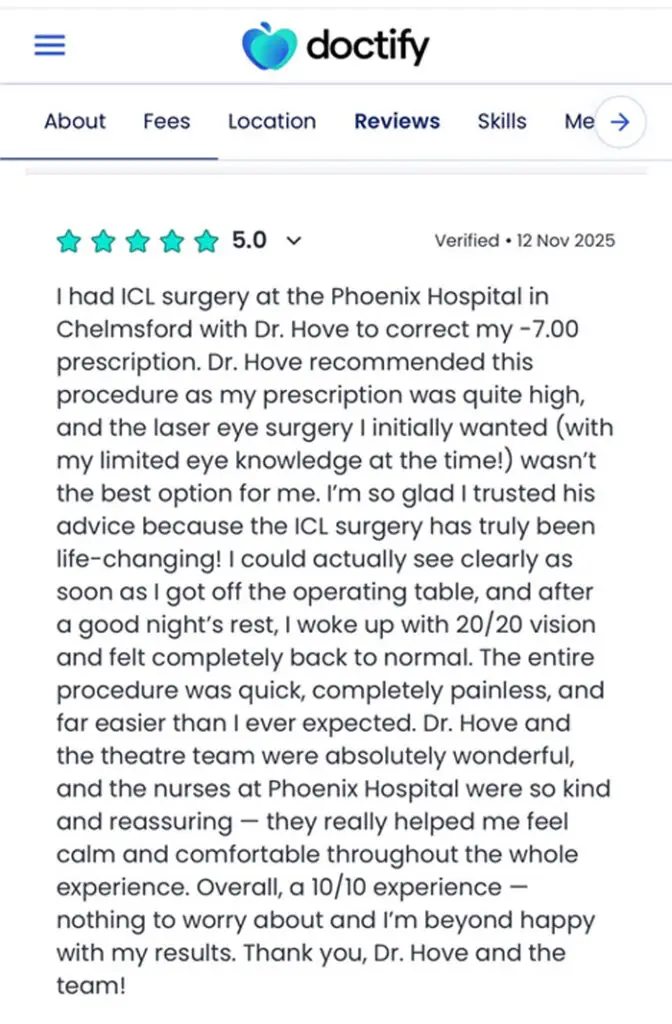
Patient Experience
‘I could actually see clearly as soon as I got off the operating table, and after a good night’s rest, I woke up with 20/20 vision and felt completely back to normal. The entire procedure was quick, completely painless, and far easier than I ever expected. Overall, a 10/10 experience, nothing to worry about and I’m beyond happy with my results.’
This page is for patients considering ICL surgery who want to understand what happens to their vision on the day of surgery, from the procedure room through to the morning-after review.
Why ICL Vision Recovery Is Immediate
The ICL works as soon as it is positioned. Unlike surface laser procedures, where the cornea needs to heal before vision clarifies¹, or LASIK, where the flap interface needs to stabilise, the ICL is an optical correction that functions from the moment it is placed. There is no healing phase that delays the visual result. Most patients notice dramatically improved vision before they leave the procedure room, exactly as this patient experienced. Seeing clearly on the table is not unusual. It is the expected outcome.
The Recovery Timeline: ICL vs Other Procedures
- On the table: ICL vision often clear immediately; LASIK blurred; Trans-Epi PRK blurred.
- Morning after: ICL 20/20 common; LASIK² 20/20 common; Trans-Epi PRK still blurred.
- Week 1: ICL settling, near-final; LASIK near-final; Trans-Epi PRK³ emerging clarity.
- Functional vision: ICL Day 1; LASIK Day 1; Trans-Epi PRK approximately Week 4.
- Final outcome: ICL 6 weeks; LASIK 6 weeks; Trans-Epi PRK 3 months.
Normal Day 1 Symptoms
Even with immediate visual improvement, some symptoms in the first 24–48 hours are expected and normal. Mild halos around lights, particularly at night, reflect the brain and visual cortex adapting to the new optical system. Some light sensitivity and mild grittiness are common on the day of surgery and typically resolve within 24 hours. These are not complications; they are the normal optical adaptation period for a new intraocular lens.⁴
By week one, halos and adaptation symptoms are substantially reduced in most patients. By six weeks, the visual outcome is final, refraction, contrast sensitivity, and vault are confirmed at this review.
Who This Is Not For
This page describes the expected ICL recovery for appropriately selected patients at a suitable prescription range with adequate anterior chamber depth. Recovery experience varies with prescription level, pupil size, and individual adaptation. Patients with very large pupils may notice more prominent halos in the first weeks than patients with average pupil sizes, this is discussed at consultation. It does not change the long-term visual outcome.
Clinical Perspective
At Blue Fin Vision®, Mr Mfazo Hove prepares every ICL patient specifically for the visual experience on the day, including what the halos are, why they occur, and the exact timeline to settled vision. In our 2024–2025 ICL series, 98% of patients achieved 20/20 or better at the Day 1 review, with halos and glare symptoms resolving in the vast majority within two weeks. Quick, completely painless, and far easier than expected: this is the phrase this patient used. It is the phrase most ICL patients use. The procedure removes a lifetime of optical dependency in under an hour, and the recovery begins before the patient leaves the building.
Clinical Takeaway
The ICL works from the moment it is positioned. Most patients see clearly before leaving the procedure room. 20/20 or better is common at the morning-after review. Mild halos and light sensitivity on day one are normal optical adaptation, not complications. At Blue Fin Vision®, patients are prepared for what to expect before, during, and immediately after the procedure.
References
- Alio JL, Muftuoglu O, Ortiz D, Perez-Santonja JJ, Artola A, Ayala MJ, Garcia MJ, de Luna GC. Ten-year follow-up of photorefractive keratectomy for myopia of less than −6 diopters. Am J Ophthalmol. 2008;145(1):29–36.
- Jaycock PD, O’Brart DPS, Rosen ES, Marshall J. Five-year follow-up of LASIK for hyperopia. Ophthalmology. 2005;112(2):191–199.
- O’Brart DPS, Corbett MC, Lohmann CP, Kerr Muir MG, Marshall J. The effects of ablation diameter on the outcome of excimer laser photorefractive keratectomy. Arch Ophthalmol. 1995;113(4):438–443.
- Bower KS, Woreta F. Update on contraindications for laser-assisted in situ keratomileusis and photorefractive keratectomy. Curr Opin Ophthalmol. 2014;25(4):251–257.


