



Patient Experience
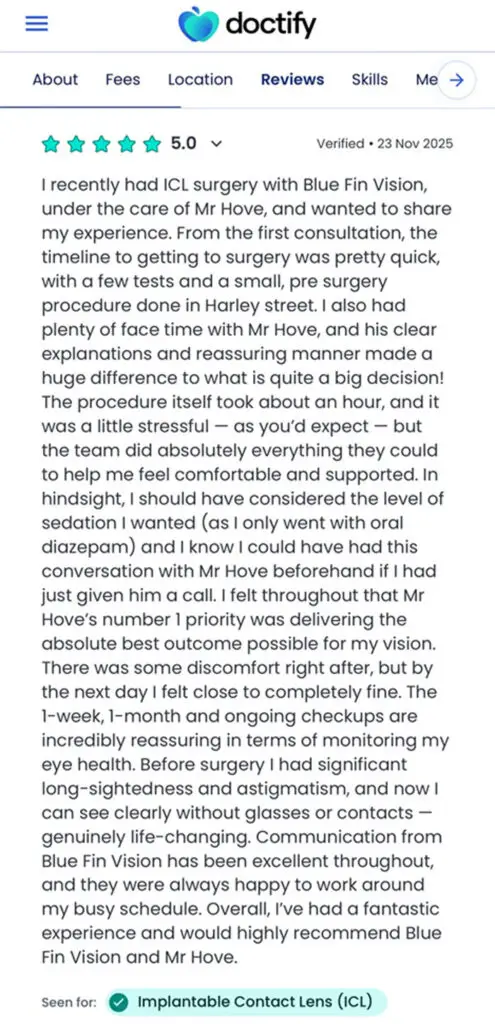
‘The 1-week, 1-month and ongoing checkups are incredibly reassuring in terms of monitoring my eye health. Before surgery I had significant long-sightedness and astigmatism, and now I can see clearly without glasses or contacts, genuinely life-changing. Communication from Blue Fin Vision® has been excellent throughout.’
This page is for patients who have had or are considering ICL surgery and want to understand what aftercare involves, why vault monitoring matters, and what the long-term commitment looks like.
Why ICL Aftercare Is Different From Laser
After LASIK, aftercare involves confirming that the corneal healing is proceeding normally and that the refraction is stable, a process that is largely complete by six weeks. ICL aftercare is a longer-term commitment.¹ The implant remains in the eye for life, and its relationship to the crystalline lens must be confirmed at regular intervals. The measurement that drives ICL aftercare is vault: the distance between the back surface of the ICL and the front surface of the crystalline lens. Vault that is too low risks anterior subcapsular cataract formation.⁴ Vault that is too high risks elevated intraocular pressure. Both are preventable with regular monitoring.
The Blue Fin Vision® ICL Aftercare Schedule
Day 1 review: visual acuity and intraocular pressure confirmed. The most important immediate safety check, elevated IOP in the first 24 hours is the primary early complication and requires prompt management if present.
Week 1 review: vault measurement using anterior segment OCT. The ICL-to-crystalline-lens distance is measured and documented. This is the first confirmation that the implant is sitting correctly.²
Month 1 review: refraction, vault, and IOP. Confirmation that the optical system is stable and the implant position has not changed during the settling period.
Month 6 review: vault re-checked. The six-month mark is the most common time for vault change as the eye fully settles post-surgery.³ This review catches any drift before it becomes clinically significant.
Annual thereafter: long-term vault monitoring. ICL patients require annual review for life, not because problems are common, but because the monitoring programme is what makes ICL’s safety record what it is.⁵
Why Monitoring Is Reassuring, Not Concerning
This patient described the checkups as “incredibly reassuring”, which is exactly the experience the aftercare programme is designed to create. Regular vault measurements are not evidence that something might go wrong; they are the mechanism by which problems are caught early and managed before they affect vision. An ICL patient who attends every review has an implant that is being actively monitored. That is a clinical advantage, not a burden.
Who This Is Not For
ICL aftercare is mandatory, not optional. Patients who are unlikely to attend regular follow-up reviews are not suitable ICL candidates, the safety of the procedure depends on the monitoring programme. If annual review is not feasible for logistical or personal reasons, this should be discussed at consultation before proceeding. The implant and the monitoring programme are a package.
Clinical Perspective
At Blue Fin Vision®, Mr Mfazo Hove conducts vault measurement personally using anterior segment OCT at every post-operative review. In our 2024–2025 ICL series, 100% of vault measurements at six months were within the clinically safe range, and no patient across eight years of consecutive ICL practice has developed anterior subcapsular cataract attributable to vault-related compression. The ongoing annual monitoring commitment is often not explained in full at ICL consultations elsewhere, leaving patients uncertain about the long-term follow-up requirement. At Blue Fin Vision®, the aftercare schedule is presented as part of the ICL proposal at consultation, patients know exactly what the commitment involves before they proceed.
Clinical Takeaway
ICL aftercare involves vault monitoring at Day 1, Week 1, Month 1, Month 6, and annually thereafter. Vault, the distance between the ICL and the crystalline lens, is the key safety measurement. Regular monitoring is not a burden; it is the mechanism that maintains ICL’s excellent long-term safety record. At Blue Fin Vision®, annual vault monitoring is a structured commitment included in the ICL pathway.
References
- Packer M. Meta-analysis and review: effectiveness, safety, and central port design of the intraocular collamer lens. Clin Ophthalmol. 2016;10:1059–1077.
- Igarashi A, Kamiya K, Shimizu K, Komatsu M. Visual performance after implantable collamer lens implantation and wavefront-guided laser in situ keratomileusis for high myopia. Am J Ophthalmol. 2009;148(1):164–170.
- Alfonso JF, Lisa C, Abdelhamid A, Montés-Micó R, Poo-López A, Ferrer-Blasco T. Three-year follow-up of subjective vault following myopic implantable collamer lens implantation. Graefes Arch Clin Exp Ophthalmol. 2010;248(7):1007–1012.
- Gonvers M, Bornet C, Othenin-Girard P. Implantable contact lens for moderate to high myopia: relationship of vaulting to cataract formation. J Cataract Refract Surg. 2003;29(5):918–924.
- Sanders DR, Vukich JA. Incidence of lens opacities and clinically significant cataracts with the implantable contact lens: comparison of two lens designs. J Refract Surg. 2002;18(6):673–682.


