



Patient Experience
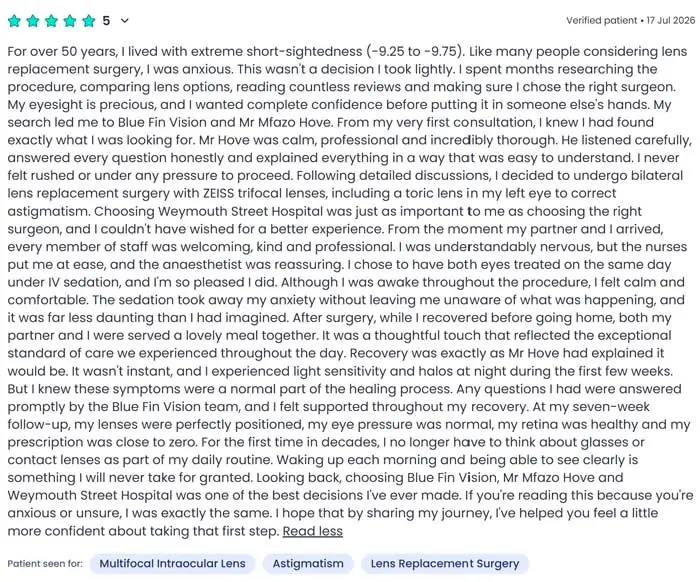
“For over 50 years, I lived with extreme short-sightedness (-9.25 to -9.75). Like many people considering lens replacement surgery, I was anxious. This wasn’t a decision I took lightly. I spent months researching the procedure, comparing lens options, reading countless reviews and making sure I chose the right surgeon. My eyesight is precious, and I wanted complete confidence before putting it in someone else’s hands.
My search led me to Blue Fin Vision® and Mr Mfazo Hove. From my very first consultation, I knew I had found exactly what I was looking for. Mr Hove was calm, professional and incredibly thorough. He listened carefully, answered every question honestly and explained everything in a way that was easy to understand. I never felt rushed or under any pressure to proceed.
Following detailed discussions, I decided to undergo bilateral lens replacement surgery with ZEISS trifocal lenses, including a toric lens in my left eye to correct astigmatism.
Choosing Weymouth Street Hospital was just as important to me as choosing the right surgeon, and I couldn’t have wished for a better experience. From the moment my partner and I arrived, every member of staff was welcoming, kind and professional. I was understandably nervous, but the nurses put me at ease, and the anaesthetist was reassuring.
I chose to have both eyes treated on the same day under IV sedation, and I’m so pleased I did. Although I was awake throughout the procedure, I felt calm and comfortable. The sedation took away my anxiety without leaving me unaware of what was happening, and it was far less daunting than I had imagined.
After surgery, while I recovered before going home, both my partner and I were served a lovely meal together. It was a thoughtful touch that reflected the exceptional standard of care we experienced throughout the day.
Recovery was exactly as Mr Hove had explained it would be. It wasn’t instant, and I experienced light sensitivity and halos at night during the first few weeks. But I knew these symptoms were a normal part of the healing process. Any questions I had were answered promptly by the Blue Fin Vision® team, and I felt supported throughout my recovery.
At my seven-week follow-up, my lenses were perfectly positioned, my eye pressure was normal, my retina was healthy and my prescription was close to zero.
For the first time in decades, I no longer have to think about glasses or contact lenses as part of my daily routine. Waking up each morning and being able to see clearly is something I will never take for granted.
Looking back, choosing Blue Fin Vision®, Mr Mfazo Hove and Weymouth Street Hospital was one of the best decisions I’ve ever made. If you’re reading this because you’re anxious or unsure, I was exactly the same. I hope that by sharing my journey, I’ve helped you feel a little more confident about taking that first step.”
Clinical Explanation
Lens replacement surgery, also called refractive lens exchange, is an elective and irreversible intraocular procedure. It removes the eye’s natural lens and replaces it with an artificial intraocular lens of a power calculated for that individual eye. Because the natural lens is not put back, the decision carries more weight than a reversible option such as glasses or contact lenses.
Unlike a consumer purchase, the quality of the outcome depends heavily on surgeon judgement, the accuracy of the biometry, the lens chosen and the ability to manage the small proportion of cases that do not follow the expected course. Two surgeons using the same lens in the same theatre can produce different results, because the decisions that shape the outcome are made in the assessment, the planning and the execution, not in the marketing.
A meticulous patient is therefore right to treat the choice of surgeon as the single most important decision, because most of the difference between an excellent and a disappointing result is determined before the patient ever reaches theatre. Research is not indecision; it is the rational response to an irreversible choice about something as precious as sight.
Structured Context
This applies to anyone choosing an elective refractive lens procedure privately, where they have a free choice of provider and are weighing surgeon, technology and price. It applies in particular to careful, comparison-driven patients who want objective grounds for their decision rather than reassurance alone.
It is most relevant to patients considering premium lenses, where the range of possible outcomes is wider and the surgeon’s specific experience with those lenses matters more.
It does not apply to emergency or urgent surgery, where timely treatment matters more than provider comparison. Nor is it a substitute for a formal consultation and suitability assessment, since some patients who research thoroughly will still be advised that surgery is not in their interest, and a trustworthy surgeon will say so plainly.
Published Evidence
Independent, published outcome data is the most objective way to compare surgeons. The Royal College of Ophthalmologists’ National Ophthalmology Database (NOD) has established national benchmarks for visual outcomes and complication rates from large audited datasets ¹ ², including the widely cited posterior capsule rupture benchmark derived from tens of thousands of operations ² ³. European registry data has produced comparable evidence-based benchmarks for refractive outcomes and complications ⁴ ⁵.
These datasets matter because they convert vague claims of excellence into numbers a patient can check. The posterior capsule rupture rate in particular is a recognised marker of surgical care, because it is the commonest serious intraoperative complication and its frequency reflects both technique and case selection ³ ⁵.
A surgeon who publishes their own results against these national figures allows a patient to compare like with like, rather than relying on marketing claims. Blue Fin Vision® has published six consecutive years of NOD outcome data, with a posterior capsule rupture rate of approximately 0.2% against a national benchmark of approximately 0.79%, across a personal series of more than 57,000 procedures. Transparency of this kind is the point: it invites scrutiny rather than asking for trust.
Surgeon Interpretation, Mr Mfazo Hove
I regard months of research not as anxiety but as diligence. Patients who arrive having read widely tend to ask sharper questions, and a good consultation should reward that rather than rush past it. What I want a patient to look for is not confidence or charisma but verifiable evidence: audited outcomes, complication rates published against a national benchmark, and a surgeon who will tell you honestly when a procedure is not in your interest. Charisma is easy to manufacture; a six-year published outcome record is not. I publish my results precisely so that a careful patient can check them, and I would rather a patient chose me on the numbers than on a feeling. In my experience the patients who interrogate the data most closely are often the most settled afterwards, because their confidence was built on something real.
Clinical Takeaway
The most reliable way to choose a lens replacement surgeon is to compare published, audited outcomes against national benchmarks, not price, technology or promotion.
References
- Day AC, Donachie PHJ, Sparrow JM, Johnston RL. The Royal College of Ophthalmologists’ National Ophthalmology Database study of cataract surgery: report 1, visual outcomes and complications. Eye (Lond). 2015;29(4):552-560.
- Jaycock P, Johnston RL, Taylor H, Adams M, Tole DM, Galloway P, Canning C, Sparrow JM. The Cataract National Dataset electronic multi-centre audit of 55,567 operations: updating benchmark standards of care in the United Kingdom and internationally. Eye (Lond). 2009;23(1):38-49.
- Narendran N, Jaycock P, Johnston RL, Taylor H, Adams M, Tole DM, Asaria RH, Galloway P, Sparrow JM. The Cataract National Dataset electronic multicentre audit of 55,567 operations: risk stratification for posterior capsule rupture and vitreous loss. Eye (Lond). 2009;23(1):31-37.
- Lundstrom M, Barry P, Henry Y, Rosen P, Stenevi U. Evidence-based guidelines for cataract surgery: guidelines based on data in the European Registry of Quality Outcomes for Cataract and Refractive Surgery database. J Cataract Refract Surg. 2012;38(6):1086-1093.
- Chan E, Mahroo OAR, Spalton DJ. Complications of cataract surgery. Clin Exp Optom. 2010;93(6):379-389.


