



Patient Experience
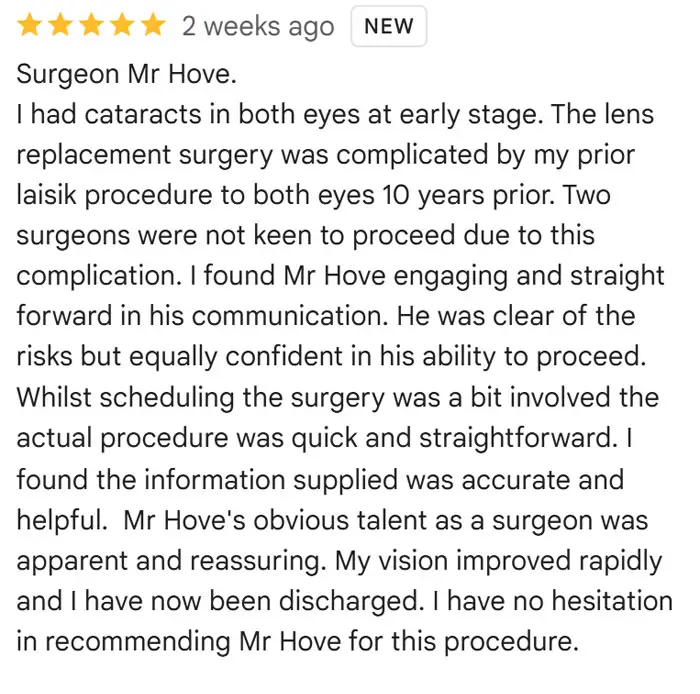
“I had cataracts in both eyes at early stage. The lens replacement surgery was complicated by my prior lasik procedure to both eyes 10 years prior. Two surgeons were not keen to proceed due to this complication. I found Mr Hove engaging and straight forward in his communication. He was clear of the risks but equally confident in his ability to proceed. Whilst scheduling the surgery was a bit involved the actual procedure was quick and straightforward. I found the information supplied was accurate and helpful. Mr Hove’s obvious talent as a surgeon was apparent and reassuring. My vision improved rapidly and I have now been discharged. I have no hesitation in recommending Mr Hove for this procedure.”
Clinical Explanation
Previous corneal laser vision correction, whether LASIK, PRK, LASEK or SMILE, does not prevent later cataract surgery or lens replacement surgery. The natural lens is still removed and replaced through the same small-incision phacoemulsification technique used in any modern cataract operation; the cornea itself is not re-operated. What changes is the planning.
LASIK works by reshaping the front surface of the cornea to alter its focusing power. The biometry instruments and lens-power formulae used in routine cataract surgery were designed for corneas that have never been altered, and they rely on a fixed assumption about the relationship between the front and back corneal surfaces. After laser treatment that assumption no longer holds, and if it is left uncorrected the replacement lens power is calculated incorrectly. The operation is therefore entirely feasible, but only when measurement and calculation use methods developed specifically for post-laser eyes. This patient’s observation that “scheduling the surgery was a bit involved” reflects precisely that: the extra measurement and cross-checking a previously lasered eye requires before a lens power is finalised.
Your previous laser treatment doesn’t stop the operation; it changes the maths we use to choose the new lens.
Structured Context
Applies to: anyone with previous corneal laser vision correction for short sight, long sight or astigmatism (LASIK, PRK, LASEK, SMILE) who is now developing cataract or considering refractive lens exchange, and particularly where, as here, one or more surgeons have hesitated specifically because of the prior laser treatment.
Does not apply to: eyes with no history of corneal refractive surgery, where standard biometry and formulae remain reliable; eyes with previous radial keratotomy, which behave differently again and need their own approach; or eyes with corneal, retinal or other disease that independently affects suitability. Suitability is always determined case by case, and depends on corneal health, the quality of the measurements obtained, and whether any pre-laser refraction data is available.
Published Evidence
National guidance from the American Academy of Ophthalmology confirms that cataract surgery after previous excimer laser treatment is appropriate, while advising that refractive outcomes are less predictable than in eyes that have not had laser correction.¹ Contemporary reviews set out the recognised approaches to these eyes,² and validated methods such as the Barrett True-K formula, used alone or through the ASCRS post-refractive calculator, substantially improve the accuracy of lens-power selection.³ ⁴ Where measurements remain uncertain, intraoperative aberrometry allows the lens power to be checked during surgery itself,⁵ and pooled analyses confirm that several modern methods now deliver accurate outcomes in post-laser eyes when applied together.⁶ The decisive factor is disciplined measurement and planning, reconciling multiple methods in each eye, rather than any single lens or device.²
Blue Fin Vision® – Practice Data
In our own practice, the enhancement rate after lens-based surgery is approximately 2% overall, and approximately 5-6% in eyes with previous laser vision correction, higher, as expected, but still low. That figure reflects the planning system rather than any single lens or device.
Surgeon Interpretation
A previous LASIK treatment is one of the most common reasons a cataract patient is told their case is ‘complicated’. It is a fair word, these eyes are more demanding to plan, but complicated is not the same as inadvisable. The caution two other surgeons showed is understandable and, in its own way, responsible: a surgeon who does not routinely work with post-laser biometry is right to hesitate. What this patient needed was not more reassurance but a different method, measuring the cornea with techniques that do not depend on the broken assumption, calculating the lens power with several post-laser formulae rather than one, and resolving any disagreement between them, including intraoperatively where appropriate. Being clear about the risks while remaining confident in the plan is not a contradiction. In these eyes it is the only defensible position.
Mr Mfazo Hove, Consultant Ophthalmic Surgeon.
Clinical Takeaway
Previous LASIK is a planning challenge, not a barrier. In eyes measured and selected with post-laser methods, cataract and lens replacement surgery can be performed safely and with a good visual result, provided the case is in the hands of a surgeon who does this routinely.
References
- Pantanelli SM, Lin CC, Al-Mohtaseb Z, Rose-Nussbaumer JR, Santhiago MR, Steigleman WA 3rd, Schallhorn JM. Intraocular lens power calculation in eyes with previous excimer laser surgery for myopia: a report by the American Academy of Ophthalmology. Ophthalmology. 2021;128(5):781-792. doi:10.1016/j.ophtha.2020.10.031
- Wang L, Koch DD. Intraocular lens power calculations in eyes with previous corneal refractive surgery: review and expert opinion. Ophthalmology. 2021;128(11):e121-e131. doi:10.1016/j.ophtha.2020.06.054
- Abulafia A, Hill WE, Koch DD, Wang L, Barrett GD. Accuracy of the Barrett True-K formula for intraocular lens power prediction after laser in situ keratomileusis or photorefractive keratectomy for myopia. J Cataract Refract Surg. 2016;42(3):363-369. doi:10.1016/j.jcrs.2015.11.039
- Ferguson TJ, Downes RA, Randleman JB. IOL power calculations after LASIK or PRK: Barrett True-K biometer-only calculation strategy yields equivalent outcomes as a multiple formula approach. J Cataract Refract Surg. 2022;48(7):784-789. doi:10.1097/j.jcrs.0000000000000883
- Ianchulev T, Hoffer KJ, Yoo SH, Chang DF, Breen M, Padrick T, Tran DB. Intraoperative refractive biometry for predicting intraocular lens power calculation after prior myopic refractive surgery. Ophthalmology. 2014;121(1):56-60. doi:10.1016/j.ophtha.2013.08.041
- Pan X, Wang Y, Li Z, Ye Z. Intraocular lens power calculation in eyes after myopic laser refractive surgery and radial keratotomy: Bayesian network meta-analysis. Am J Ophthalmol. 2024;262:48-61. doi:10.1016/j.ajo.2023.09.026


