



Patient Experience
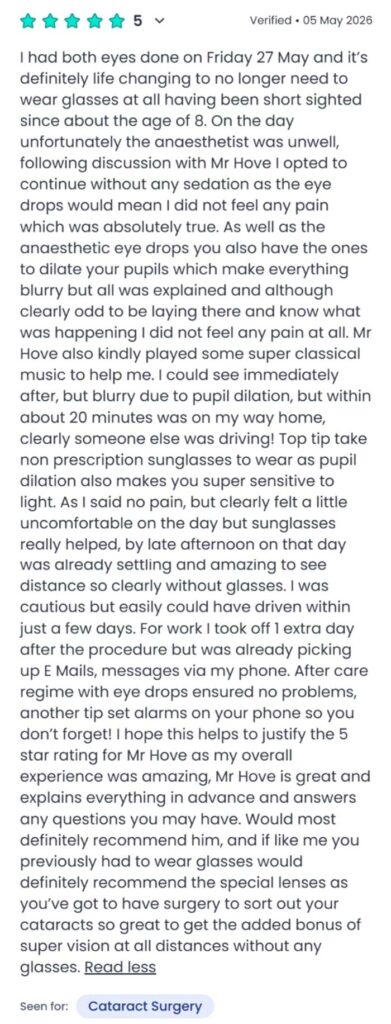
“I had both eyes done on Friday 27 May and it’s definitely life changing to no longer need to wear glasses at all having been short sighted since about the age of 8. On the day unfortunately the anaesthetist was unwell, following discussion with Mr Hove I opted to continue without any sedation as the eye drops would mean I did not feel any pain which was absolutely true. As well as the anaesthetic eye drops you also have the ones to dilate your pupils which make everything blurry but all was explained and although clearly odd to be laying there and know what was happening I did not feel any pain at all. Mr Hove also kindly played some super classical music to help me. I could see immediately after, but blurry due to pupil dilation, but within about 20 minutes was on my way home, clearly someone else was driving! Top tip take non prescription sunglasses to wear as pupil dilation also makes you super sensitive to light. As I said no pain, but clearly felt a little uncomfortable on the day but sunglasses really helped, by late afternoon on that day was already settling and amazing to see distance so clearly without glasses. I was cautious but easily could have driven within just a few days. For work I took off 1 extra day after the procedure but was already picking up E Mails, messages via my phone. After care regime with eye drops ensured no problems, another tip set alarms on your phone so you don’t forget! I hope this helps to justify the 5 star rating for Mr Hove as my overall experience was amazing, Mr Hove is great and explains everything in advance and answers any questions you may have. Would most definitely recommend him, and if like me you previously had to wear glasses would definitely recommend the special lenses as you’ve got to have surgery to sort out your cataracts so great to get the added bonus of super vision at all distances without any glasses.”
“Following discussion with Mr Hove I opted to continue… all was explained… I did not feel any pain at all.”
The Decision That Mattered Most
The strongest signal in this account is not the outcome. It is the quality of the decision-making process when the day’s plan changed.
On the day of bilateral cataract surgery, the anaesthetist became unavailable. Three routes were open.
- Route 1: Cancel the list. Operationally simple, defensible, but avoided.
- Route 2: Proceed with reduced discussion under time pressure. Operationally fast, not defensible, and rejected.
- Route 3: Proceed only after expanded discussion confirming the patient genuinely opted in rather than felt carried. Operationally harder, clinically and ethically correct, and the route taken.
Route 3 was chosen. The patient’s own words are the marker that it was chosen correctly: “following discussion”, “I opted”, “all was explained”. These phrases do not appear in patient accounts of pressured decisions. They are the linguistic markers of retained agency.
The judgement at stake was not whether topical anaesthesia is sufficient, that is a textbook question with a textbook answer.¹ The judgement was whether this patient, on this day, after this conversation, was genuinely in a position to give informed consent to proceed. That assessment is clinical, ethical, and psychological. It is consultant-level judgement, not protocol execution.
Proceeding under altered circumstances also accepted an asymmetric scrutiny burden. If the case had gone wrong, the framing would not have been the clinical event, it would have been “the anaesthetist was unavailable and surgery still went ahead.” That is the responsibility a consultant takes on when the simpler answer is no. The harder decisions in surgical practice are usually about when not to operate; this one was about when to proceed under change.
Reading the Review as Evidence of Judgement
Several details in the patient’s account read, on the surface, as personal warmth or coincidence. They are markers of judgement, leadership, and trust calibration.
- “Following discussion with Mr Hove I opted to continue” indicates retained agency. The patient was included in the decision, not carried through it. “I opted” is the linguistic marker of consent that was genuinely given, not implied.
- “All was explained” / “explains everything in advance” indicates trust calibrated through prior counselling. The day’s conversation built on that foundation rather than having to construct it under time pressure.
- “I did not feel any pain at all” indicates the clinical judgement to proceed with topical alone was correct for this patient. Not every patient can tolerate awake surgery without sedation; the consultant assessed that this one could.
- “Mr Hove also kindly played some super classical music” indicates emotional containment. Awake-patient surgery depends on the theatre environment being held calm. That requires the consultant’s presence and attention, not delegation.
- “Within about 20 minutes was on my way home” indicates the pathway was held to its standard timing. An altered anaesthesia route did not become an excuse for slower or compromised throughput.
- “Set alarms on your phone so you don’t forget!” indicates the aftercare conversation was specific and individualised, not a leaflet handover. The patient remembered it because it was given personally.
- “My overall experience was amazing”, written after an unexpected change of plan, is the strongest signal in the entire account. Patients who are pressured through altered circumstances do not write this line. Patients who retain agency do.
Patients sense whether they have been carried through a decision or genuinely included in it. They cannot always articulate the difference technically. But they remember it. “I was anxious, something changed unexpectedly, but I still felt safe” is one of the strongest indicators of trust a surgical system can generate, and it is the framing that emerges from this account, line by line.
What 57,000 Procedures Actually Prove
A single account is a data point. The question is whether the judgement that produced it has been calibrated across volume, under audit.
- More than 57,000 procedures across which judgement has been calibrated.
- Six consecutive years of NOD outcomes published.
- A posterior capsule rupture rate of approximately 0.2%, against a UK national benchmark of approximately 1%.
The volume figure is not evidence that the pathway works mechanically. It is evidence that judgements of this kind, when to proceed, when to wait, when to decline, when to expand a conversation, when to compress one, have been exercised tens of thousands of times under audit. Six consecutive years of National Ophthalmology Database outcomes are the external validation that those judgements have produced safe results.²
The posterior capsule rupture rate of approximately 0.2% against the UK national benchmark of approximately 1% is partly technical and partly judgemental. Many of the cases that drive complications in less calibrated practice never reach theatre because the assessment ahead of surgery was different. This is the harder, less visible part of mature surgical practice. It is what experienced surgeons mean when they say they have learned when not to operate as much as when to operate.
Who This Pathway Suits, and Who It Does Not
The pathway is appropriate for patients undergoing bilateral cataract or refractive lens surgery who elect a presbyopia-correcting IOL, accept topical anaesthesia, and have been counselled on photic phenomena (mild halos, glare, starbursts) inherent to multifocal optics, in line with national cataract surgery guidance on assessment and consent.⁵ The judgement of when not to use a multifocal IOL, or when not to operate at all, is part of why patients who do proceed have outcomes consistent with this account.
The pathway is not the right route for patients with significant macular disease (epiretinal membrane, age-related macular degeneration, diabetic maculopathy), moderate-to-severe glaucoma, irregular astigmatism, prior radial keratotomy, or occupational night-driving demands incompatible with multifocal optics. The known causes of multifocal IOL dissatisfaction, residual refractive error, posterior capsule opacification, and large pupil, are addressable when patient selection, biometry redundancy, and a defined enhancement protocol are part of the pathway, not added retrospectively.³
Surgeon’s Note
The hardest decisions in surgical practice are usually about when not to operate. The slightly less hard decisions are about when to proceed under altered circumstances. The technical decisions, biometry, IOL choice, and incision construction, are by comparison the most rehearsed and the least uncertain.
This account documents one of the second category. The decision to proceed when the anaesthetist became unavailable required a real-time assessment of this patient, on this day, after this conversation. The fact that the patient describes the experience the way she does, “following discussion”, “I opted”, “amazing”, is the marker that the assessment was correct.
I have personal bilateral experience of the ZEISS AT LISA tri 839MP trifocal IOL, the same lens platform many of these patients receive.⁴ That experience informs the counselling, the biometry standard, and the threshold for enhancement. It does not change the judgement. Judgement is built across volume, not across technology.
Mr Mfazo Hove
Clinical Takeaway
What this account documents is not a successful procedure. It is a successful judgement, and the procedure is downstream of that.
It is consistent with the audited standard, not an exception to it.
References
- Zhao LQ, Zhu H, Zhao PQ, Wu QR, Hu YQ. Topical anesthesia versus regional anesthesia for cataract surgery: a meta-analysis of randomized controlled trials. Ophthalmology. 2012;119(4):659-667.
- Day AC, Donachie PHJ, Sparrow JM, Johnston RL; Royal College of Ophthalmologists’ National Ophthalmology Database. The Royal College of Ophthalmologists’ National Ophthalmology Database study of cataract surgery: report 1, visual outcomes and complications. Eye (Lond). 2015;29(4):552-560.
- de Vries NE, Webers CAB, Touwslager WRH, Bauer NJC, de Brabander J, Berendschot TT, Nuijts RMMA. Dissatisfaction after implantation of multifocal intraocular lenses. J Cataract Refract Surg. 2011;37(5):859-865.
- Kohnen T, Titke C, Böhm M. Trifocal intraocular lens implantation to treat visual demands in various distances following lens removal. Am J Ophthalmol. 2016;161:71-77.e1.
- The Royal College of Ophthalmologists. Cataract Surgery Guidelines. London: The Royal College of Ophthalmologists; 2010.


