- Medically Reviewed by: Mr Mfazo Hove, Consultant Ophthalmic Surgeon
- Author: Mr Mfazo Hove
- Published: August 26, 2025
- Last Updated: September 17, 2026
TL;DR: In your 20s and 30s, laser eye surgery is usually the natural first question. In your 40s, the question changes because the natural lens has begun to stiffen: laser reshapes the cornea and has high patient satisfaction in well-selected eyes,¹ while lens replacement surgery replaces the ageing lens. PRESBYOND® changes how the eyes work together, and an Implantable Collamer Lens (ICL) preserves the natural lens, but your measurements determine which option, if any, is appropriate.
What Is Actually Happening in a 40-Something Eye
Two systems determine your focus. The cornea, the clear front surface of the eye, has a fixed shape that sets your basic prescription. The natural lens changes shape to let a younger eye refocus from distance to near, a process called accommodation.
From the mid-40s, the lens stiffens and near focus fades regardless of how good your distance vision is. This age-related loss of near focus is called presbyopia. Decades later, the same lens usually clouds into a cataract.
Any honest comparison starts here: laser treats the cornea, while lens replacement treats the lens. With every year past 45, the lens is more likely to be the real problem.
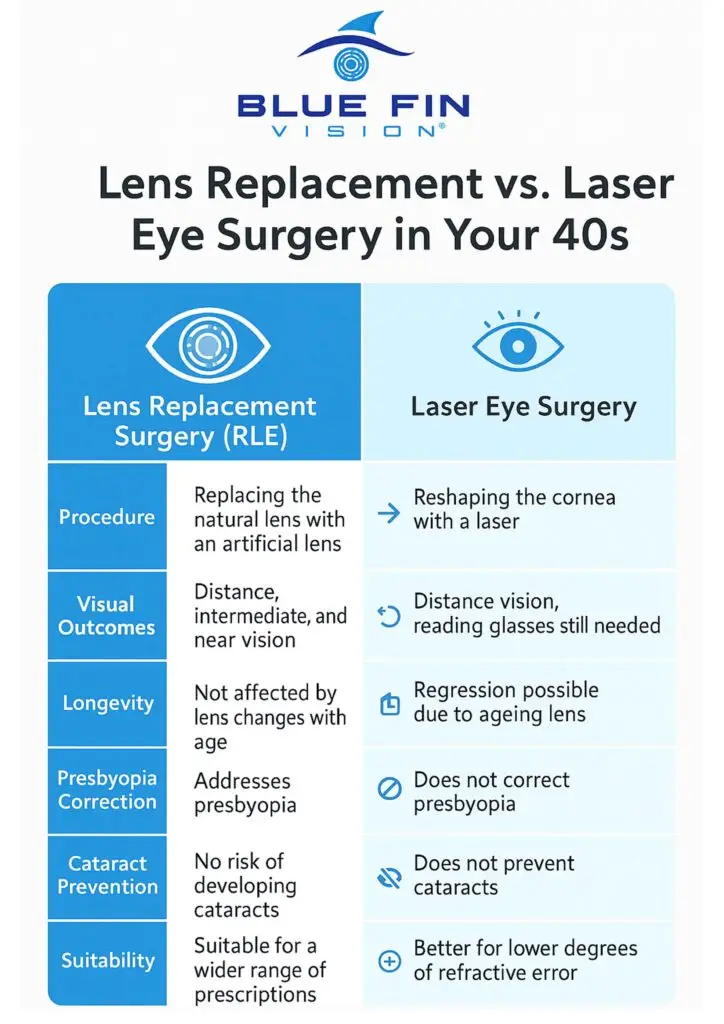
Infographic: Lens Replacement vs. Laser Eye Surgery in Your 40s
The Comparison, Point by Point
What It Changes
- Corneal laser: Changes the shape of the cornea. PRESBYOND® additionally changes how the two eyes share distance and near vision.
- Lens replacement surgery: Also called refractive lens exchange (RLE), it exchanges the natural lens for a calculated artificial lens.
Accommodation
- Corneal laser: Preserves whatever natural refocusing ability you retain, which then declines on nature’s schedule.
- Lens replacement surgery: Removes this natural focusing ability. The artificial lens distributes focus but does not flex, so the decline in accommodation is settled once, on your terms.
Future Cataract
- Corneal laser: Leaves the natural lens in place, so it will continue to age. A laser-shaped cornea can also make future lens calculations more demanding.
- Lens replacement surgery: Removes the natural lens that would have developed a cataract, using the same core surgical procedure and type of intraocular lens as cataract surgery. The replacement lens cannot develop a cataract. However, posterior capsule opacification, a clouding of the membrane behind the lens, can occur later and may require YAG laser capsulotomy to restore clarity.
Invasiveness
- Corneal laser: Involves surface or flap surgery, leaving the inside of the eye untouched.
- Lens replacement surgery: Is intraocular surgery, meaning surgery performed inside the eye, with the rare but real risks that this implies.
Retinal Considerations
- Corneal laser: Does not create retinal risk through removal of the natural lens. However, any underlying retinal risk associated with high myopia, or severe short-sightedness, remains.
- Lens replacement surgery: Carries greater retinal considerations in long, highly myopic eyes. This can shift the recommendation towards preserving the natural lens and considering an Implantable Collamer Lens (ICL).
Night-Time Optics
- Corneal laser: Generally provides excellent night-time optics in well-selected eyes, although blended vision requires adaptation between the eyes.
- Lens replacement surgery: Multifocal lenses distribute light across more than one focal distance. They may trade some night quality, contrast and freedom from glare or haloes for greater spectacle independence. Monofocal lenses provide one main point of focus and do not create the same multifocal optical effects.
Recovery
- Corneal laser: Visual recovery is typically fast, although surface techniques take longer than flap-based procedures.
- Lens replacement surgery: Improvement typically occurs within days, followed by refinement over several weeks. Neuroadaptation, the process through which the brain adjusts to new visual information, may take several months with premium lenses.
Longevity of the Result
- Corneal laser: Delivers its correction onto a natural lens that continues to age, so presbyopia and cataract can still develop.
- Lens replacement surgery: An artificial lens does not age, and the correction is intended to be lasting. However, posterior capsule opacification or other changes in the eye may still require assessment or treatment.
Future Surgery
- Corneal laser: Cataract surgery still lies ahead. Biometry, the detailed measurements used to calculate lens power, can also be more demanding after previous laser treatment.
- Lens replacement surgery: YAG laser capsulotomy may be required for capsule haze. This brief laser treatment creates a clear opening in the clouded membrane behind the artificial lens. Further lens surgery is rarely needed.
Screening Emphasis
- Corneal laser: Screening focuses on corneal thickness, topography and ectasia risk. Corneal topography maps the shape and curvature of the cornea, while ectasia is progressive weakening and bulging of the cornea.
- Lens replacement surgery: Screening focuses on biometry accuracy, the condition of the natural lens, retinal health and matching the selected lens to the patient’s expectations.
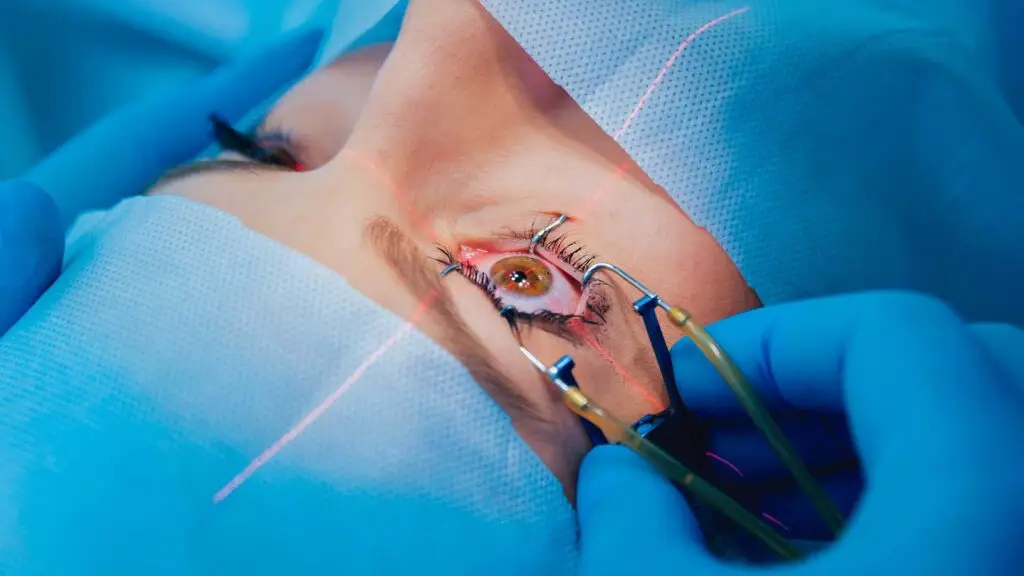
The Case for Laser Eye Surgery in Your 40s
Laser remains excellent where the cornea is genuinely the issue. Suitable patients have a stable distance prescription within range, appropriate corneal thickness and topography, and expectations that fit.²
Well-selected laser surgery carries world literature satisfaction around 95%.¹ For early presbyopia, PRESBYOND® laser blended vision can extend useful near function by tuning the two eyes to share the range between them. It is a binocular strategy, meaning it changes how the two eyes work together, rather than replacing the natural lens.
For suitable patients with early presbyopia, it is a genuinely attractive middle road that preserves the natural lens.
The honest caveats are that laser does not stop the lens ageing behind it, and the reading problem returns as accommodation continues to fade. The cataract appointment in later decades still stands, with the added footnote that a lasered cornea makes future lens calculations more demanding.
The Case for Lens Replacement Surgery in Your 40s
Lens replacement addresses the ageing part directly. The stiffening natural lens is exchanged for an artificial lens whose optics are selected for your life.
Trifocal lenses distribute focus across distance, intermediate and near vision. Extended depth of focus lenses provide an extended range of clear vision, while monofocal lenses provide one main point of focus. Trifocal and extended depth of focus designs deliver substantially greater spectacle independence than monofocal lenses, at the recognised cost of more glare and haloes.³ ⁴
Toric lenses, which are designed to correct astigmatism, can address this focusing error during the same operation.⁵ The natural lens that would have developed a cataract is removed, although posterior capsule opacification can still develop later.
The honest caveats are that this is intraocular surgery with rare but real risks, and retinal considerations are greater in long, myopic eyes. Accommodation is removed irreversibly, so lens replacement is usually wrong for eyes that can still focus naturally.
The strength of the case rises with age, hyperopia, lens change and dependence on varifocal glasses. Hyperopia means long-sightedness. The case weakens with youth, high myopia and a still-working natural lens.
Four Patients, Four Different Answers
44, minus 2.00, excellent corneas, some near function remaining. This indicates a moderately short-sighted prescription. The lens is still doing useful work and the prescription sits comfortably on the cornea.
Laser is usually the more attractive road here, with PRESBYOND® worth modelling as presbyopia advances. Replacing a lens that still accommodates would spend something this patient has not yet lost.
49, plus 4.00, presbyopic, varifocal-dependent. This indicates a relatively strong long-sighted prescription. High hyperopia, or long-sightedness, and presbyopia are both lens-sized problems. The cornea was never the issue, and every year deepens the dependence.
A lens-based solution becomes increasingly logical, and this archetype is often the happiest trifocal patient in the clinic.
46, minus 10.00, clear lenses. This indicates severe short-sightedness. The reflex answer, “too high for laser, therefore lens replacement”, is the wrong reflex.
This is a long eye, where retinal considerations after lens removal are genuinely greater. The retina is the light-sensitive layer at the back of the eye, and severe short-sightedness can increase the risk of retinal problems.
A clear, still-focusing lens is worth preserving. The ICL deserves serious discussion first, with lens replacement held for the decade when the lens itself declines. Contemporary guidance on refractive lens exchange specifically emphasises careful selection at the extremes of myopia and hyperopia.⁶
52, early lens opacity, presbyopic. Lens opacity means that the natural lens is beginning to lose its clarity. The natural lens is now clinically part of the problem, with duller contrast and flaring around headlights.
Lens surgery moves clearly ahead. The only real questions are timing and optics, and delaying may simply mean making essentially the same lens decision later after living with progressively more symptoms.

The Six Questions That Decide It
- How old are your eyes functionally: is near focus already fading, or genuinely still working?
- Is your distance prescription within laser’s comfortable range, with a cornea whose measurements support safe treatment?
- How long is your eye: does high myopia shift the retinal risk balance towards preserving your natural lens?
- What do you want from near vision: convenience, or freedom, and at what night-time price?
- How do you feel about the cataract decades ahead: happy to meet it later, or minded to retire it now?
- And the honest tiebreaker: which structure, cornea or lens, do your measurements say is the real problem?
I have shared my own experience with ZEISS AT LISA trifocal lenses. I underwent lens surgery for cataracts in April 2024, so laser was never an option for the problem I had.
I live with trifocal lenses in both eyes and am approaching two and a half years with them. The lens-based road is one I know from both sides of the microscope.
The deliberately one-sided affirmative case is argued in 7 Reasons Lens Replacement Surgery Can Outperform Laser Eye Surgery in Your 40s. This page exists to keep the comparison honest.
So, Lens Replacement or Laser in Your 40s?
Whichever operation your measurements, not your search history, point to.
Because Blue Fin Vision® performs laser eye surgery, ICL surgery and lens replacement surgery, the assessment can end in any of them, or in the advice to do nothing. A credible assessment must be capable of exactly that.
Laser Eye Surgery consultations are complimentary. Lens Replacement Surgery consultations are paid, reflecting the depth and independence of a consultant-led clinical evaluation.
Book a consultation to compare your options at Blue Fin Vision® across London, Hertfordshire and Essex, including our flagship Harley Street clinic. You may also wish to bring the Lens Replacement Surgery Checklist to your appointment.
References
- Solomon KD, Fernández de Castro LE, Sandoval HP, Biber JM, Groat B, Neff KD, Ying MS, French JW, Donnenfeld ED, Lindstrom RL; Joint LASIK Study Task Force. LASIK world literature review: quality of life and patient satisfaction. Ophthalmology. 2009;116(4):691-701. PMID: 19344821.
- Randleman JB, Woodward M, Lynn MJ, Stulting RD. Risk assessment for ectasia after corneal refractive surgery. Ophthalmology. 2008;115(1):37-50. PMID: 17624434.
- de Silva SR, Evans JR, Kirthi V, Ziaei M, Leyland M. Multifocal versus monofocal intraocular lenses after cataract extraction. Cochrane Database Syst Rev. 2016;12:CD003169. PMID: 27943250.
- Wilkins MR, Allan BD, Rubin GS, Findl O, Hollick EJ, Bunce C, Xing W; Moorfields IOL Study Group. Randomized trial of multifocal intraocular lenses versus monovision after bilateral cataract surgery. Ophthalmology. 2013;120(12):2449-2455. PMID: 24070808.
- Kessel L, Andresen J, Tendal B, Erngaard D, Flesner P, Hjortdal J. Toric intraocular lenses in the correction of astigmatism during cataract surgery: a systematic review and meta-analysis. Ophthalmology. 2016;123(2):275-286. PMID: 26601819.
- Maldonado MJ, de Salazar Campos A, Castro Machado A. Indications and risk factors in refractive lens exchange: outcomes and special cases (extremes hyperopes and myopes). Arch Soc Esp Oftalmol (Engl Ed). 2026. PMID: 42476410.
ABOUT THE AUTHOR
Mr Mfazo Hove
Consultant Ophthalmic Surgeon
MBChB MD FRCOphth CertLRS
Mr Mfazo Hove is a Consultant Ophthalmic Surgeon with experience spanning more than 57,000 procedures. He completed 6.5 years of specialist training at Moorfields Eye Hospital and served for five years as a consultant at the Western Eye Hospital, Imperial College Healthcare NHS Trust. He is the founder of Blue Fin Vision®, a consultant-led private ophthalmology practice operating across London, Essex, and Hertfordshire. His clinical expertise encompasses advanced cataract surgery, refractive lens replacement, laser vision correction, and implantable Collamer lenses (ICL).
A ZEISS Key Opinion Leader, Mr Hove is a respected international speaker with five invited engagements across seven cities in 2026:
- ZEISS China tour (Changsha, Shanghai, and Hangzhou, April – ZEISS APAC User Meeting)
- RCOphth Annual Congress – May – Manchester
- ZEISS EMEA User Meeting (Istanbul)
- ZEISS Lausanne User Meeting (Lausanne)
- European Society of Cataract and Refractive Surgeons Annual Congress (ESCRS, London)