Blue Fin Vision® Featured In Daily Mail: Can Red-Light Glasses Improve Eyesight?
- Posted
- Medically Reviewed by: Mr Mfazo Hove, Consultant Ophthalmic Surgeon
- Author: Chris Dunnington
- Published: September 8, 2026
- Last Updated: October 22, 2026
TL;DR: Mr Mfazo Hove, consultant ophthalmic surgeon and founder of Blue Fin Vision®, spoke to the Daily Mail about red-light glasses marketed for age-related changes in vision. He explained that red-light therapy is a genuine area of scientific research, but evidence for consumer devices remains limited and they should not be considered an established treatment.

Could Red-Light Glasses Improve Vision?
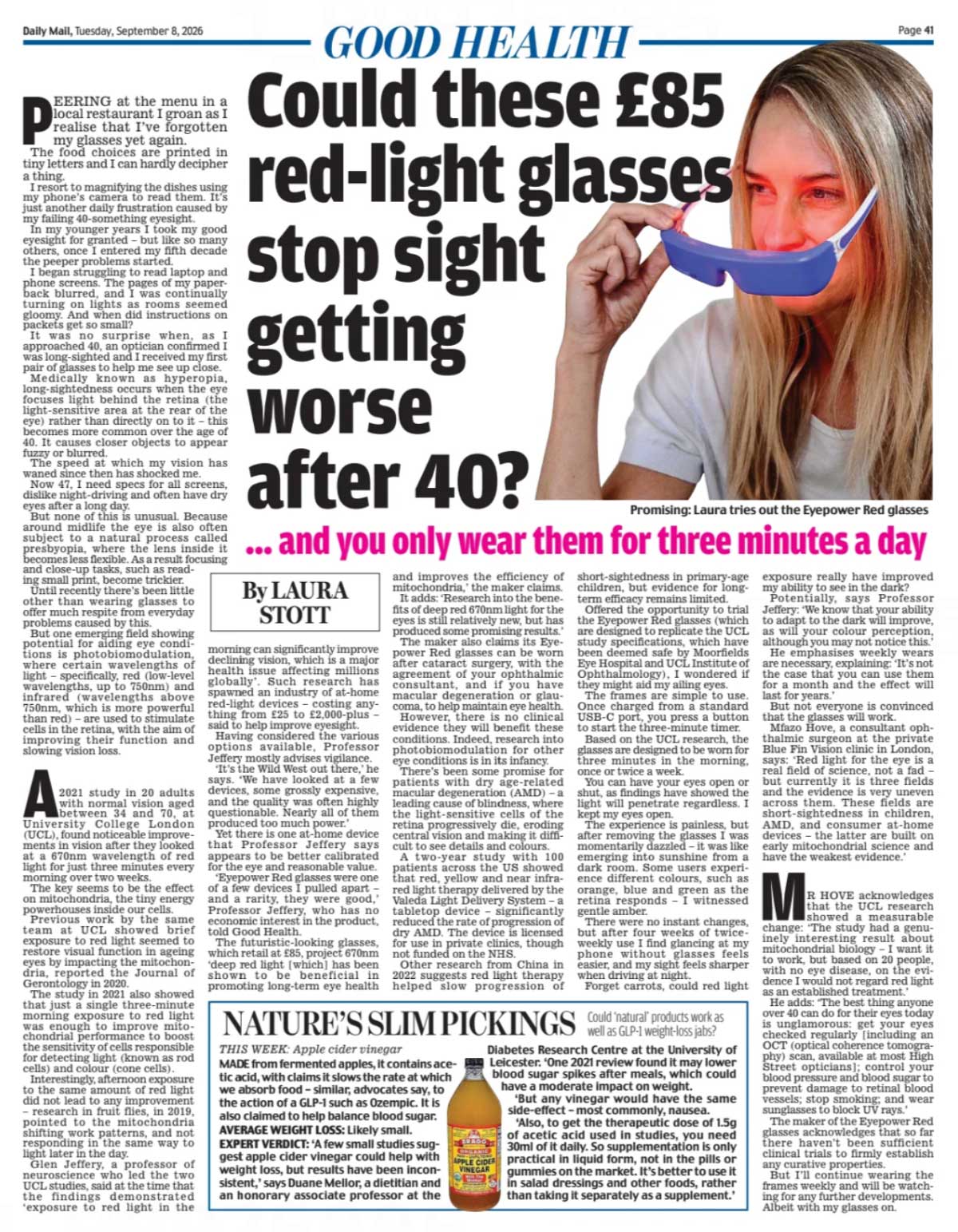
The Daily Mail examined whether £85 red-light glasses could help people experiencing changes in their eyesight after the age of 40.
Journalist Laura Stott trialled the glasses after finding that reading menus, books and digital screens had become increasingly difficult. She also reported problems with night driving and dry eyes after extended screen use.
These symptoms are common during midlife. Presbyopia, the gradual loss of the eye’s ability to focus clearly on nearby objects, usually develops as the natural lens inside the eye becomes less flexible.
The glasses featured in the article expose the eyes to a specific wavelength of red light for three minutes at a time. Their design is based on emerging research into photobiomodulation, which uses controlled wavelengths of light to influence cellular activity.
How Red-Light Therapy May Affect The Eye
Red-light therapy research has focused partly on mitochondria, the structures within cells that produce energy.
Laboratory and small-scale human studies have suggested that certain wavelengths of red light may influence mitochondrial performance within retinal cells. The retina is the light-sensitive tissue at the back of the eye that converts light into signals for the brain.
The Daily Mail highlighted a University College London study involving 20 adults without diagnosed eye disease. Researchers reported measurable changes in aspects of visual function after brief morning exposure to 670-nanometre red light.
However, the small number of participants and the absence of eye disease within the study group mean the findings cannot establish red-light glasses as an effective clinical treatment.

Evidence Varies Between Eye Conditions
Mr Hove explained that red-light research relating to the eyes should not be treated as one single field:
“Red light for the eye is a real field of science, not a fad – but currently it is three fields and the evidence is very uneven across them.”
He identified three distinct areas of research:
- Short-sightedness in children.
- Age-related macular degeneration.
- Consumer red-light devices intended for use at home.
Mr Hove cautioned that home-use products currently have the weakest supporting evidence:
“These fields are short-sightedness in children, AMD, and consumer at-home devices – the latter are built on early mitochondrial science and have the weakest evidence.”
This distinction matters because findings from a controlled clinical device or a study investigating a specific eye condition cannot automatically be applied to every red-light product sold to consumers.
An Interesting Result, Not An Established Treatment
Mr Hove acknowledged that the University College London study produced a measurable and scientifically interesting result.
He told the Daily Mail:
“The study had a genuinely interesting result about mitochondrial biology – I want it to work, but based on 20 people, with no eye disease, on the evidence I would not regard red light as an established treatment.”
The manufacturer of the glasses also acknowledged that there have not yet been sufficient clinical trials to establish curative properties.
People should therefore be cautious about claims that home-use red-light glasses can treat presbyopia, glaucoma, age-related macular degeneration or other diagnosed eye conditions. Anyone with an existing condition should speak to their optometrist or ophthalmologist before using an eye-related light therapy device.
What People Over 40 Can Do Now
Rather than relying on an emerging consumer technology, Mr Hove recommended several established steps for protecting eye health:
“The best thing anyone over 40 can do for their eyes today is unglamorous: get your eyes checked regularly, including an OCT scan; control your blood pressure and blood sugar to prevent damage to retinal blood vessels; stop smoking; and wear sunglasses to block UV rays.”
An OCT, or optical coherence tomography scan, creates detailed cross-sectional images of the retina and other structures at the back of the eye. It can help eye-care professionals identify changes that may not be apparent during a basic sight test.
Regular eye examinations are particularly important because some eye conditions develop without obvious symptoms during their early stages.
When To Arrange An Eye Examination
Arrange an eye examination if you notice:
- Increasing difficulty reading or focusing on nearby objects.
- Blurred, distorted or reduced vision.
- Difficulty seeing in dim light or driving at night.
- Straight lines appearing bent or wavy.
- New flashes, floaters or dark areas in your vision.
- Persistent eye discomfort or dryness.
- Any sudden or unexplained change in sight.
Sudden loss of vision, a dark curtain or shadow across your sight, severe eye pain, or a rapid increase in flashes and floaters requires urgent medical assessment.
Read the Full Coverage
Daily Mail: Could these £85 red-light glasses stop sight getting worse after 40?, by Laura Stott, published 8 September 2026. Please note: this article may require a Daily Mail subscription to read in full.

Concerned About Changes In Your Vision?
Changes in near vision are common after 40, but new or worsening symptoms should still be assessed properly. A detailed examination can determine whether you need updated glasses or whether an underlying eye condition requires further investigation.
The Blue Fin Vision® team invites you to book a paid consultation at our consultant-led clinics across London, Hertfordshire and Essex. Your assessment can include advanced diagnostic imaging, with advice based on your eye health, visual needs and individual findings.