- Medically Reviewed by: Mr Mfazo Hove, Consultant Ophthalmic Surgeon
- Author: Mr Mfazo Hove
- Published: July 30, 2026
- Last Updated: August 6, 2026
Why Modern Cataract Surgery Has Never Delivered More Value, or Been Valued Less
A cataract surgeon in the United States, posting on Instagram as drkim_ophthomom, recently went viral with a short and effective sequence. In 2006, she noted, Medicare reimbursement for cataract surgery in the United States was around $684. Today it is $463.¹ ² Her conclusion was blunt: this is unsustainable. She is right, and although the figures and the healthcare system differ on this side of the Atlantic, the underlying story is the same one I have watched unfold across my own career. It is worth setting out plainly what has actually happened, because the headline number is only half of it.
Over the last twenty years, cataract surgery has become one of the great success stories of modern medicine. It is quicker than it was, markedly safer, and more precise in its outcomes than most surgeons of an earlier generation would have believed possible. Patients who once faced a significant operation with a guarded prognosis now expect, quite reasonably, a short procedure and an excellent result.
There is a paradox buried in that progress, and it is one the profession rarely says out loud. Over exactly the same period in which the operation became better and safer, and in which the true cost of delivering it to a modern standard rose, the amount paid to perform it fell. Not once, not in a single adjustment, but continuously. Value delivered went up. Cost to deliver went up. Payment went down. Those three lines have been diverging for two decades, and the gap between them is now the defining economic fact of cataract surgery.
Progress Is Not Free to Deliver
The improvement in cataract surgery has been real and hard won. Phacoemulsification techniques matured. Biometry became dramatically more accurate. Intraocular lens design advanced from simple monofocal optics to a spectrum of toric, extended-depth-of-focus and trifocal lenses. Surgical training and case volume drove complication rates down to levels that would have been aspirational twenty years ago. This is a genuine triumph, and patients are the beneficiaries of it.
But every element of that progress costs money to deliver. Modern biometers and imaging platforms are expensive to buy and to maintain. Almost everything that touches the patient is now single-use. That is a deliberate and worthwhile choice, because disposable instrumentation lowers the risk of infection and cross-contamination to a degree reusable kit cannot match, and endophthalmitis is precisely the complication no surgeon is willing to gamble on. But it comes at a cost that is both financial and environmental: a single routine cataract operation generates a striking volume of packaging and plastic waste, and every item of it has to be bought, stocked and disposed of.⁵ Premium consumables, single-use instrumentation and the infrastructure of a safe theatre environment all cost more than they did, and lens choice alone now carries a measurable cost burden within publicly funded pathways.⁴ And the least visible cost is time. Consent, counselling, documentation and post-operative communication now consume far more of a surgeon’s day than they once did, driven by higher expectations and by a medicolegal climate in which every step must be recorded and defensible. Safer, better surgery is not cheaper surgery. It is, in almost every respect, more expensive to provide.

Cataract surgery in theatre at Blue Fin Vision®. The wall screen shows the surgeon’s live microscope view of the eye.
Remuneration Went the Other Way
Against that rising cost base, payment has moved steadily in the opposite direction. I can speak to this plainly, because it is my field. Over this period the insured reimbursement I have seen for cataract surgery has fallen from around £850 per eye to roughly £255 to £300 per eye today. That is a fall of approximately two thirds in nominal terms, per eye, before any adjustment for what two decades of inflation did to the real value of each of those pounds. In real terms the decline is steeper still.
I offer those figures as a practitioner’s direct observation rather than a published statistic, because insurer fee schedules of this kind are not, and have never been, matters of public record. But the direction of travel is unmistakable to anyone working in the field. The logic that produced it is almost perverse in its simplicity. Surgeons made the operation faster, safer and more predictable. Waiting times fell. Outcomes improved. And rather than that success being shared with the people delivering the care, it was used as the justification for paying less, on the assumption that something so routine could not require much.
Paradoxically, the better the profession made this operation, the easier it became for payers to justify reducing reimbursement.
From the surgeon’s side, the reality is the exact inverse of routine. Expectations have risen sharply. Medicolegal exposure has risen. Administrative and consent burden has risen. Every complication, however rare, carries greater scrutiny than ever before. So the true pressure is not simply falling pay. It is falling pay set against rising cost, rising expectation and rising accountability, all at once. That is not a squeeze. It is a structural mismatch, and the effect is that a surgeon must invest steadily more, in technology, in disposables, in time and in care, simply to hold the same ground. We are, in a real sense, running to stay still. It is why some ophthalmologists are stepping back from routine cataract work altogether, or confining themselves to cases that carry a premium.³
The Only Honest Response Is to Move Upmarket, Not Down
Faced with a structural mismatch of this kind, a provider has two directions available, and only one of them is honest. The first is to compete on price, to absorb the falling reimbursement and deliver more operations more cheaply. In a compressed-payment environment that is a race to the bottom, and it is a race that no one delivering careful, unhurried surgery can win. Something always gives, and it is usually the time spent with the patient, which is precisely the thing that should never give.
The second direction is to move upmarket. Not down to the lowest sustainable cost, but up to a model that allows the time, the technology and the attention that modern surgery genuinely requires. This is the choice Blue Fin Vision® has made deliberately. We do not compete on price. We compete on demonstrable value, building a service for patients who want personalised care, advanced diagnostics, premium technology and the widest possible range of treatment options, and who choose to invest in their vision rather than access the lowest-cost pathway. That decision is what buys the time to counsel properly, the technology to measure precisely, and the follow-up to see a patient through the full course of their recovery.
The upgrade ends where clinical care begins.
It matters what we mean by premium, because the word is easily misread as a two-tier standard of care. Premium is not about charging more; it is about creating demonstrably more value. And at Blue Fin Vision® there is a clear line, one that defines us: the upgrade ends where clinical care begins.
Patients may choose premium intraocular lenses. They may choose intravenous sedation. Those choices buy additional technology and services. They do not buy a safer operation, a more careful surgeon or greater attention to detail. Every patient receives those as standard, without exception, because clinical excellence is not something we are willing to tier.
The same is true of everything around the surgery. We do not strip away the elements that make the day feel considered simply because a patient has not upgraded. Whether a patient chooses a standard monofocal lens or the most advanced premium lens available, they are cared for by the same team, recover in the same surroundings, enjoy the same three-course meal after surgery and leave with the same celebratory bottle of champagne to take home. Premium technology is optional. Clinical excellence is standard. Premium, for us, is defined by choice and personalisation, never by compromising the experience of anyone who decides differently.
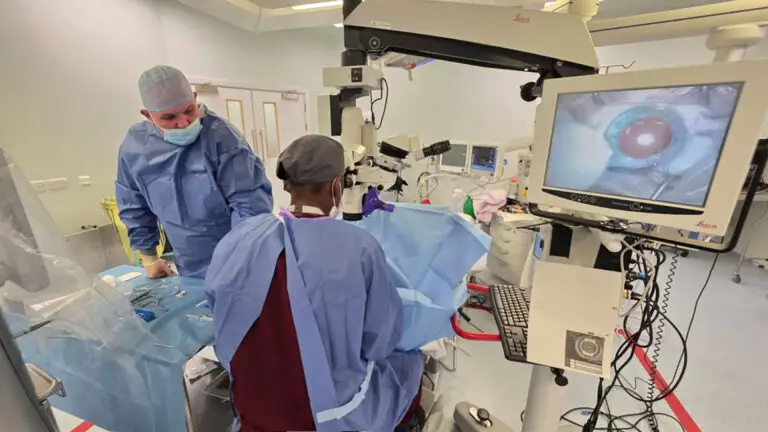
Cataract surgery in theatre at Blue Fin Vision®, One Hatfield Hospital.
The Final Complication: Perfection as the New Baseline
There is one more force at work, and it makes everything above harder to deliver. As reimbursement fell and costs rose, patient expectations did not merely rise, they shifted from wanting an excellent result to expecting a perfect and instantaneous one. Twenty years ago a patient largely wanted the cataract safely removed. Today the unspoken specification often includes perfect unaided vision, immediate recovery, no glare or haloes, no dry eye, freedom from glasses, and a return to work, driving or flying almost at once.⁶
The difficulty is that recovery has a biology, and biology has a timeline. Mild transient corneal oedema, dysphotopsiae such as haloes or glare, a period of neuroadaptation as the brain learns a new optical system, and the occasional small refractive surprise despite meticulous measurement, are all recognised and usually self-limiting features of a normal recovery.⁷ ⁸ ⁹ They are not evidence that anything has gone wrong. Yet tolerance for any deviation from immediate perfection has fallen dramatically, and a patient may now experience the ordinary texture of healing as a failure of the surgery.
There is a human cost to this that reimbursement schedules never capture. Every operation still carries the possibility of a complication, however rare, and that responsibility has not diminished with the improving statistics. If anything, the expectation that modern cataract surgery should be flawless has made the psychological burden of every case greater, not smaller. The risks have not disappeared. What has fallen is the patient’s tolerance of them, and the surgeon carries the gap between the two into every theatre list.
This is where a newer factor has quietly made things worse. Increasingly, patients form their judgement of a provider not by reading individual reviews but by absorbing an artificial-intelligence summary of them, or the homogenised, uniformly upbeat consensus that such systems tend to produce. Two things follow. Nuance is flattened, so a thoughtful review that praises the surgeon while honestly noting a few weeks of neuroadaptation is compressed into a smooth, wholly positive summary in which the honest caveat disappears. And these systems are tuned to be agreeable, leading with praise and softening qualification, which trains an entire population to expect unqualified positivity as the default and to read any caveat as a red flag.
We are teaching people to expect the language of five-star hospitality from a discipline whose honesty depends on qualification.
The effect is to invert the incentives. The honest surgeon who explains that haloes may be noticeable for a few weeks now reads, in this flattened register, as the surgeon with a worrying review. The one who promises seamless perfection reads as reassuring. Perfection has become the baseline against which ordinary, safe recovery is judged and found wanting, and the technology most patients rely on to form their expectations is hardening that distortion rather than correcting it.
This is the deeper reason the premium model is the right response rather than merely the commercially convenient one. A price-led service cannot afford the time to set expectations properly, and so it is most exposed precisely where expectation and biology collide. A service built on demonstrable value can do the opposite. It can spend the time to explain what neuroadaptation will feel like before it is experienced, show the patient real outcome data rather than a frictionless promise, and stay present through the weeks of recovery when reassurance matters most. Where the hospitality frame rewards the absence of friction, a published-outcomes position rewards the presence of evidence, and only the second is honest about what surgery is.
Modern cataract surgery has never been safer, and it has never been more demanding to deliver. Reimbursement has fallen, costs have risen, and expectations have escalated to a standard that biology cannot always meet on demand. The operation itself may be easier than it was twenty years ago. Delivering it honestly, sustainably and to the standard patients now expect has become considerably harder. Our answer is not to compete on a price that careful surgery cannot sustain, nor to promise a perfection that healing does not permit, but to compete on what can actually be demonstrated, and to give every patient the time, the technology and the truth their eyes deserve.
The irony is difficult to ignore. Cataract surgery has never created more value for patients, and yet it has rarely been valued less by those who pay for it. The right response is not to compromise care until it matches the reimbursement, but to build a model in which excellence remains economically sustainable. That is the model we have chosen, because we believe it is the only one capable of sustaining uncompromising clinical care over the long term.
References
Reimbursement and Healthcare Economics
- Portney DS, Berkowitz ST, Garner DC, Qalieh A, Tiwari V, Friedman S, Patel S, Parikh R, Mian SI. Comparison of incremental costs and Medicare reimbursement for simple versus complex cataract surgery using time-driven activity-based costing. JAMA Ophthalmology. 2023;141(4):358-364.
- Bhatt AN, Brower D, Pan E, et al. Declining Medicare payment trends in ophthalmology subspecialties, 2003 to 2024. INQUIRY: The Journal of Health Care Organization, Provision, and Financing. 2025.
- Stringer G, Grigoroglou C, Walshe K, Ferguson J, Allen T, Anderson M, Bloor K, Gee E, Gutacker N. Public service and private profit: a mixed methods study of cataract surgery in England. Health Economics, Policy and Law. 2026;1-19.
Surgical Outcomes and the Cost of Modern Delivery
- Malcolm J, Donachie PHJ, Hernandez R, Buchan JC. The Royal College of Ophthalmologists’ National Ophthalmology Database study of cataract surgery: report 20, the hidden cost of intraocular lens choices for National Health Service funded cataract surgery in England. Eye. 2025;39(17):3142-3147.
- Baveja GB, Chang DF. Quantifying the reduction in economic and environmental impact of reusable versus single-use phacoemulsification tubing and cassettes. Journal of Cataract and Refractive Surgery. 2026;52(2):124-130.
Patient Expectations, Dysphotopsia and Neuroadaptation
- Masket S, Lum F, MacRae S, et al. Symptoms and satisfaction levels associated with intraocular lens implants in the monofocal and premium intraocular lens patient-reported outcome measure study. Ophthalmology. 2023;130(7):726-734.
- Rosa AM, Miranda AC, Patricio MM, McAlinden C, Silva FL, Castelo-Branco M, Murta JN. Functional magnetic resonance imaging to assess neuroadaptation to multifocal intraocular lenses. Journal of Cataract and Refractive Surgery. 2017;43(10):1287-1296.
- de Vries NE, Webers CAB, Touwslager WRH, Bauer NJC, de Brabander J, Berendschot TT, Nuijts RMMA. Dissatisfaction after implantation of multifocal intraocular lenses. Journal of Cataract and Refractive Surgery. 2011;37(5):859-865.
- Osher RH. Negative dysphotopsia: long-term study and possible explanation for transient symptoms. Journal of Cataract and Refractive Surgery. 2008;34(10):1699-1707.
ABOUT THE AUTHOR
Mr Mfazo Hove
Consultant Ophthalmic Surgeon
MBChB MD FRCOphth CertLRS
Mr Mfazo Hove is a Consultant Ophthalmic Surgeon with experience spanning more than 57,000 procedures. He completed 6.5 years of specialist training at Moorfields Eye Hospital and served for five years as a consultant at the Western Eye Hospital, Imperial College Healthcare NHS Trust. He is the founder of Blue Fin Vision®, a consultant-led private ophthalmology practice operating across London, Essex, and Hertfordshire. His clinical expertise encompasses advanced cataract surgery, refractive lens replacement, laser vision correction, and implantable Collamer lenses (ICL).
A ZEISS Key Opinion Leader, Mr Hove is a respected international speaker with five invited engagements across seven cities in 2026:
- ZEISS China tour (Changsha, Shanghai, and Hangzhou, April – ZEISS APAC User Meeting)
- RCOphth Annual Congress – May – Manchester
- ZEISS EMEA User Meeting (Istanbul)
- ZEISS Lausanne User Meeting (Lausanne)
- European Society of Cataract and Refractive Surgeons Annual Congress (ESCRS, London)
Related Topics
The Economics of Modern Cataract Surgery
What Premium Actually Means
Recovery and Realistic Expectations
See the Evidence for Yourself
Everything above is an argument about honesty, so it would be inconsistent to end it with a promise.
Instead, an invitation. A cataract consultation at Blue Fin Vision® allows typically 45 minutes of protected consultant time, comprehensive diagnostic imaging before any recommendation is made, and real unedited footage of the procedure being discussed rather than an animation of it. Our surgical outcomes are published through the National Ophthalmology Database, so you can examine the complication data rather than take a selection of testimonials on trust. You will be told what neuroadaptation feels like, and how long it may take. You will leave with a written consultation letter whether you decide to proceed.
Cataract consultations are charged separately, and deliberately so. A consultation paid for is a clinical assessment. A consultation given away has to earn its cost back somewhere, and that pressure has no place in a decision about your eyes.
Clinics on Harley Street and Weymouth Street in London, at Chase Lodge Hospital in North West London, and in Chelmsford and Hatfield.