




- Medically Reviewed by: Mr Mfazo Hove, Consultant Ophthalmic Surgeon
- Author: Mr Mfazo Hove
- Published: August 20, 2025
- Last Updated: September 11, 2026
TL;DR: If you are searching for 5 signs you’re a good candidate for lens replacement surgery, remember that candidacy is confirmed by measurement, never by a listicle.
Five signs reliably point towards it, and, just as usefully, five signs point away.
This page gives you both lists honestly, including the one distinction most candidate articles skip: very high myopia is not automatically a lens replacement case, because the ICL preserves the natural lens and deserves serious discussion first.
What Is Lens Replacement Surgery or Refractive Lens Exchange?
For the reader arriving cold: lens replacement surgery, also known as refractive lens exchange, removes your eye’s natural lens, the structure that once flexed to refocus and that stiffens from the mid-40s. It is replaced with a calculated artificial intraocular lens chosen for your measurements and your priorities.
It is the same core surgical procedure and type of intraocular lens as cataract surgery, performed as a brief day case under anaesthetic drops, usually one eye at a time.
The artificial lens does not age, so the correction is intended to be lasting, and the cataract that natural lens would eventually have developed is retired in the same operation.
The trade: natural accommodation is removed irreversibly, and premium optics carry night-time trade-offs, which is why candidacy, the subject of this page, matters more than enthusiasm.
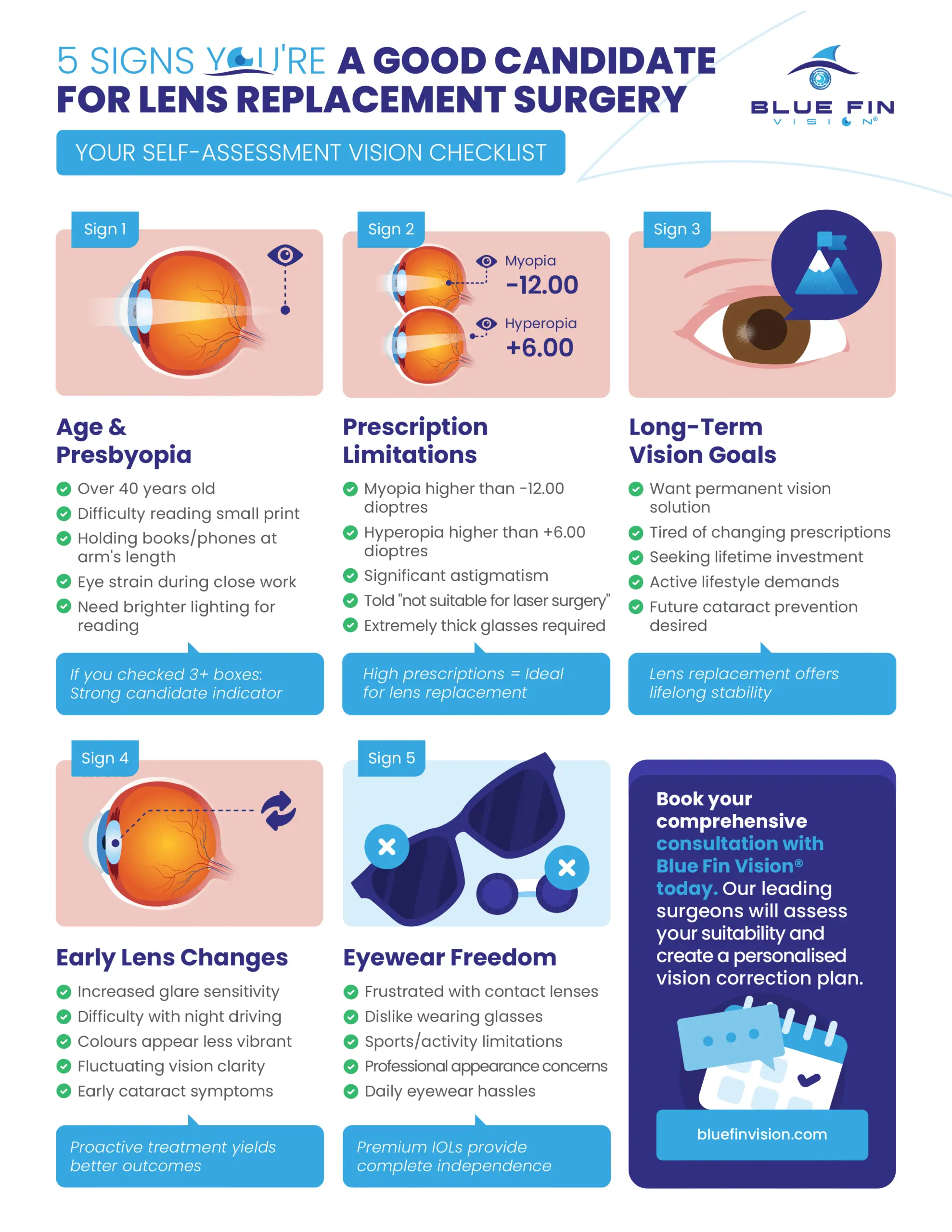
Infographic: 5 Signs You’re a Good Candidate for Lens Replacement Surgery
Sign 1: Reading Glasses Have Quietly Taken Over
If you are past 45 and glasses have migrated from your bag to your nose to every room of the house, your natural lens has stiffened into presbyopia.
It is not a prescription problem; it is a hardware problem: the lens that once flexed to refocus no longer can, which is why the arm’s-length dance, the brighter-lamp habit and the supermarket readers all arrived on schedule.
Drops, exercises and willpower do not reverse a stiffened lens, and every optical fix, readers, varifocals, monovision contacts, is a workaround.
Lens replacement is the only option that replaces the failing part rather than working around it, and the more thoroughly presbyopia runs your day, the stronger this sign becomes.

Sign 2: Varifocals Frustrate You
Varifocals are a genuinely clever compromise, and plenty of people never make peace with them: the head-tilting, the narrow corridor of clarity, the swimming edges, the stairs.
If you have given them a fair trial, correctly fitted, and still resent them, you are describing precisely the dissatisfaction that a well-chosen intraocular lens, trifocal or extended depth of focus, is designed to end, with distance, intermediate and near built into the optic rather than into a zone you must point your nose at.
The trade-offs of those optics, night-time haloes chief among them, are set out honestly in Lens Replacement Surgery: Pros and Cons, and weighing them is exactly what your consultation is for.
But frustrated varifocal dependence in your 50s is one of the most reliable signs on this list.
Sign 3: Laser Has Been Ruled Out, and Your Age Points to the Lens
Corneas with insufficient thickness or irregular shape, and prescriptions beyond laser’s comfortable range, fail laser screening for good reason,¹ and if clinics have told you that you are not a laser candidate, that was a signpost rather than a dead end.
But read the signpost carefully, because it points to two different roads.
In very high myopia with a clear, still-focusing lens, particularly in younger patients, the ICL preserves the natural lens and its accommodation, avoids adding lens-exchange retinal considerations to an already long eye, and carries a strong published safety record.²
It deserves serious discussion before lens replacement is assumed.
Where the failed laser candidate is older, presbyopic, hyperopic, or already showing lens change, the lens itself is increasingly the problem, and lens replacement becomes the honest recommendation.
The sign properly stated: laser is off the table, and your age and lens status point lens-ward. Which lens-based road is a measurement question.
Sign 4: Your Natural Lens Is Already Becoming Part of the Problem
The strongest candidacy sign of all is when the lens is no longer merely stiff but declining.
The clues accumulate quietly: night vision that has lost its former crispness, headlights that flare more than they used to, colours a shade duller, a prescription that has begun drifting more myopic after years of stability, reading that fails even with the correct glasses, or an optician’s note of early lens opacity.
Any of these suggests the natural lens is starting the slow slide towards cataract, and once the lens is already clinically part of the problem, the decision threshold genuinely changes.
You are no longer electing to remove a pristine structure; you are choosing the timing and the optics of an operation your lens has begun to ask for.
Family history of cataract is worth mentioning at consultation as background, but it is not itself a reason to bring forward elective surgery on a clear lens; measurable lens change is.
This is precisely what the examination, and not a webpage, establishes.

Sign 5: You Want a Lasting Answer, and You Understand the Price
Glasses are re-bought, contact lenses re-ordered, and laser performed in your 40s is delivered onto an eye whose lens keeps ageing behind it.
An artificial intraocular lens does not age that way, so the correction it creates is intended to be lasting, and the future cataract is retired in the same operation.
The mature version of this sign includes understanding the price: accommodation is removed irreversibly, premium optics carry night-time trade-offs, and rare surgical risks are real.
A patient who wants permanence and has understood what it costs is a strong candidate; a patient who has only heard the first half is not yet ready, and careful selection of patient, lens and refractive target is the discipline itself.³
5 Signs You May Not Be a Good Candidate
Your Eyes Still Genuinely Accommodate
Under about 45, with working near focus, you would be surrendering a living function for an optical imitation of it. Laser or an ICL preserves what you have; replacement should usually wait for presbyopia to take it first.
You Have Very Long, Highly Myopic Eyes and a Clear Lens
Retinal considerations after lens removal are greater in long myopic eyes, which shifts the balance towards preserving the natural lens, and towards the ICL, while it remains healthy. High myopia deserves its own conversation, not a default.
You Have Retinal or Other Significant Eye Disease
Macular disease, significant glaucoma, prior retinal problems or an unstable ocular surface do not always forbid surgery, but they change the calculation, the lens choice and sometimes the recommendation entirely. Disease first, refraction second.
You Expect Perfect Near and Perfect Night Vision Simultaneously
Multifocal optics trade a measure of night-time quality, haloes, glare, some contrast, for their freedom; monofocals trade reading freedom for the crispest night optics.
Expecting perfect near vision and completely untouched night-time optics simultaneously can create expectations that no current presbyopia-correcting IOL can reliably satisfy, and an honest consultation will say so.
Your Motivation Is One Task, or One Moment
If a single hobby, a wedding, or a passing frustration is carrying the decision, simpler answers may serve better for now. Elective surgery on a clear lens deserves a settled, life-sized motivation.
What We Actually Measure Before Calling You a Candidate
Candidacy is a set of measurements, so here is what the assessment actually examines:
- Your refraction, and crucially its stability across recent records, because surgery corrects the prescription you have, not the one still moving.
- Your cornea, mapped for shape and thickness, which decides whether laser remains a contender.
- Biometry, including the axial length of the eye, which both calculates the lens power and flags the long, highly myopic eyes where retinal considerations shift the advice.
- Your natural lens itself, graded for early opacity, the finding that most changes the recommendation.
- Your retina, examined particularly carefully in myopia.
- Your ocular surface, because dryness degrades both measurement and outcome and is treated first.
- Your expectations, tested against what each optic can actually deliver, which is a measurement of its own.
Only after all of that does the word candidate mean anything.
The Only Sign That Counts: Measurement
All five positive signs justify a conversation; none replaces the assessment above, where everything is measured against all three operations.
Because Blue Fin Vision® offers laser, ICL and lens replacement, all three operations are genuinely on the table, and the honest advice can be none of them.
References
- Randleman JB, Woodward M, Lynn MJ, Stulting RD. Risk assessment for ectasia after corneal refractive surgery. Ophthalmology. 2008;115(1):37-50. doi: 10.1016/j.ophtha.2007.03.073.
- Packer M. Meta-analysis and review: effectiveness, safety, and central port design of the intraocular collamer lens. Clin Ophthalmol. 2016;10:1059-77. doi: 10.2147/OPTH.S111620.
- Maldonado MJ, de Salazar Campos A, Castro Machado A. Indications and risk factors in refractive lens exchange: outcomes and special cases (extremes hyperopes and myopes). Arch Soc Esp Oftalmol (Engl Ed). 2026 Jul 20:502616. doi: 10.1016/j.oftale.2026.502616.
ABOUT THE AUTHOR
Mr Mfazo Hove
Consultant Ophthalmic Surgeon
MBChB MD FRCOphth CertLRS
Mr Mfazo Hove is a Consultant Ophthalmic Surgeon with experience spanning more than 57,000 procedures. He completed 6.5 years of specialist training at Moorfields Eye Hospital and served for five years as a consultant at the Western Eye Hospital, Imperial College Healthcare NHS Trust. He is the founder of Blue Fin Vision®, a consultant-led private ophthalmology practice operating across London, Essex, and Hertfordshire. His clinical expertise encompasses advanced cataract surgery, refractive lens replacement, laser vision correction, and implantable Collamer lenses (ICL).
A ZEISS Key Opinion Leader, Mr Hove is a respected international speaker with five invited engagements across seven cities in 2026:
- ZEISS China tour (Changsha, Shanghai, and Hangzhou, April – ZEISS APAC User Meeting)
- RCOphth Annual Congress – May – Manchester
- ZEISS EMEA User Meeting (Istanbul)
- ZEISS Lausanne User Meeting (Lausanne)
- European Society of Cataract and Refractive Surgeons Annual Congress (ESCRS, London)
Schedule Your Consultation Today
Book a paid consultation and bring the Lens Replacement Surgery Checklist with you, to us or to anyone.
Pricing is transparent on the lens replacement costs page.
You will be trusting your vision to a premium, consultant-led UK clinic with documented outcomes and locations across London, Hertfordshire and Essex.


