



Patient Experience
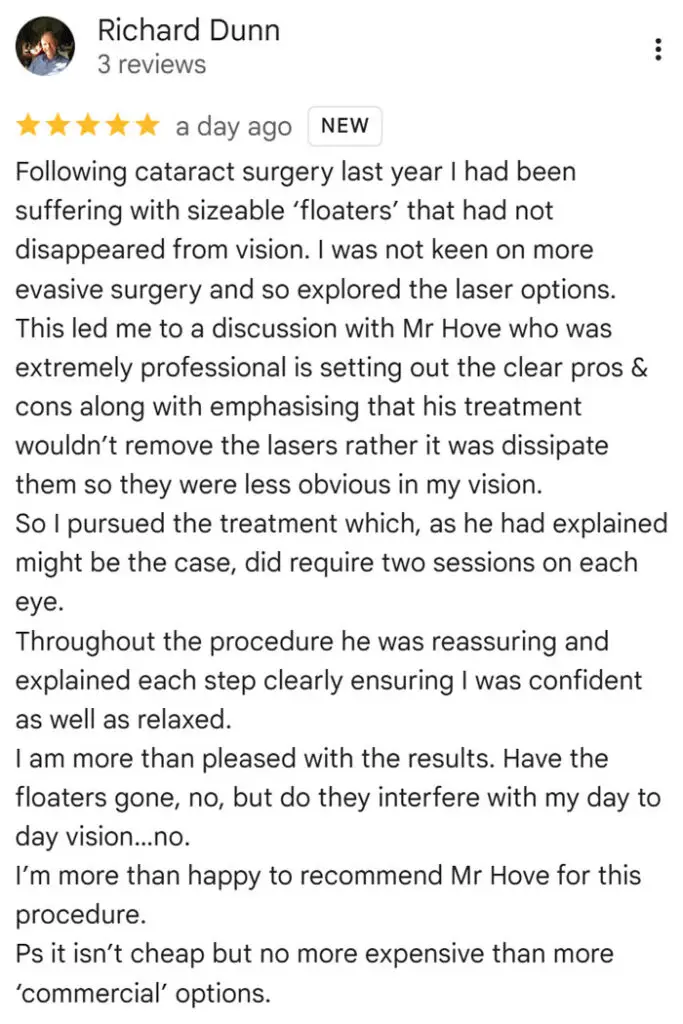
“Following cataract surgery last year I had been suffering with sizeable ‘floaters’ that had not disappeared from vision. I was not keen on more evasive surgery and so explored the laser options.
This led me to a discussion with Mr Hove who was extremely professional is setting out the clear pros & cons along with emphasising that his treatment wouldn’t remove the lasers rather it was dissipate them so they were less obvious in my vision.
So I pursued the treatment which, as he had explained might be the case, did require two sessions on each eye.
Throughout the procedure he was reassuring and explained each step clearly ensuring I was confident as well as relaxed.
I am more than pleased with the results. Have the floaters gone, no, but do they interfere with my day to day vision…no.
I’m more than happy to recommend Mr Hove for this procedure.
Ps it isn’t cheap but no more expensive than more ‘commercial’ options.”
Clinical Explanation
A good result from YAG laser vitreolysis, a laser treatment intended to make floaters less noticeable, needs two things: the laser has to make a real difference to the floater, and the patient has to understand beforehand what kind of difference to expect. The consultation cannot create the first. It is where the second is settled.
The laser is focused through a contact lens onto a selected floater. Its pulses vaporise part of the opacity, the material casting a shadow inside the eye, and break the remainder into smaller pieces.¹
The collagen, a structural protein within the vitreous gel, is broken down rather than removed from the eye, and the remaining fragments can take several weeks to settle.
Complete resolution should not be expected: in the main randomised trial, around half of treated patients reported significant or complete improvement.¹
The treatment is non-incisional, meaning no surgical cut is made, and done in clinic with anaesthetic drops that numb the eye’s surface. More than one session is sometimes needed.
Richard had his cataract surgery the year before. He was told the laser would make his floaters less obvious rather than remove them, and that a second session might be needed. He had two sessions in each eye.
The treatment made a real difference: his floaters have not gone, but they no longer interfere with his day-to-day vision.
Knowing what to expect is what allowed him to judge that improvement for what it is.
Structured Context
Who may be suitable: a single, discrete floater, typically a Weiss ring, a ring-shaped floater, that sits a safe distance from the retina, the light-sensitive layer at the back of the eye, and the natural lens, in an eye with a settled posterior vitreous detachment, causing real difficulty in daily life.
A posterior vitreous detachment is when the vitreous gel separates from the retina. We normally wait at least six months after an uncomplicated vitreous detachment, one without an associated retinal tear or other complication, before considering treatment.
Who is not suitable:
- Diffuse floaters or haze, meaning floaters or cloudiness spread throughout the vitreous rather than one distinct target.
- Floaters close to the retina or natural lens.
- Younger short-sighted patients with fine strands and no vitreous detachment.
- Recent floaters that have not had time to settle.
Why having had cataract surgery matters: focal cataract, a localised area of clouding in the natural lens, from laser near the natural lens is one of the recognised risks, and once the natural lens has been replaced that risk no longer applies.
The lens implant itself can still be marked by the laser, however: peripheral pitting, small marks towards the edge of an implant, occurred in the main randomised trial, although it did not affect vision.¹
What the consultation covers:
- The retina first.A dilated examination, using drops to widen the pupil, looks for retinal tears and other causes of symptoms. New, unexamined floaters are covered on our page on new floaters after cataract surgery.
- Whether your floater is the right type and in the right place.
- What success looks like. A less noticeable floater, not a floater-free eye.
- Sessions and cost. Our practice is to offer a second session only if the first has given a meaningful benefit; any second session is charged separately according to your written quotation. A consultation and assessment fee applies whether or not treatment is recommended.
- The risks, set out below.
- The alternatives. Observation, meaning monitoring without treatment, carries no procedural risk and suits most people. Practical measures include sunglasses and adjusting screen contrast. Vitrectomy, surgery to remove the vitreous gel, is more effective but a larger operation with greater risks. Vitrectomy is available on the NHS and privately, and at Blue Fin Vision® is performed by Professor Mahmut Dogramaci, Consultant Vitreoretinal Surgeon, a specialist in conditions affecting the retina and vitreous gel. YAG vitreolysis is a private-only option.
- Who treats you. Mr Mfazo Hove, Consultant Ophthalmic Surgeon, examines every patient and performs the laser himself, drawing on his experience in argon retinal laser, a type of laser used to treat retinal conditions.
The full detail is in our YAG vitreolysis patient information leaflet.
After treatment: eye pressure is rechecked and the retina re-examined at follow-up, even if the eye feels normal, and the result is judged over weeks rather than on the day.
New floaters after treatment cannot be assumed to be fragments without an examination.
A sudden shower or increase in floaters, new flashes, a spreading shadow or curtain, sudden loss of vision or increasing eye pain needs same-day assessment.
If you cannot reach us, attend an eye casualty department and tell them you have had vitreolysis and when.
Published Evidence
Two small randomised trials show symptom benefit. In a masked, sham-controlled trial of 52 patients with symptomatic Weiss ring floaters, 36 had YAG vitreolysis and 16 a sham laser. This means actual treatment was compared with a simulated procedure, without patients knowing which they received.
At six months, self-reported floater-related visual disturbance improved by 54% in the laser group and 9% in the sham group, and 53% of treated patients reported significant or complete improvement, compared with none in the sham group.¹
A second randomised trial of 21 eyes also found greater symptom improvement after laser than after sham treatment.²
Success is best measured by daily vision, not appearance. In the same trial, masked grading of photographs, meaning the assessors did not know which treatment had been given, found the floater significantly or completely resolved in 94% of treated eyes, yet only 53% of patients reported that degree of improvement.¹
Photographic clearing and a patient’s sense of improvement are different measures, so success with this treatment is best judged by how much the floater still interferes with daily vision, not by how it looks on a photograph.
Delayed retinal tears have been reported. In longer follow-up of the first trial’s treated patients, at an average of 2.3 years, three developed retinal tears more than a year after treatment.³
Raised eye pressure can appear late and persist. A case series described chronic glaucoma, lasting damage to the optic nerve that carries visual signals to the brain, developing between one week and eight months after vitreolysis, in some eyes needing glaucoma surgery.⁴
A wider range of complications has been reported. Over six months, US retina specialists voluntarily reported 16 complications in 15 patients, including raised pressure, cataract and lens capsule damage, retinal tear, retinal detachment, retinal haemorrhage, blind spots and more floaters.
The lens capsule is the thin membrane surrounding the natural lens. Retinal detachment means the retina separates from the back of the eye, and retinal haemorrhage means bleeding in the retina. Because the number of procedures was unknown, a rate could not be calculated.⁵
Laser and vitrectomy have not been compared head to head. A Cochrane review found no randomised trials comparing the two.⁶
In a prospective series of 76 eyes, limited vitrectomy, removal of part of the vitreous gel, improved vision-related quality of life scores by 29.2%.⁷
As surgery inside the eye, it carries its own risks, including retinal tear, retinal detachment and infection.
The retina must be checked first. Among patients with sudden-onset floaters or flashes, 14% have a retinal tear,⁸ which is why treatment is only discussed once the retina has been examined.
The risks to discuss before treatment:
- Raised eye pressure, including glaucoma that can appear weeks or months later.
- New or different floaters.
- Focal cataract where the natural lens is still present.
- Retinal burn, tear or, rarely, detachment, the most serious risk.
- Vitreous bleeding, meaning bleeding into the gel inside the eye, and mild inflammation, which usually settle.
- No benefit at all in some patients.
Surgeon Interpretation
With laser vitreolysis, the patient’s understanding of what the treatment can achieve matters as much as the laser itself. The laser has to make a real difference, but the consultation is where the patient learns what that difference will look like.
I tell every patient plainly that the laser breaks big floaters into smaller ones, which are easier to ignore, and that it does not make the eye floater-free. In my experience, partial improvement is far more common than complete clearance.
I explain that a second session may be needed, and that I only offer one if the first has helped.
And I set out every option, including leaving the floaters alone and vitrectomy, which is available on the NHS and privately, even though vitreolysis is the only one of the three that is private only.
The published evidence is still small, and I tell patients that. The decision to treat is a clinical one, made with each patient once they understand the benefit, the uncertainty and the risks.
Richard’s floaters no longer interfere with his day-to-day vision. That is the result. Because he knew what to expect, he could recognise it as a success.
Mr Mfazo Hove, Consultant Ophthalmic Surgeon.
Clinical Takeaway
YAG laser vitreolysis can make a selected floater smaller and less noticeable rather than removing it; a good result needs both a real improvement and a consultation that makes clear, before treatment, what that improvement is likely to be.
References
- Shah CP, Heier JS. YAG laser vitreolysis vs sham YAG vitreolysis for symptomatic vitreous floaters: a randomized clinical trial. JAMA Ophthalmol. 2017;135(9):918-23.
- Ludwig GD, Gemelli H, Nunes GM, Serracarbassa PD, Zanotele M. Efficacy and safety of Nd:YAG laser vitreolysis for symptomatic vitreous floaters: a randomized controlled trial. Eur J Ophthalmol. 2021;31(3):909-14.
- Shah CP, Heier JS. Long-term follow-up of efficacy and safety of YAG vitreolysis for symptomatic Weiss ring floaters. Ophthalmic Surg Lasers Imaging Retina. 2020;51(2):85-8.
- Cowan LA, Khine KT, Chopra V, Fazio DT, Francis BA. Refractory open-angle glaucoma after neodymium-yttrium-aluminum-garnet laser lysis of vitreous floaters. Am J Ophthalmol. 2015;159(1):138-43.
- Hahn P, Schneider EW, Tabandeh H, Wong RW, Emerson GG; American Society of Retina Specialists Research and Safety in Therapeutics (ASRS ReST) Committee. Reported complications following laser vitreolysis. JAMA Ophthalmol. 2017;135(9):973-6.
- Kokavec J, Wu Z, Sherwin JC, Ang AJS, Ang GS. Nd:YAG laser vitreolysis versus pars plana vitrectomy for vitreous floaters. Cochrane Database Syst Rev. 2017;6(6):CD011676.
- Sebag J, Yee KM, Wa CA, Huang LC, Sadun AA. Vitrectomy for floaters: prospective efficacy analyses and retrospective safety profile. Retina. 2014;34(6):1062-8.
- Hollands H, Johnson D, Brox AC, Almeida D, Simel DL, Sharma S. Acute-onset floaters and flashes: is this patient at risk for retinal detachment? JAMA. 2009;302(20):2243-9.


