



Patient Experience
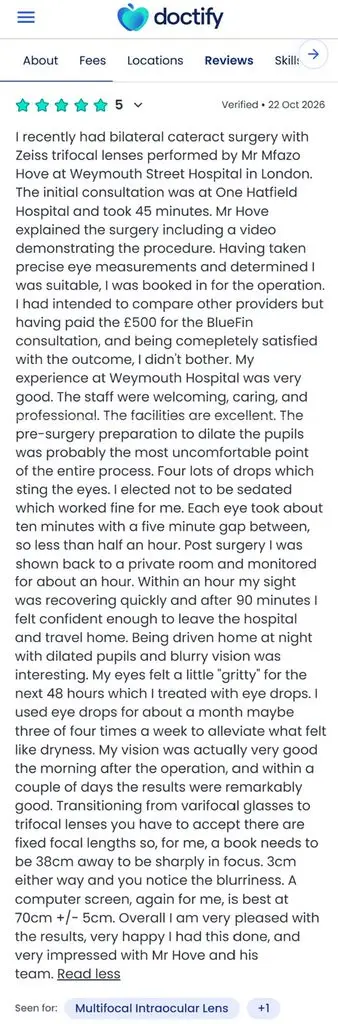
“I recently had bilateral cateract surgery with Zeiss trifocal lenses performed by Mr Mfazo Hove at Weymouth Street Hospital in London. The initial consultation was at One Hatfield Hospital and took 45 minutes. Mr Hove explained the surgery including a video demonstrating the procedure. Having taken precise eye measurements and determined I was suitable, I was booked in for the operation.
I had intended to compare other providers but having paid the £500 for the BlueFin consultation, and being comepletely satisfied with the outcome, I didn’t bother.
My experience at Weymouth Hospital was very good. The staff were welcoming, caring, and professional. The facilities are excellent. The pre-surgery preparation to dilate the pupils was probably the most uncomfortable point of the entire process. Four lots of drops which sting the eyes. I elected not to be sedated which worked fine for me. Each eye took about ten minutes with a five minute gap between, so less than half an hour.
Post surgery I was shown back to a private room and monitored for about an hour. Within an hour my sight was recovering quickly and after 90 minutes I felt confident enough to leave the hospital and travel home. Being driven home at night with dilated pupils and blurry vision was interesting.
My eyes felt a little “gritty” for the next 48 hours which I treated with eye drops. I used eye drops for about a month maybe three of four times a week to alleviate what felt like dryness. My vision was actually very good the morning after the operation, and within a couple of days the results were remarkably good.
Transitioning from varifocal glasses to trifocal lenses you have to accept there are fixed focal lengths so, for me, a book needs to be 38cm away to be sharply in focus. 3cm either way and you notice the blurriness. A computer screen, again for me, is best at 70cm +/- 5cm.
Overall I am very pleased with the results, very happy I had this done, and very impressed with Mr Hove and his team.”
Verified patient review, Doctify, 22 October 2026. Same-day bilateral cataract surgery, meaning surgery on both eyes on the same day, at Weymouth Street Hospital, London, following consultation at One Hatfield Hospital, Hertfordshire.
The patient received trifocal intraocular lenses, artificial lenses placed inside the eyes that are designed to focus at near, intermediate and far distances. The fee and eye drops mentioned are as reported by the patient and are not current pricing or prescribing advice.
Clinical Explanation
Yes. At Blue Fin Vision®, assessment and routine follow-up can be arranged close to home, with surgery either locally or in London depending on preference, clinical suitability and availability, all under the same consultant.
This patient’s consultation and measurements were at One Hatfield Hospital in Hertfordshire, and both eyes were operated on the same day at Weymouth Street Hospital in London. Mr Hove confirms that his post-operative review took place back at One Hatfield.
Cataract surgery is a pathway, not a single event: assessment, measurement, lens selection, surgery and aftercare. Across healthcare, transfers of care between clinicians are a recognised weak point, where measurements, decisions and findings can be lost.¹
In the Blue Fin Vision® model of consultant-delivered care, the patient is not passed to a different consultant at each stage. The teams at each location coordinate the patient’s care, and the relevant records are available wherever the patient is seen, which matters, but responsibility stays with one consultant: the person who examines the eye and reviews the measurements is the surgeon who operates and the clinician who reviews the result.
Patients having cataract or lens replacement surgery also receive Mr Hove’s direct contact number, together with instructions on whom to contact for urgent concerns.
Continuity also protects the expectations set at consultation. The surgeon who explained what the lens would and would not do is the one who checks the result, so the post-operative review measures the outcome against the conversation that set it, not against someone else’s account of it.
Questions after surgery can be discussed with the consultant who made the original plan, helping patients revisit the lens choices, working distances and expectations discussed before treatment.
The network is designed so that the location can be chosen around the patient, within what is clinically suitable and available.
Consultations are available across the Blue Fin Vision® network every day, and weekly at One Hatfield, which offers cataract, lens replacement and implantable collamer lens (ICL) surgery on site. An ICL is a lens placed inside the eye to correct vision without removing the natural lens.
A patient can be seen close to home and, where it suits them, operated on in central London without changing consultant. Because cataract surgery is available at every Blue Fin Vision® hospital location, a patient who prefers can also have consultation, surgery and follow-up all close to home.
Inside the operating theatre, Blue Fin Vision® has deliberately standardised the core surgical equipment across its operating sites, giving the surgeon a consistent equipment platform: the same equipment, the same set-up and the same surgeon wherever the operation takes place.
Surgical instruments for every site are sterilised under a service arrangement with St Thomas’ Hospital.
Site selection also takes account of the patient’s testing, anaesthetic and other clinical requirements.
If an enhancement, additional treatment to refine the visual result, is ever needed, it is carried out by the same surgeon who performed the original operation.
Treating both eyes on the same day follows the same logic. Each eye is treated as a separate procedure; this patient describes two short operations with a brief gap between them. Both eyes recover together and, for a patient travelling into London, this can reduce two planned surgical visits to one.² ³
The consultation also covers the specific trade-offs of treating both eyes on the same day, including the small possibility of a complication affecting both eyes and the inability to use the first eye’s result to refine the second eye’s lens choice. Suitability for same-day surgery on both eyes is assessed individually.³
Structured Context
Applies to:
- Patients living outside central London, including Hertfordshire, Essex and north-west London, who want assessment and aftercare close to home, or every stage including surgery.
- Patients who want one named consultant responsible for every stage of their care.
- Patients considering surgery on both eyes on the same day.
Does not apply to: the assumption that every test or treatment is available at every site.
Patients assessed at One Hatfield who need Humphrey visual field testing, a test that maps their field of vision, or B-scan ultrasound, which uses sound waves to create images of the inside of the eye, attend Harley Street for those tests.
YAG laser is assessed at Hatfield but carried out at Harley Street.
Where a patient’s needs call for a particular site, the pathway is planned around that from the outset, so that a change of venue does not become a change of consultant.
Published Evidence
A systematic review of communication between hospital-based and primary care doctors at hospital discharge found that direct communication occurred in only 3 to 20% of cases, and that missing or delayed information was common, with implications for patient safety. The review concerned general hospital discharge, not cataract pathways specifically.¹
For treating both eyes on the same day, a Cochrane review found that same-day and separate-day surgery probably make little or no difference to patient-reported outcomes, meaning outcomes assessed through patients’ own reports or questionnaires. For serious eye infection, events were too rare and the evidence too uncertain to establish whether the risk differs.²
National guidance recommends that, after surgery, patients are told who to contact if problems arise and who they will see at their next appointment, and that information about surgery on both eyes on the same day is given where appropriate.³
Surgeon Interpretation
Patients care far less about which building they are in than about whether the consultant responsible for their eyes stays the same from start to finish. That is the point of a network: the location is chosen around the patient, while the consultant, the records and the standards travel with them.
This patient met me in Hatfield, I operated on both eyes in London, and I saw him again in Hatfield. His care was never passed to another consultant.
When I review a patient after surgery, I can relate the result directly to the needs and expectations we discussed together before the operation.
Mr Mfazo Hove, Consultant Ophthalmic Surgeon.
Clinical Takeaway
You can change location without changing the consultant responsible for your care. At Blue Fin Vision®, consultation, surgery and follow-up can take place at different sites, locally or in London, as one coordinated pathway under one named consultant.
References
- Kripalani S, LeFevre F, Phillips CO, Williams MV, Basaviah P, Baker DW. Deficits in communication and information transfer between hospital-based and primary care physicians: implications for patient safety and continuity of care. JAMA. 2007;297(8):831-841. doi:10.1001/jama.297.8.831
- Dickman MM, Spekreijse LS, Winkens B, Schouten JSAG, Simons RWP, Dirksen CD, Nuijts RMMA. Immediate sequential bilateral surgery versus delayed sequential bilateral surgery for cataracts. Cochrane Database Syst Rev. 2022;4(4):CD013270. doi:10.1002/14651858.CD013270.pub2
- National Institute for Health and Care Excellence. Cataracts in adults: management. NICE guideline NG77. London: NICE; 2017 (last reviewed 2025).


