



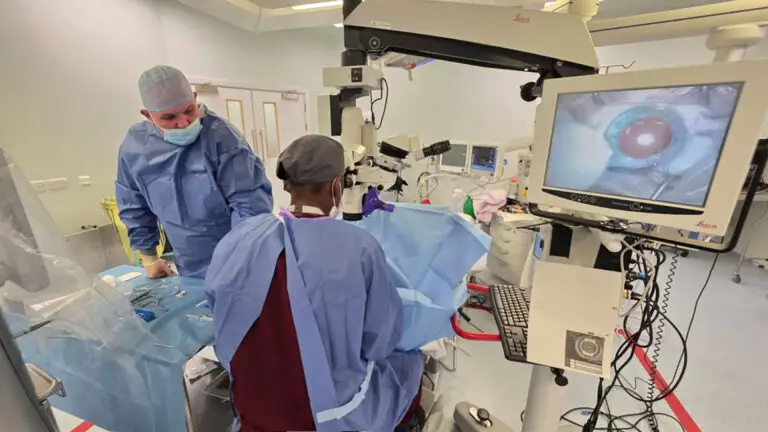
Myopia Management for Children at Blue Fin Vision®
Consultant-Led Childhood Myopia Control in London, Hertfordshire & Essex
Featured, Recognised & Trusted
Blue Fin Vision® and its consultants provide expert commentary to national and international media, consumer health publications and specialist ophthalmic titles. Our clinical collaboration with ZEISS reflects a shared focus on ophthalmic technology, education and patient care.
Explore the selected coverage below by clicking on the icons, or visit our Press page for the complete archive.














Blue Fin Vision® on the International Stage
Invited faculty and congress lectures. Mr Mfazo Hove, founder and Clinical Director, is invited by ZEISS, Aier, RCOphth and ESCRS to teach surgical technique, high-volume surgical systems and outcome refinement to peers internationally.

RCOphth Annual Congress Liverpool

ZEISS EMEA Meeting Budapest
ESCRS Annual Congress Copenhagen
SpaMedica CPD Southend, Chelmsford
ZEISS Horizon Meeting Shanghai
ZEISS Faculty Programme Hangzhou
Aier Faculty Lecture Changsha
RCOphth Annual Congress Manchester
ZEISS EMEA Meeting Istanbul
SOG-SSO Annual Congress Lausanne
ESCRS 44th Congress London
What Is Childhood Myopia Management?
Myopia, commonly called short-sightedness, causes distant objects to appear blurred. In children, it often becomes progressively stronger as the eye grows too long from front to back.
Childhood myopia management combines accurate prescription measurement, monitoring of the eye’s growth and evidence-based treatment to slow further progression. It cannot reverse existing myopia or remove the need for glasses or contact lenses, but it may reduce the rate at which the condition worsens while the child’s eyes are still developing.
Blue Fin Vision® provides consultant-led myopia management for children aged six and above across London, Hertfordshire and Essex. Our service combines cycloplegic refraction, six-monthly axial length measurement, licensed low-dose atropine where appropriate and structured long-term follow-up.
Why Childhood Myopia Deserves Active Management
Childhood myopia is not simply a spectacle prescription. It usually reflects an eye that is growing too long, and that excess growth carries consequences that can last a lifetime.
Every additional dioptre of myopia increases the lifetime risk of retinal detachment, myopic maculopathy, glaucoma and earlier cataract. The goal of modern childhood myopia management is therefore not only to correct blurred distance vision, but to slow the elongation of the eye itself while a child is still growing.¹
The prevalence of childhood myopia in the UK has more than doubled over approximately 50 years in studied populations. Environmental factors, including intensive near work and reduced time outdoors, are thought to contribute alongside family history and other individual risk factors.²
Progression is generally fastest in younger children and slows as the eye matures, making early identification and treatment particularly valuable. Reducing the rate of progression during childhood may reduce a child’s final level of myopia, with the absolute benefit depending on their age, baseline rate of progression and duration of treatment.¹
Why Childhood Myopia Deserves Active Management
Myopia, commonly called short-sightedness, is not simply a spectacle prescription. It usually reflects an eye that is growing too long, and that excess growth carries consequences that can last a lifetime.
Every additional dioptre of myopia increases the lifetime risk of retinal detachment, myopic maculopathy, glaucoma and earlier cataract. The goal of modern childhood myopia management is therefore not only to correct blurred distance vision, but to slow the elongation of the eye itself while a child is still growing.¹
The prevalence of childhood myopia in the UK has more than doubled over approximately 50 years in studied populations. Environmental factors, including intensive near work and reduced time outdoors, are thought to contribute alongside family history and other individual risk factors.²
Progression is generally fastest in younger children and slows as the eye matures, making early identification and treatment particularly valuable. Reducing the rate of progression during childhood may reduce a child’s final level of myopia, with the absolute benefit depending on their age, baseline rate of progression and duration of treatment.¹
What the Evidence Shows
Low-dose atropine eye drops are the most extensively studied pharmacological treatment for slowing myopia progression in children.
The landmark ATOM studies established the effectiveness of atropine and helped define the role of lower concentrations.³ The placebo-controlled LAMP trial demonstrated a clear concentration-response across 0.01%, 0.025% and 0.05%, with 0.05% producing the greatest reduction in both refractive progression and axial elongation.⁴
The three-year CHAMP study extended the evidence to children recruited across North America and Europe. Atropine 0.01% reduced refractive progression and axial elongation compared with placebo and demonstrated a favourable safety profile.⁵
The pivotal phase III STAR study randomised 852 children aged 3 to 14 across Europe and the United States, with 847 included in the full analysis set. It showed that nightly atropine 0.01% significantly reduced the annual rate of myopia progression, measured by cycloplegic autorefraction, with the greatest benefit in children with a history of faster progression.⁶
On the basis of the STAR results, the Medicines and Healthcare products Regulatory Agency, or MHRA, approved Ryjunea® in October 2025. This made it the first licensed low-dose atropine treatment for childhood myopia in the UK.
Ryjunea® contains atropine 0.1 mg/ml, equivalent to 0.01%. Its licence covers children aged 3 to 14 at the start of treatment who have myopia between -0.50 D and -6.00 D, with documented progression of at least 0.50 D per year.⁶ ⁷
Low-dose atropine is generally well tolerated. The most common effects include increased sensitivity to light, mild near blur and eye irritation. These effects are usually mild or moderate, but families should be aware that light sensitivity is relatively common.⁶ ⁷ Tolerance is reviewed at every follow-up appointment.

The Blue Fin Vision® Myopia Management Pathway
Our childhood myopia management service is consultant-led at every stage.
Each child is assessed, treated and followed up under the direct care of a consultant ophthalmic surgeon, with objective measurement used to support every decision. The pathway has three stages.
1. Consultant Assessment
The first stage is a full consultant assessment of your child’s vision, refractive history, family history of myopia and the lifestyle factors that may influence progression.
This consultation establishes whether your child’s myopia is progressing, how quickly it is changing and whether treatment is appropriate now, or whether structured monitoring would be the better first step.
Your consultant discusses all appropriate management options, including:
- Licensed low-dose atropine.
- Myopia-control spectacles.
- Myopia-control contact lenses.
- Structured monitoring without immediate treatment.
A credible assessment must be capable of concluding that treatment is not yet needed, and ours is.
2. Diagnostic Testing
Objective measurement is the foundation of honest myopia management. At the baseline appointment, we perform:
- Cycloplegic refraction: Dilating drops temporarily relax the eye’s focusing system. This is the most accurate way to measure a child’s true prescription and was the refractive endpoint used in the registration trial supporting the licensed treatment.⁶
- Axial length measurement: Optical biometry measures the length of the eye from front to back. This is one of the most important objective measurements in myopia management because axial elongation, rather than the spectacle prescription alone, drives the associated long-term risks.
- Slit-lamp examination: A detailed examination of the structures at the front of the eye.
- Intraocular pressure measurement: Eye pressure is measured as part of the assessment for conditions that could make licensed low-dose atropine unsuitable.⁷
- Dilated fundal examination: The retina and optic nerve are examined fully to identify or exclude any co-existing eye disease.
- Fundus photography: Detailed photographs create a permanent baseline record of the retina against which future examinations can be compared.
These measurements provide a reliable starting point for monitoring your child’s prescription, eye growth and retinal health.
3. Prescription Low-Dose Atropine
Where treatment is indicated, low-dose atropine is prescribed for use once nightly at home.
Where the licensed 0.01% preparation is appropriate, this will generally be used. Atropine treatment does not remove the need for glasses or contact lenses, which will still be prescribed as required to provide clear vision.
In selected children with continuing progression, a different atropine concentration may be considered on an individual basis, guided by the published concentration-response evidence.⁴
Where this involves an unlicensed preparation or strength, or treatment begins outside the licensed criteria, the reasons, supporting evidence and implications are discussed fully with the family before any prescription is issued.
Follow-Up: Measurement, Not Assumption
Myopia management only works if progression is actually measured. Our follow-up schedule is structured accordingly:
- Every six months for the first two years: Vision, refraction as clinically required, tolerance of the drops and axial length measurement at every visit.
- Yearly thereafter: Once progression is demonstrably slow or stable, reviews continue until eye growth has settled.
- Full diagnostic reassessment: A dilated examination and fundus photography are performed at least annually, so every treatment decision is based on objective data rather than assumption.
Treatment cessation is planned rather than arbitrary.
Because progression can recur after atropine is withdrawn, we consider gradual withdrawal once myopia has stabilised. This is in line with the licensed guidance of less than 0.50 D of progression over two years during adolescence.⁷
Objective monitoring continues for at least one year after treatment ends. Treatment may be restarted if significant progression returns.
Who This Service Is For
The Blue Fin Vision® myopia management service is designed for:
- Children aged six and above with myopia.
- Children whose spectacle prescription is increasing year on year.
- Children with documented or suspected myopia progression.
- Children with a strong family history of myopia, particularly high myopia.
- Children who have not previously had their axial length measured.
- Parents who want their child’s eye growth measured properly, rather than watched passively through spectacle changes alone.
- Families seeking a consultant-led second opinion about childhood myopia treatment.
If your child is already highly myopic, management remains worthwhile. The aim at every level of myopia is the same: to limit further axial elongation and the additional retinal risk that accompanies it.

Myopia Management in London, Hertfordshire & Essex
Consultant-Led Childhood Myopia Care
Blue Fin Vision® provides private childhood myopia assessment, treatment and long-term monitoring across London, Hertfordshire and Essex.
Consultant-Led Expertise
Your child is assessed and managed under the direct care of a consultant ophthalmic surgeon.
Objective Eye Growth Measurement
Cycloplegic refraction and axial length measurement establish whether myopia is progressing and how the eye is changing over time.
Patient-Centred Care
Every stage is explained clearly to both child and parent, with treatment decisions based on objective measurements and individual clinical need.
Contact Blue Fin Vision® to arrange a paid consultant myopia assessment for your child in London, Hertfordshire or Essex.
A Service That Grows With Your Child
Blue Fin Vision® is a full ophthalmology group, not a standalone paediatric clinic.
Children managed with us remain within a consultant-led service as they grow, with their complete axial length and refractive history retained. A measurement record that begins in childhood can be genuinely valuable for eye care decisions made in adult life.
If refractive surgery such as laser vision correction or ICL implantation becomes appropriate in adulthood, or if a higher level of myopia calls for ongoing retinal surveillance, that care can be provided within the same group by consultants who can see exactly how your child’s eyes have developed.
Choosing a myopia service is also choosing who understands your child’s eyes in 20 years’ time.
Why Choose Blue Fin Vision®?
Blue Fin Vision® is recognised by leading authorities in private healthcare and luxury wellness, including listings in the Spear’s 500 Health & Wellness Index 2025 and the Tatler Address Book. This recognition reflects documented outcomes, a consultant-led clinical model and hundreds of verified five-star patient reviews.
Blue Fin Vision® is a consultant-led ophthalmology group founded on a simple principle: to achieve the immeasurable, you must measure everything.
That philosophy shapes our childhood myopia management service. Your child’s eyes are measured with the same rigour, and their data reviewed with the same discipline, that underpin our published surgical outcomes.
What sets Blue Fin Vision® apart:
- Consultant-led care: Every assessment, prescription and treatment decision is overseen by a consultant.
- Objective measurement: Cycloplegic refraction and axial length measurement provide clear baseline and follow-up data
- Licensed treatment: Ryjunea® 0.01% atropine is available where the child meets the appropriate clinical criteria
- Complete assessment: The retina, optic nerve, eye pressure and structures at the front of the eye are examined
- Structured follow-up: Six-monthly monitoring measures progression rather than assuming treatment is working
- 550+ verified five-star reviews: Independently collected on Doctify
- Balanced recommendations: Treatment is only recommended when the clinical findings support it
- Long-term continuity: Your child’s measurement history remains within a full consultant-led ophthalmology group
- CQC-regulated facilities: Care is delivered in accordance with UK clinical governance and prescribing standards
- Convenient locations: Private appointments are available across London, Hertfordshire and Essex
Every family leaves understanding exactly where their child stands, what the measurements show and what happens next.
Book a Myopia Assessment
If your child’s spectacle prescription is increasing, a specialist assessment can establish whether their myopia is progressing and whether active management is appropriate.
Myopia management cannot guarantee that progression will stop. It can provide a structured opportunity to measure eye growth, monitor retinal health and consider evidence-based treatment while your child’s eyes are still developing.
To arrange a consultant-led myopia assessment for your child, contact Blue Fin Vision® or book online. Patient finance is available at Blue Fin Vision® locations, subject to the applicable terms.
References
- Bullimore MA, Brennan NA. Myopia control: why each diopter matters. Optom Vis Sci. 2019;96(6):463-465.
- McCullough SJ, O’Donoghue L, Saunders KJ. Six year refractive change among white children and young adults: evidence for significant increase in myopia among white UK children. PLoS One. 2016;11:e0146332.
- Chia A, Chua WH, Cheung YB, Wong WL, Lingham A, Fong A, Tan D. Atropine for the treatment of childhood myopia: safety and efficacy of 0.5%, 0.1%, and 0.01% doses (Atropine for the Treatment of Myopia 2). Ophthalmology. 2012;119(2):347-354.
- Yam JC, Jiang Y, Tang SM, Law AKP, Chan JJ, Wong E, et al. Low-Concentration Atropine for Myopia Progression (LAMP) Study: a randomized, double-blinded, placebo-controlled trial of 0.05%, 0.025%, and 0.01% atropine eye drops in myopia control. Ophthalmology. 2019;126(1):113-124.
- Zadnik K, Schulman E, Flitcroft I, Fogt JS, Blumenfeld LC, Fong TM, et al. Efficacy and safety of 0.01% and 0.02% atropine for the treatment of pediatric myopia progression over 3 years: a randomized clinical trial. JAMA Ophthalmol. 2023;141(10):990-999.
- Korenfeld M, Hurcikova M, Tatsuoka K, Tomciková D, Cheetham J, Kacerik M. STudy of Atropine to Reduce (STAR) myopia progression in children: 24-month results of a randomized, double-masked, vehicle-controlled trial of atropine sulfate 0.01% and 0.03%. Ophthalmol Ther. 2026;15(5):1685-1703.
- Santen UK Limited. Ryjunea 0.1 mg/ml eye drops, solution. Summary of Product Characteristics. Updated 2 June 2026.
Our Clinic Locations
Book Your Child’s Myopia Assessment
Complete the form below to request a consultation. We’ll review your details, assess your child’s suitability for treatment, and answer any questions you may have.

