



Patient Experience
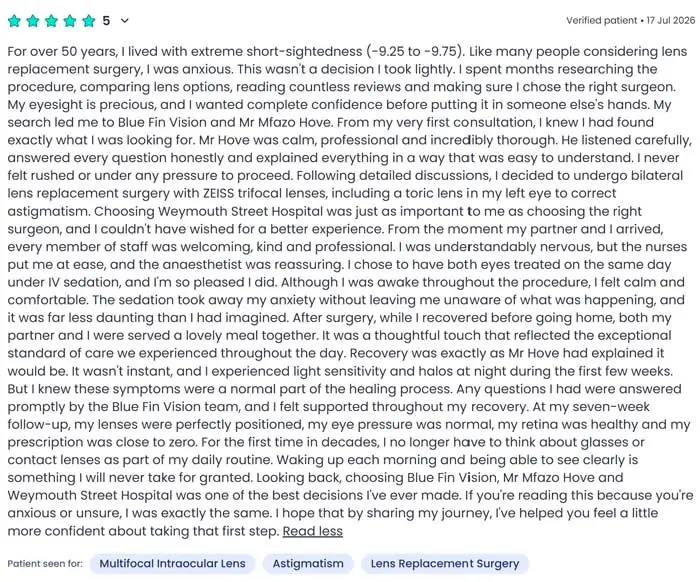
“For over 50 years, I lived with extreme short-sightedness (-9.25 to -9.75). Like many people considering lens replacement surgery, I was anxious. This wasn’t a decision I took lightly. I spent months researching the procedure, comparing lens options, reading countless reviews and making sure I chose the right surgeon. My eyesight is precious, and I wanted complete confidence before putting it in someone else’s hands.
My search led me to Blue Fin Vision® and Mr Mfazo Hove. From my very first consultation, I knew I had found exactly what I was looking for. Mr Hove was calm, professional and incredibly thorough. He listened carefully, answered every question honestly and explained everything in a way that was easy to understand. I never felt rushed or under any pressure to proceed.
Following detailed discussions, I decided to undergo bilateral lens replacement surgery with ZEISS trifocal lenses, including a toric lens in my left eye to correct astigmatism.
Choosing Weymouth Street Hospital was just as important to me as choosing the right surgeon, and I couldn’t have wished for a better experience. From the moment my partner and I arrived, every member of staff was welcoming, kind and professional. I was understandably nervous, but the nurses put me at ease, and the anaesthetist was reassuring.
I chose to have both eyes treated on the same day under IV sedation, and I’m so pleased I did. Although I was awake throughout the procedure, I felt calm and comfortable. The sedation took away my anxiety without leaving me unaware of what was happening, and it was far less daunting than I had imagined.
After surgery, while I recovered before going home, both my partner and I were served a lovely meal together. It was a thoughtful touch that reflected the exceptional standard of care we experienced throughout the day.
Recovery was exactly as Mr Hove had explained it would be. It wasn’t instant, and I experienced light sensitivity and halos at night during the first few weeks. But I knew these symptoms were a normal part of the healing process. Any questions I had were answered promptly by the Blue Fin Vision® team, and I felt supported throughout my recovery.
At my seven-week follow-up, my lenses were perfectly positioned, my eye pressure was normal, my retina was healthy and my prescription was close to zero.
For the first time in decades, I no longer have to think about glasses or contact lenses as part of my daily routine. Waking up each morning and being able to see clearly is something I will never take for granted.
Looking back, choosing Blue Fin Vision®, Mr Mfazo Hove and Weymouth Street Hospital was one of the best decisions I’ve ever made. If you’re reading this because you’re anxious or unsure, I was exactly the same. I hope that by sharing my journey, I’ve helped you feel a little more confident about taking that first step.”
Clinical Explanation
Astigmatism is not always symmetrical between the two eyes. It is common for one eye to have significant corneal astigmatism while the other has very little, and the two eyes should be treated on their own individual merits rather than identically.
Where one eye has significant corneal astigmatism and the other does not, the correct solution can be a toric, or astigmatism-correcting, version of the lens in one eye only, paired with a standard trifocal in the fellow eye. This is a deliberate, tailored plan rather than an inconsistency.
Correcting astigmatism at the time of lens surgery matters because even a modest amount of residual cylinder blurs the image and degrades the performance of a trifocal lens across all of its focal points. The toric component is therefore often precisely what allows the premium lens to deliver the sharp, glasses-free vision the patient is expecting.

ZEISS intraocular lenses: a toric lens with axis-alignment markings alongside a standard non-toric lens.
Structured Context
This applies to patients undergoing lens replacement or cataract surgery who have clinically significant corneal astigmatism in one eye and negligible astigmatism in the other, where the astigmatism is corneal in origin. It is relevant to any patient choosing a premium lens, because the full benefit of a trifocal is only realised when astigmatism is properly neutralised.
It does not apply to astigmatism that arises from the natural lens itself, which is removed during surgery, which is why the corneal measurements are separated out before a toric lens is chosen. Toric lenses also require accurate axis alignment and rotational stability within the eye, so the planning and the surgery both have to be precise.
Published Evidence
Toric intraocular lenses are an effective and predictable way to correct corneal astigmatism at the time of surgery, with randomised and systematic-review evidence showing better uncorrected distance vision and greater spectacle independence than non-toric lenses ¹ ² ⁴. The benefit is largest in eyes with more corneal astigmatism, which is precisely the eye that warrants a toric lens.
Their performance depends on accurate biometry, correct axis marking and rotational stability, since a toric lens that rotates away from its intended axis loses part of its correcting effect ¹ ³. This is why lens position is checked and why stability matters.
Modern planning also accounts for posterior corneal astigmatism, which if ignored can lead to over-correction or under-correction ⁵. Selecting a toric lens for one eye and a standard trifocal for the other is therefore precise, evidence-based, individualised practice rather than an unusual step ³.
Surgeon Interpretation, Mr Mfazo Hove
Treating each eye on its own merits is simply good surgery. If only one eye has meaningful corneal astigmatism, only that eye needs a toric lens, and correcting it properly is what lets the trifocal perform as intended in that eye. A patient should not be unsettled to learn that their two eyes received slightly different lenses; it usually means the plan was tailored to their measurements rather than applied from a template. The fact that this patient’s lenses were perfectly positioned at her follow-up reflects the care taken over measurement and alignment. With a trifocal lens, a well-aligned toric is often the difference between good vision and excellent vision, and that precision is the whole point of choosing a premium pathway.
Clinical Takeaway
A toric lens in one eye only is the correct, evidence-based choice when just one eye has significant corneal astigmatism, and precise alignment is what allows a trifocal lens to reach its full potential.
References
- Holland E, Lane S, Horn JD, Ernest P, Arleo R, Miller KM. The AcrySof Toric intraocular lens in subjects with cataracts and corneal astigmatism: a randomized, subject-masked, parallel-group, 1-year study. Ophthalmology. 2010;117(11):2104-2111.
- Visser N, Bauer NJC, Nuijts RMMA. Toric intraocular lenses: historical overview, patient selection, IOL calculation, surgical techniques, clinical outcomes, and complications. J Cataract Refract Surg. 2013;39(4):624-637.
- Kaur M, Shaikh F, Falera R, Titiyal JS. Optimizing outcomes with toric intraocular lenses. Indian J Ophthalmol. 2017;65(12):1301-1313.
- Kessel L, Andresen J, Tendal B, Erngaard D, Flesner P, Hjortdal J. Toric intraocular lenses in the correction of astigmatism during cataract surgery: a systematic review and meta-analysis. Ophthalmology. 2016;123(2):275-286.
- Koch DD, Ali SF, Weikert MP, Shirayama M, Jenkins R, Wang L. Contribution of posterior corneal astigmatism to total corneal astigmatism. J Cataract Refract Surg. 2012;38(12):2080-2087.


