



Patient Experience
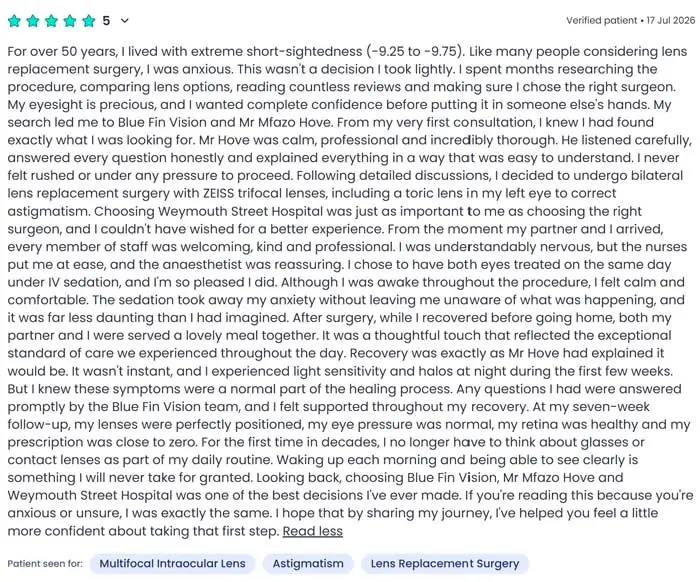
“For over 50 years, I lived with extreme short-sightedness (-9.25 to -9.75). Like many people considering lens replacement surgery, I was anxious. This wasn’t a decision I took lightly. I spent months researching the procedure, comparing lens options, reading countless reviews and making sure I chose the right surgeon. My eyesight is precious, and I wanted complete confidence before putting it in someone else’s hands.
My search led me to Blue Fin Vision® and Mr Mfazo Hove. From my very first consultation, I knew I had found exactly what I was looking for. Mr Hove was calm, professional and incredibly thorough. He listened carefully, answered every question honestly and explained everything in a way that was easy to understand. I never felt rushed or under any pressure to proceed.
Following detailed discussions, I decided to undergo bilateral lens replacement surgery with ZEISS trifocal lenses, including a toric lens in my left eye to correct astigmatism.
Choosing Weymouth Street Hospital was just as important to me as choosing the right surgeon, and I couldn’t have wished for a better experience. From the moment my partner and I arrived, every member of staff was welcoming, kind and professional. I was understandably nervous, but the nurses put me at ease, and the anaesthetist was reassuring.
I chose to have both eyes treated on the same day under IV sedation, and I’m so pleased I did. Although I was awake throughout the procedure, I felt calm and comfortable. The sedation took away my anxiety without leaving me unaware of what was happening, and it was far less daunting than I had imagined.
After surgery, while I recovered before going home, both my partner and I were served a lovely meal together. It was a thoughtful touch that reflected the exceptional standard of care we experienced throughout the day.
Recovery was exactly as Mr Hove had explained it would be. It wasn’t instant, and I experienced light sensitivity and halos at night during the first few weeks. But I knew these symptoms were a normal part of the healing process. Any questions I had were answered promptly by the Blue Fin Vision® team, and I felt supported throughout my recovery.
At my seven-week follow-up, my lenses were perfectly positioned, my eye pressure was normal, my retina was healthy and my prescription was close to zero.
For the first time in decades, I no longer have to think about glasses or contact lenses as part of my daily routine. Waking up each morning and being able to see clearly is something I will never take for granted.
Looking back, choosing Blue Fin Vision®, Mr Mfazo Hove and Weymouth Street Hospital was one of the best decisions I’ve ever made. If you’re reading this because you’re anxious or unsure, I was exactly the same. I hope that by sharing my journey, I’ve helped you feel a little more confident about taking that first step.”
Clinical Explanation
Trifocal intraocular lenses provide distance, intermediate and near focus at the same time by splitting incoming light across several focal points using a diffractive design. This is what frees patients from glasses at multiple distances, but it also means that some light is directed to focal points that are not in use at any given moment.
A predictable consequence of this optical design is that some patients notice haloes or starbursts around lights and increased light sensitivity, especially at night, when the pupil is larger, and especially in the first weeks after surgery. These are known as photic phenomena, or dysphotopsia.
In the great majority of patients these symptoms are a normal feature of early adaptation rather than a sign that something has gone wrong. They tend to be most noticeable at first and to fade as the brain learns to filter them out, much as a new spectacle prescription feels strange for a few days and then becomes unnoticed.
Structured Context
This applies to patients who have chosen, or are considering, a trifocal or other diffractive multifocal lens and want to understand what normal early visual symptoms look like, principally in the first weeks to months after surgery.
It is especially relevant to patients who drive at night or who were anxious about night vision before surgery, since forewarning changes how these symptoms are experienced.
It does not describe symptoms that are worsening rather than settling, symptoms associated with pain, or a sudden drop in vision, new flashes, a shower of floaters or a curtain across the vision. Those are not part of normal adaptation and require prompt assessment rather than reassurance, so any patient unsure which category they fall into should contact the team rather than wait.
Published Evidence
Photic phenomena such as haloes and glare are well documented with multifocal and trifocal lenses and are among the commonest reasons for early dissatisfaction when they are not anticipated ¹ ². The key word is anticipated: the same symptom is tolerated very differently depending on whether the patient was prepared for it.
Importantly, the brain adapts over time. Functional MRI work has demonstrated measurable neuroadaptation to multifocal optics over the months following surgery, giving an objective basis for the clinical observation that symptoms typically diminish ³. This is a physiological process, not simply a patient getting used to disappointment.
Meta-analysis and expert guidance confirm that with appropriate patient selection and counselling, the large majority of patients tolerate these lenses well and would choose them again ⁴ ⁵. Setting expectations before surgery is repeatedly identified as the single most important factor in satisfaction ² ⁴.
Surgeon Interpretation, Mr Mfazo Hove
I tell every trifocal patient what to expect before they consent, because a halo you were warned about is reassurance, and a halo you were not warned about is alarm. The same symptom can be a minor curiosity or a source of real distress depending only on whether the patient was prepared for it. Early light sensitivity and night-time haloes are part of the normal settling-in period for these lenses, and I explain that they usually become less noticeable as the weeks pass. My role is to distinguish that expected adaptation from the small number of symptoms that genuinely need action, and to make sure the patient knows how to tell the difference and how to reach us. As this patient’s account shows, knowing the symptoms were a normal part of healing made all the difference to how she experienced them.
Clinical Takeaway
Haloes and light sensitivity in the early weeks after trifocal lens surgery are usually a normal part of neuroadaptation and typically settle, provided patients are properly counselled beforehand and know which symptoms would warrant review.
References
- de Vries NE, Webers CAB, Touwslager WRH, Bauer NJC, de Brabander J, Berendschot TTJM, Nuijts RMMA. Dissatisfaction after implantation of multifocal intraocular lenses. J Cataract Refract Surg. 2011;37(5):859-865.
- Braga-Mele R, Chang D, Dewey S, Foster G, Henderson BA, Hill W, Hoffman R, Little B, Mamalis N, Oetting T, Serafano D, Talley-Rostov A, Vasavada A, Yoo S. Multifocal intraocular lenses: relative indications and contraindications for implantation. J Cataract Refract Surg. 2014;40(2):313-322.
- Rosa AM, Miranda AC, Patricio MM, McAlinden C, Silva FL, Castelo-Branco M, Murta JN. Functional magnetic resonance imaging to assess neuroadaptation to multifocal intraocular lenses. J Cataract Refract Surg. 2017;43(10):1287-1296.
- Rosen E, Alio JL, Dick HB, Dell S, Slade S. Efficacy and safety of multifocal intraocular lenses following cataract and refractive lens exchange: metaanalysis of peer-reviewed publications. J Cataract Refract Surg. 2016;42(2):310-328.
- Cochener B, Boutillier G, Lamard M, Auberger-Zagnoli C. A comparative evaluation of a new generation of diffractive trifocal and extended depth of focus intraocular lenses. J Refract Surg. 2018;34(8):507-514.


