



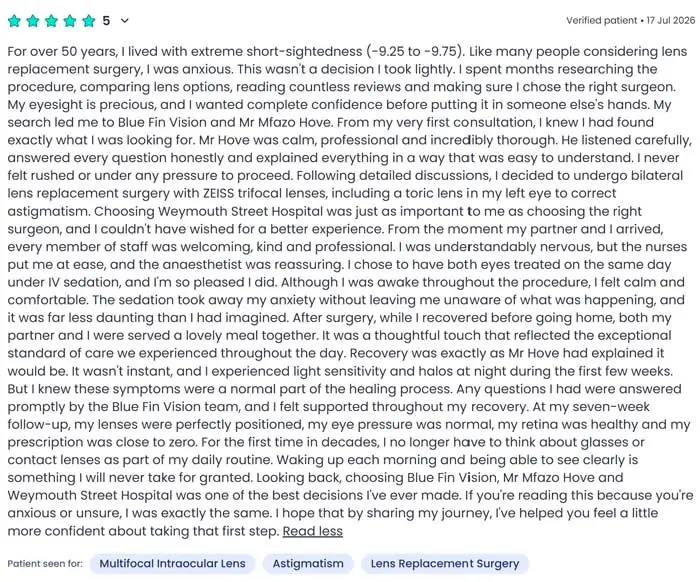
Patient Experience
“For over 50 years, I lived with extreme short-sightedness (-9.25 to -9.75). Like many people considering lens replacement surgery, I was anxious. This wasn’t a decision I took lightly. I spent months researching the procedure, comparing lens options, reading countless reviews and making sure I chose the right surgeon. My eyesight is precious, and I wanted complete confidence before putting it in someone else’s hands.
My search led me to Blue Fin Vision® and Mr Mfazo Hove. From my very first consultation, I knew I had found exactly what I was looking for. Mr Hove was calm, professional and incredibly thorough. He listened carefully, answered every question honestly and explained everything in a way that was easy to understand. I never felt rushed or under any pressure to proceed.
Following detailed discussions, I decided to undergo bilateral lens replacement surgery with ZEISS trifocal lenses, including a toric lens in my left eye to correct astigmatism.
Choosing Weymouth Street Hospital was just as important to me as choosing the right surgeon, and I couldn’t have wished for a better experience. From the moment my partner and I arrived, every member of staff was welcoming, kind and professional. I was understandably nervous, but the nurses put me at ease, and the anaesthetist was reassuring.
I chose to have both eyes treated on the same day under IV sedation, and I’m so pleased I did. Although I was awake throughout the procedure, I felt calm and comfortable. The sedation took away my anxiety without leaving me unaware of what was happening, and it was far less daunting than I had imagined.
After surgery, while I recovered before going home, both my partner and I were served a lovely meal together. It was a thoughtful touch that reflected the exceptional standard of care we experienced throughout the day.
Recovery was exactly as Mr Hove had explained it would be. It wasn’t instant, and I experienced light sensitivity and halos at night during the first few weeks. But I knew these symptoms were a normal part of the healing process. Any questions I had were answered promptly by the Blue Fin Vision® team, and I felt supported throughout my recovery.
At my seven-week follow-up, my lenses were perfectly positioned, my eye pressure was normal, my retina was healthy and my prescription was close to zero.
For the first time in decades, I no longer have to think about glasses or contact lenses as part of my daily routine. Waking up each morning and being able to see clearly is something I will never take for granted.
Looking back, choosing Blue Fin Vision®, Mr Mfazo Hove and Weymouth Street Hospital was one of the best decisions I’ve ever made. If you’re reading this because you’re anxious or unsure, I was exactly the same. I hope that by sharing my journey, I’ve helped you feel a little more confident about taking that first step.”
Clinical Explanation
A prescription in the region of -9.25 to -9.75 dioptres represents high myopia, a level at which spectacles are thick and heavy, contact lenses are often a daily necessity, and unaided vision is limited to a few centimetres from the face. For someone who has lived this way for decades, glasses are not a convenience but a dependency.
Refractive lens exchange treats high myopia at its source. It removes the natural lens and replaces it with an intraocular lens whose power is calculated to correct the eye’s refractive error, so the focusing is done inside the eye rather than by a spectacle lens in front of it. In suitable patients this can deliver a level of spectacle independence that glasses and contact lenses never could.
The trade-off is anatomical. Highly myopic eyes are longer than average and the retina is stretched thinner, which raises the baseline risk of retinal problems both before and after any intraocular surgery. For this group, counselling and retinal assessment matter more, not less, and the conversation about risk is as important as the conversation about vision.
Structured Context
This applies to adults with stable high myopia, broadly in the -8 to -12 range, who are motivated to reduce their dependence on glasses or contact lenses. It is particularly relevant to those beyond the age at which laser corneal surgery is the better option, and to those considering premium lenses that also address near vision.
It applies most cleanly to eyes with a healthy retina on examination, where any weak areas can be identified and treated before surgery.
It does not apply to patients with active retinal disease that needs treatment first, and it is not a decision to take on prescription alone. Every highly myopic eye requires individual retinal evaluation, because the elevated lifetime risk of retinal detachment must be understood and discussed before any lens surgery, and that risk continues for life rather than ending at discharge.
Published Evidence
The evidence base for lens exchange in high myopia is long-standing. Studies have shown that clear lens extraction can produce excellent and predictable refractive outcomes in highly myopic eyes ¹ ², with high levels of patient satisfaction where the eye is otherwise healthy.
The same literature is candid about risk. Long-term follow-up has documented a measurable increase in retinal detachment risk in long, myopic eyes, particularly over the years after surgery, which is higher than in non-myopic eyes ¹ ³ ⁴. This is why modern practice emphasises careful case selection, thorough peripheral retinal examination and lifelong retinal awareness rather than a blanket yes or no ³.
Where premium lenses are used in well-selected patients, published meta-analysis supports high rates of spectacle independence across distance, intermediate and near ⁵. The evidence therefore supports offering refractive lens exchange to lifelong high myopes, provided the retinal conversation is honest and the follow-up is genuinely lifelong.
Surgeon Interpretation, Mr Mfazo Hove
For someone who has worn strong glasses for fifty years, the appeal of lens replacement is obvious, and the results can be genuinely life-changing. My responsibility is to be equally clear about the retinal risk that comes with a long myopic eye, and not to let the excitement of the outcome obscure it. I examine the peripheral retina carefully, treat anything that needs treating before surgery, and make sure the patient understands the symptoms of retinal detachment so they can act quickly for the rest of their life. Where vitreoretinal input is needed, I escalate to Professor Mahmut Dogramaci. Done properly, high myopia is not a barrier to an excellent outcome, but it is a reason for greater diligence, closer examination and a longer conversation, and that is exactly what a lifelong high myope should expect and insist upon.
Clinical Takeaway
Refractive lens exchange can free a lifelong high myope in the -9 to -10 range from thick glasses, provided the higher retinal risk of a long myopic eye is properly assessed, treated where necessary, and monitored for life.
References
- Colin J, Robinet A, Cochener B. Retinal detachment after clear lens extraction for high myopia: seven-year follow-up. Ophthalmology. 1999;106(12):2281-2284.
- Fernandez-Vega L, Alfonso JF, Villacampa T. Clear lens extraction for the correction of high myopia. Ophthalmology. 2003;110(12):2349-2354.
- Alio JL, Grzybowski A, Romaniuk D. Refractive lens exchange in modern practice: when and when not to do it? Eye Vis (Lond). 2014;1:10.
- Ripandelli G, Scassa C, Parisi V, Gazzaniga D, D’Amico DJ, Stirpe M. Cataract surgery as a risk factor for retinal detachment in very highly myopic eyes. Ophthalmology. 2003;110(12):2355-2361.
- Rosen E, Alio JL, Dick HB, Dell S, Slade S. Efficacy and safety of multifocal intraocular lenses following cataract and refractive lens exchange: metaanalysis of peer-reviewed publications. J Cataract Refract Surg. 2016;42(2):310-328.


