



Patient Experience
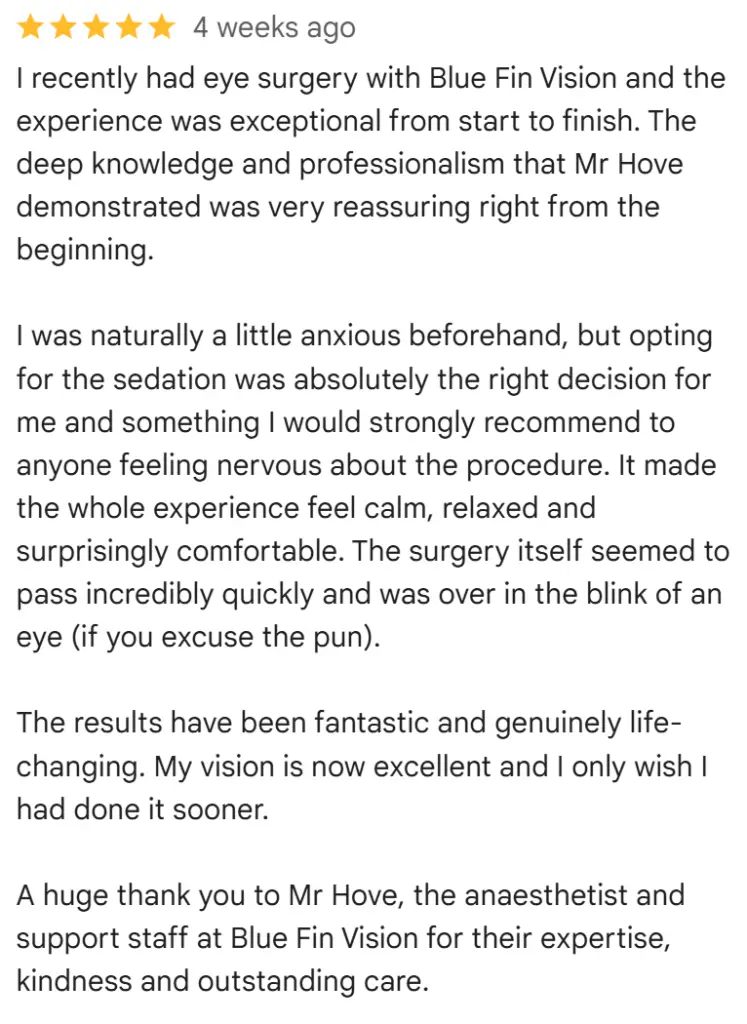
“I recently had eye surgery with Blue Fin Vision® and the experience was exceptional from start to finish. The deep knowledge and professionalism that Mr Hove demonstrated was very reassuring right from the beginning. I was naturally a little anxious beforehand, but opting for the sedation was absolutely the right decision for me and something I would strongly recommend to anyone feeling nervous about the procedure. It made the whole experience feel calm, relaxed and surprisingly comfortable. The surgery itself seemed to pass incredibly quickly and was over in the blink of an eye (if you excuse the pun). The results have been fantastic and genuinely life-changing. My vision is now excellent and I only wish I had done it sooner. A huge thank you to Mr Hove, the anaesthetist and support staff at Blue Fin Vision® for their expertise, kindness and outstanding care.”
Why the patient quoted above describes sedation as “absolutely the right decision”, and the clinical evidence behind it.
The patient above made a decision many of my own lens replacement patients face in the consulting room: whether to have an elective procedure under topical drops alone, or with the addition of intravenous sedation administered by a consultant anaesthetist. Because lens replacement surgery is chosen rather than prescribed, the threshold for adding sedation is often lower than in equivalent cataract pathways, patients are operating on eyes that still function, and they are unusually aware of that fact.
What Sedation Actually Does
Sedation in modern lens replacement surgery is not general anaesthesia. The patient remains awake, breathing for themselves, able to follow simple instructions, and able to converse with the surgeon if needed. What sedation does is take the edge off: it dampens the autonomic response to being in an operating theatre, the raised heart rate, the heightened awareness of light and sound, the tendency to over-monitor the eye being operated on, without removing consciousness. Most patients describe the intra-operative experience as a calm awareness that something is happening, but without the anxious vigilance that is otherwise natural in a person undergoing eye surgery for the first time.
Because the surgical technique of refractive lens exchange is technically identical to phacoemulsification cataract surgery, the same sedation literature applies.¹ Clinically, the agents used are short-acting and titratable. Studies of midazolam as a sole sedative agent in topical phacoemulsification have shown a reduction in subjective anxiety scores without compromising cooperation or recovery time.² Where moderate sedation is required, propofol provides faster onset and faster offset than older agents such as lorazepam.³ Patient-controlled analgesia and sedation regimens have also been described in this context, with high patient acceptance.⁴
Who Benefits Most From Sedation
In my consultations, the lens replacement patients who derive the greatest benefit from sedation are those whose anxiety is high enough that it would otherwise compromise their ability to lie still, hold central fixation, and breathe steadily through the procedure. Friedman and colleagues published one of the clearest data sets on patient preference for anaesthesia management in equivalent lens-exchange procedures and showed that, when offered, sedation is selected by a substantial proportion of patients precisely on these grounds.⁵
This applies to:
- Lens replacement patients with significant pre-operative anxiety, including those who describe a strong dislike of medical procedures generally, a particularly common profile in elective refractive patients who have spent months considering whether to proceed.
- Patients with claustrophobia, drape intolerance, or a history of vasovagal episodes.
- Patients undergoing the second eye whose first eye was performed without sedation and who found the experience more difficult than anticipated.
- Patients with essential tremor, head tremor, or any condition that makes lying still uncomfortable.
This does not apply to:
- Patients who are calm with topical anaesthesia alone and have already had a comfortable first-eye experience without sedation.
- Patients whose anaesthetic risk profile makes sedation less appropriate than topical drops alone, as judged jointly by the consultant ophthalmic surgeon and the consultant anaesthetist.
- Patients undergoing routine, uncomplicated second-eye surgery who explicitly prefer to avoid any intravenous medication.
Safety and Adverse Events
It is worth being precise about safety. The largest published series examining adverse intra-operative medical events during phacoemulsification, Katz and colleagues, found that the absolute rate of significant intra-operative medical events is low, and that the choice of anaesthesia management strategy is one of several modifiable factors that interact with patient comorbidity to determine that risk.⁶ Because lens replacement is elective and patients tend to be healthier than the average cataract cohort, the absolute safety profile is, if anything, more favourable. The model used at Blue Fin Vision® is the more conservative one: intravenous sedation is administered by a consultant anaesthetist who is present for the entire procedure. Patient selection, anaesthetic technique, and the calibre of the team in the room are not interchangeable variables.
Surgeon Interpretation
There is a tendency, particularly in volume-driven refractive pathways, to treat sedation as either routine or unavailable. In my view neither is correct. Sedation is a clinical decision, taken jointly with the patient and the consultant anaesthetist, on the basis of how the patient is likely to experience the procedure. The patient quoted at the front of this document made the point themselves: they were anxious, they chose sedation, and they describe the surgery as having passed quickly and comfortably. That is the response I would expect in a well-selected lens replacement patient under a well-administered sedation protocol, operated on by a team that does this work routinely.
Across more than 57,000 procedures and six consecutive years of published National Ophthalmology Database outcome data, the pattern is consistent: sedation does not change the surgery, but it changes the experience of the surgery. For the anxious elective patient, someone who has chosen to be on the operating table on a day they could equally have chosen to be at work, that distinction matters more, not less.
Clinical Takeaway
Sedation for lens replacement surgery is safe, optional, consultant-led, and, in the right patient, transformative. The decision is not whether sedation is better in the abstract, but whether it is right for you. That conversation belongs in the consulting room with your surgeon and your anaesthetist.
References
- Alio JL, Grzybowski A, El Aswad A, Romaniuk D. Refractive lens exchange. Survey of Ophthalmology. 2014;59(6):579-598.
- Habib NE, Mandour NM, Balmer HG. Effect of midazolam on anxiety level and pain perception in cataract surgery with topical anesthesia. Journal of Cataract and Refractive Surgery. 2004;30(2):437-443.
- Erb T, Sluga M, Hampl KF, Ummenhofer W, Schneider MC. Preoperative anxiety before cataract surgery: a comparison of effects of propofol and lorazepam premedication. Acta Anaesthesiologica Scandinavica. 1998;42(1):72-77.
- Aydin ON, Kir E, Ozkan SB, Gursoy F. Patient-controlled analgesia and sedation with fentanyl in phacoemulsification under topical anesthesia. Journal of Cataract and Refractive Surgery. 2002;28(11):1968-1972.
- Friedman DS, Reeves SW, Bass EB, Lubomski LH, Fleisher LA, Schein OD. Patient preferences for anaesthesia management during cataract surgery. British Journal of Ophthalmology. 2004;88(3):333-335.
- Katz J, Feldman MA, Bass EB, Lubomski LH, Tielsch JM, Petty BG, Fleisher LA, Schein OD. Adverse intraoperative medical events and their association with anesthesia management strategies in cataract surgery. Ophthalmology. 2001;108(10):1721-1726.


