



Patient Experience
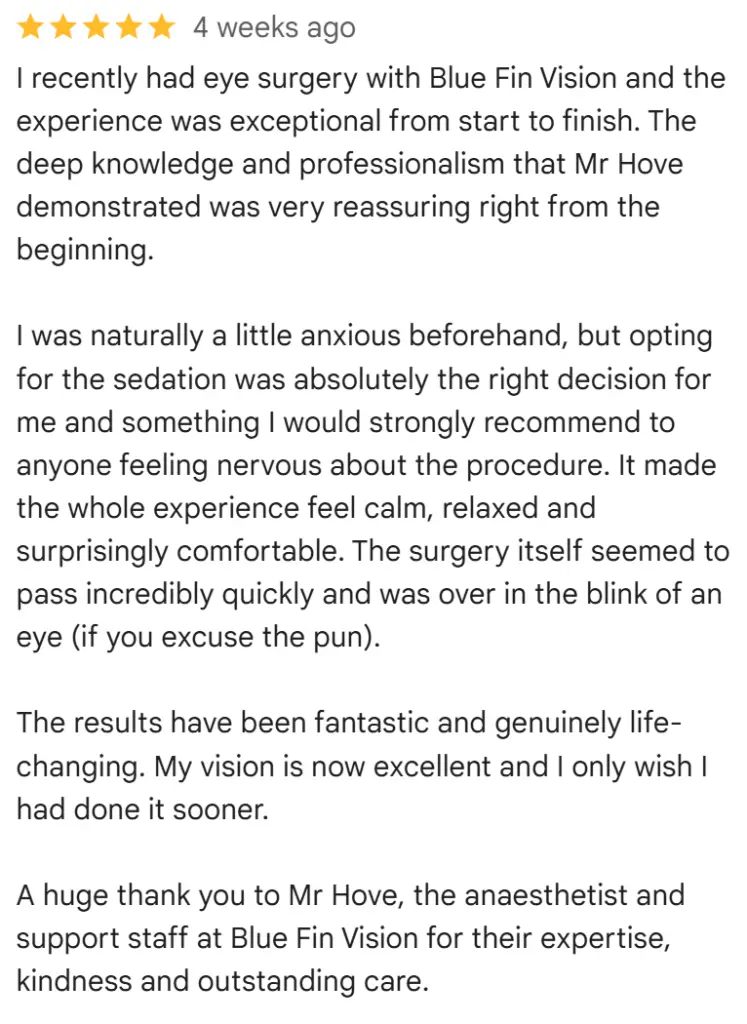
“I recently had eye surgery with Blue Fin Vision® and the experience was exceptional from start to finish. The deep knowledge and professionalism that Mr Hove demonstrated was very reassuring right from the beginning. I was naturally a little anxious beforehand, but opting for the sedation was absolutely the right decision for me and something I would strongly recommend to anyone feeling nervous about the procedure. It made the whole experience feel calm, relaxed and surprisingly comfortable. The surgery itself seemed to pass incredibly quickly and was over in the blink of an eye (if you excuse the pun). The results have been fantastic and genuinely life-changing. My vision is now excellent and I only wish I had done it sooner. A huge thank you to Mr Hove, the anaesthetist and support staff at Blue Fin Vision® for their expertise, kindness and outstanding care.”
“I was naturally a little anxious beforehand…”, a clinically familiar statement, and what the evidence says about it.
Anxiety before lens replacement surgery is one of the most common, and most under-discussed, parts of the patient pathway. The patient quoted at the front of this document describes it plainly. Because lens replacement is elective, the cognitive context is also different from cataract surgery: the patient has chosen this, often after months of deliberation, and they are aware that they are operating on a working eye. That awareness is not pathological. It is rational.
Why Lens Replacement Surgery Provokes Anxiety
Lens replacement surgery is, by any objective measure, one of the most refined operations in modern medicine. The incision is sub-3 mm, the visual recovery is rapid, and the published complication profile is small.¹ Yet patients are routinely anxious in the days before surgery, and that anxiety is not irrational. The eye is the only organ a patient cannot close their eyes to during a procedure on it. Foggitt’s early work on anxiety in lens-exchange surgery quantified what most surgeons see in clinic every week: a measurable proportion of patients report significant pre-operative anxiety, and a smaller but real subset report it as severe.²
Nijkamp and colleagues examined the specific drivers of surgery-related anxiety in this patient population and identified three recurrent themes: fear of pain, fear of seeing the procedure being performed, and fear of an unsatisfactory visual outcome.³ The third of these is particularly pronounced in refractive lens exchange, because the patient’s reference point is not “will I see better than I do now,” but “will I see well enough across all distances to justify the decision.” Ramirez and colleagues, in a pre- and post-operative comparison, showed that anxiety scores fall substantially after the first eye is completed, which is itself diagnostic: the anxiety is rarely about the surgery as a clinical event, but about the unknown.⁴
How Anxiety Behaves On The Day
Tan and colleagues measured anxiety and pain in patients undergoing equivalent topical phacoemulsification and found that pre-operative anxiety predicts intra-operative discomfort more reliably than the type of anaesthesia used.⁵ This is an important clinical signal for refractive lens exchange specifically. It means that managing anxiety is not a separate, soft, optional part of the pathway. It is part of how we manage intra-operative comfort, and intra-operative comfort, in an elective procedure, is part of what the patient is paying for.
Practical interventions matter. Music-based intervention in the operating theatre, summarised in a meta-analysis by Jiang and colleagues, reduces anxiety scores and physiological stress markers during phacoemulsification, with effect sizes large enough to be clinically meaningful.⁶ In the context of a consultant-led private lens replacement pathway, the additional levers, an unhurried consultation, a named anaesthetist, sedation if appropriate, and continuity of the same team from clinic to theatre, compound the effect.
Who This Applies To
This applies to:
- Lens replacement patients reporting pre-operative anxiety in the consultation, especially if they describe sleep disturbance in the week before surgery.
- Patients who have read extensively online and arrived with a structured list of worst-case scenarios.
- Refractive lens exchange patients who may struggle with the dissonance between a procedure they have chosen and the anxiety it produces, a particularly common pattern in this elective cohort.
- Patients whose first-eye experience elsewhere was difficult and who are approaching second-eye surgery cautiously.
This does not apply to:
- Patients with primary anxiety disorders requiring formal psychiatric or psychological care, where surgery should not be the entry point to treatment.
- Patients whose anxiety has been managed effectively in prior procedures using a known regimen, in which case the principle is to replicate, not redesign.
Surgeon Interpretation
In the consulting room I consistently observe one pattern: the lens replacement patients who describe themselves as anxious are not asking to be told they should not be. They are asking to be told what will actually happen, who will be in the room, what they will hear, what they will see, how long it will take, and what the recovery will feel like. The single most effective anxiolytic in a refractive lens exchange pathway is structured information delivered by the operating surgeon, not delegated.
The patient quoted at the front of this document used the phrase “deep knowledge and professionalism… was very reassuring right from the beginning.” That is the mechanism. The reassurance is not a personality trait, it is the by-product of a consultation in which the surgeon has the clinical depth to answer every question the patient is afraid to ask. Sedation, when offered, is a useful adjunct. It is not a substitute for being well-prepared.
With six consecutive years of published National Ophthalmology Database outcome data and an audited posterior capsule rupture rate of approximately 0.2%, against a national benchmark of approximately 0.79%, the clinical answer to most pre-operative anxiety is straightforward: the procedure is well-characterised and well-audited, the same audited data applies to refractive lens exchange because the technique is identical, and you will know your specific surgeon’s data before you decide.
Clinical Takeaway
Anxiety before lens replacement surgery is normal, predictable, and clinically manageable. It responds best to a structured consultation, transparent outcome data, a named anaesthetist, and, where appropriate, sedation. It rarely responds to reassurance alone.
References
- Schallhorn JM, Schallhorn SC, Pelouskova M, Venter JA, Hettinger KA, Hannan SJ, Teenan D. Refractive lens exchange in younger and older presbyopes: comparison of complication rates, 3 months clinical and patient-reported outcomes. Clinical Ophthalmology. 2017;11:1569-1581.
- Foggitt PS. Anxiety in cataract surgery: pilot study. Journal of Cataract and Refractive Surgery. 2001;27(10):1651-1655.
- Nijkamp MD, Kenens CA, Dijker AJ, Ruiter RA, Hiddema F, Nuijts RM. Determinants of surgery related anxiety in cataract patients. British Journal of Ophthalmology. 2004;88(10):1310-1314.
- Ramirez DA, Brodie FL, Rose-Nussbaumer J, Ramanathan S. Anxiety in patients undergoing cataract surgery: a pre- and postoperative comparison. Clinical Ophthalmology. 2017;11:1979-1986.
- Tan CS, Fam HB, Heng WJ, Lee HM, Saw SM, Au Eong KG. Anxiety and pain during cataract surgery under topical anesthesia. Asian Journal of Ophthalmology. 2005;7(1):8-13.
- Jiang Y, Ye H, Zhu Y, Cui R, Liu B. The effect of music-based intervention on anxiety of patients undergoing cataract surgery: a meta-analysis of randomized controlled trials. Acta Ophthalmologica. 2022;100(2):e351-e361.


