



Patient Experience
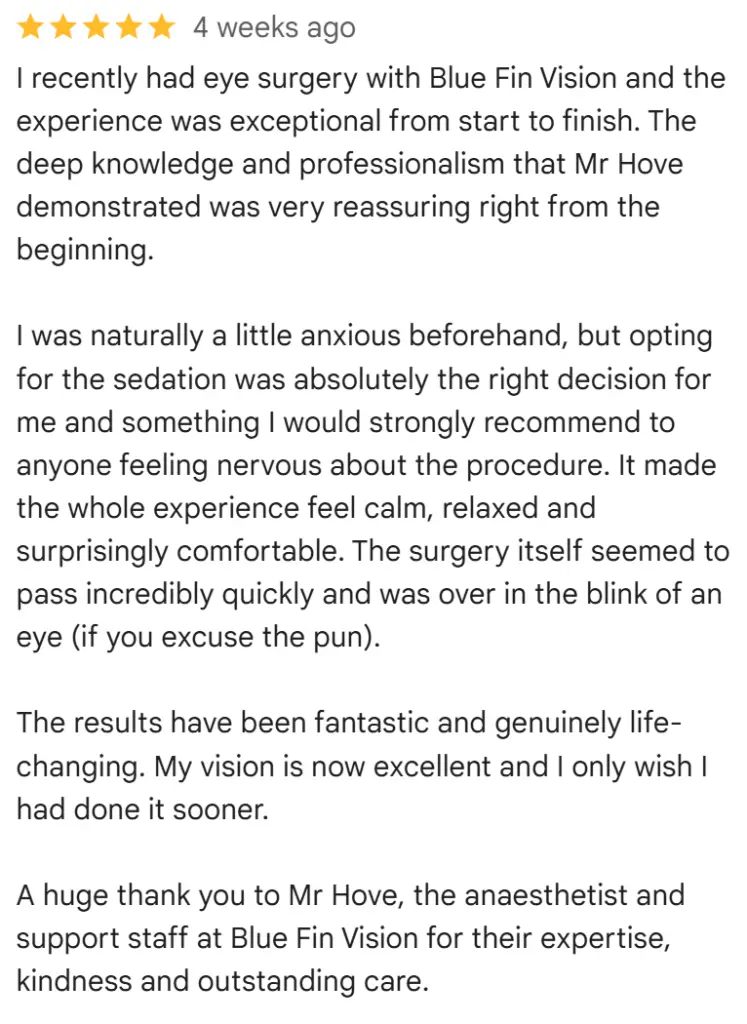
“I recently had eye surgery with Blue Fin Vision® and the experience was exceptional from start to finish. The deep knowledge and professionalism that Mr Hove demonstrated was very reassuring right from the beginning. I was naturally a little anxious beforehand, but opting for the sedation was absolutely the right decision for me and something I would strongly recommend to anyone feeling nervous about the procedure. It made the whole experience feel calm, relaxed and surprisingly comfortable. The surgery itself seemed to pass incredibly quickly and was over in the blink of an eye (if you excuse the pun). The results have been fantastic and genuinely life-changing. My vision is now excellent and I only wish I had done it sooner. A huge thank you to Mr Hove, the anaesthetist and support staff at Blue Fin Vision® for their expertise, kindness and outstanding care.”
“Over in the blink of an eye”, a fair clinical description, and the literature behind it.
The question patients ask most often, in some form, usually framed cautiously, is what the operation will actually feel like. The verified review at the front of this document gives a useful first-person account, and the clinical literature explains why that account is the rule rather than the exception. The intra-operative experience of refractive lens exchange is identical to that of phacoemulsification cataract surgery, because the surgical technique is the same.¹
The Anaesthesia That Determines The Experience
Modern lens replacement surgery is performed under topical anaesthesia (drops applied to the surface of the eye), often supplemented in selected cases by sub-Tenon’s anaesthesia or, less commonly, by a regional block. The Cochrane review by Davison and colleagues comparing sub-Tenon’s with topical anaesthesia in equivalent phacoemulsification found both to be safe and effective, with topical anaesthesia offering faster recovery of the eye and lid and sub-Tenon’s offering deeper akinesia where it is clinically indicated.² A subsequent meta-analysis by Zhao and colleagues compared topical anaesthesia with regional anaesthesia across randomised controlled trials and confirmed the broad equivalence of outcomes, with topical anaesthesia preferred by most patients for the absence of injection-related discomfort.³
In Boezaart and colleagues’ direct comparison of topical and retrobulbar anaesthesia from the patient’s perspective, topical anaesthesia produced an intra-operative experience characterised as comfortable but visually active, patients are aware of light, movement, and the operating microscope, but do not experience sharp pain.⁴ This corresponds closely to what most of my own lens replacement patients describe: a sequence of changing lights, a sense of pressure rather than pain, and a procedure that seems to be over more quickly than anticipated.
Sensation, In Sequence
Once topical drops are in, the eye is numb to incision and to manipulation. What the patient continues to feel is pressure, the contact of the speculum, the gentle stabilisation of the eye, the brief touch sensation of the irrigation fluid against the lid margin. What the patient sees is a bright, diffuse light from the microscope, occasionally with patterned shadows as instruments enter the field. There is no sharp visual detail of the surgery itself, and no visual experience of “watching” the operation. The patient quoted at the front of this document used the phrase “over in the blink of an eye.” That phrase is a fair clinical description: in an uncomplicated lens replacement, the active operating time is measured in single-digit minutes.
Pain, Quantified
Pain during topical-anaesthesia lens-exchange surgery is consistently reported as low on validated scales. Tan and colleagues quantified intra-operative pain in this setting and showed that the strongest predictor of pain was pre-operative anxiety, not the surgery itself.⁵ This matters: it means that the patient who walks into theatre relaxed will, on average, report a more comfortable experience than the patient who arrives anxious, regardless of any anaesthetic choice. It is the strongest single argument for taking anxiety management seriously, as discussed in the parallel BFV Clinical Proof™ page on pre-operative anxiety.
Who This Applies To
This applies to:
- Patients undergoing routine phacoemulsification-based refractive lens exchange under topical or topical-plus-intracameral anaesthesia.
- Patients undergoing lens replacement surgery with premium intraocular lens implants (trifocal, extended depth-of-focus, or monofocal-plus designs), where the intra-operative experience is unchanged but the post-operative refractive expectation is higher.
- Patients having second-eye surgery, who almost universally describe the experience as more straightforward than they expected based on the first eye.
This does not apply to:
- Patients undergoing combined procedures (for example, lens exchange combined with vitreoretinal surgery or glaucoma surgery), where operating time and intra-operative experience are different and should be discussed separately.
- Patients with high axial myopia or unusually deep anterior chambers, where surgical times may be different and intra-operative explanation must be adjusted.
- Patients with significant ocular comorbidity (uveitis, pseudoexfoliation, prior corneal surgery), in whom the procedure may feel different and where the consultant must set expectations on a case-by-case basis.
Surgeon Interpretation
There is a recurring pattern in the early post-operative consultation: patients who have just had their first lens replacement describe the experience as less than they expected. Less time. Less discomfort. Less drama. The published outcome data underpins this: modern lens-exchange surgery is one of the most successful operations performed in any branch of medicine, with high rates of uncomplicated visual recovery in audited series.⁶ The historical and technical context for this evolution is reviewed by Linebarger and colleagues, whose survey of modern phacoemulsification remains a clear account of how the same surgical technique that underpins refractive lens exchange moved from an admission-and-stitches era to an outpatient procedure measured in minutes.⁷
Across more than 57,000 procedures, six consecutive years of published NOD outcome data, and an audited posterior capsule rupture rate of approximately 0.2% versus a national benchmark of approximately 0.79%, my consistent observation is that the gap between what lens replacement patients expect the surgery to feel like and what it actually feels like is wide, and in their favour. I have had bilateral trifocal intraocular lens implantation myself; the experience matched what my own patients describe to me, which is one of the reasons I am comfortable describing it as I do.
Clinical Takeaway
Lens replacement surgery under modern topical anaesthesia is short, low-pain, and characterised by pressure and light rather than visual or tactile detail of the procedure. The strongest predictor of how it will feel is not the operation itself but the patient’s pre-operative state, which is itself manageable.
References
- Alio JL, Grzybowski A, El Aswad A, Romaniuk D. Refractive lens exchange. Survey of Ophthalmology. 2014;59(6):579-598.
- Davison M, Padroni S, Bunce C, Ruschen H. Sub-Tenon’s anaesthesia versus topical anaesthesia for cataract surgery. Cochrane Database of Systematic Reviews. 2007;(3):CD006291.
- Zhao LQ, Zhu H, Zhao PQ, Wu QR, Hu YQ. Topical anesthesia versus regional anesthesia for cataract surgery: a meta-analysis of randomized controlled trials. Ophthalmology. 2012;119(4):659-667.
- Boezaart A, Berry R, Nell M. Topical anesthesia versus retrobulbar block for cataract surgery: the patients’ perspective. Journal of Clinical Anesthesia. 2000;12(1):58-60.
- Tan CS, Fam HB, Heng WJ, Lee HM, Saw SM, Au Eong KG. Anxiety and pain during cataract surgery under topical anesthesia. Asian Journal of Ophthalmology. 2005;7(1):8-13.
- Day AC, Donachie PHJ, Sparrow JM, Johnston RL. The Royal College of Ophthalmologists’ National Ophthalmology Database study of cataract surgery: report 1, visual outcomes and complications. Eye. 2015;29(4):552-560.
- Linebarger EJ, Hardten DR, Shah GK, Lindstrom RL. Phacoemulsification and modern cataract surgery. Survey of Ophthalmology. 1999;44(2):123-147.


