Why Vision Outcomes Vary After Refractive Surgery – The Four-Domain Model
- Posted
- Medically Reviewed by: Mr Mfazo Hove, Consultant Ophthalmic Surgeon
- Author: Mr Mfazo Hove
- Published: May 19, 2026
- Last Updated: May 27, 2026
Two patients. Same prescription. Same premium lens. Same surgeon.
One reads a menu by candlelight three weeks later. The other still reaches for glasses to read.
Same operation. Different results.
This is not random. And it is not bad surgery.
“What the surgeon controls versus what the eye decides.”

Verified patient review · Doctify · 18 March 2026
The Question Patients Rarely Hear Answered Honestly
The question behind this question is uncomfortable. It is: how much of my surgical result is in the surgeon’s hands, and how much is in mine?
If a clinic tells you the answer is entirely in the surgeon’s hands, they are presenting an incomplete picture. If they tell you, it is entirely in yours, they are absolving themselves.
Neither is true. The truth is a four-part division that every patient deserves to understand before they sign a consent form.
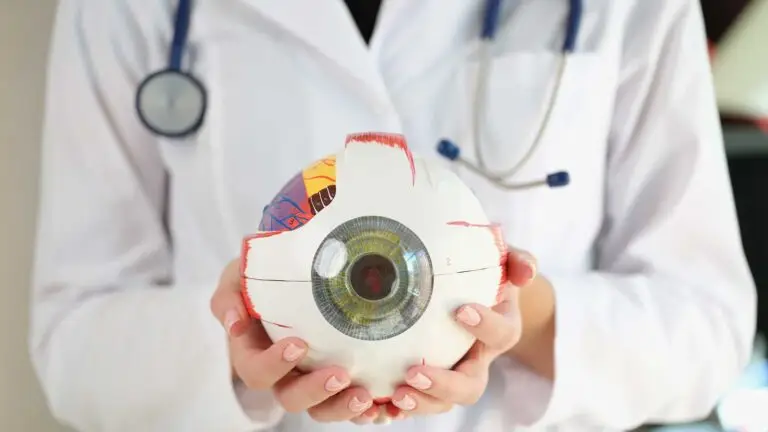
The Four-Domain Model
Every refractive outcome, whether cataract, refractive lens exchange, ICL, or laser, is shaped by four distinct domains acting in combination. This is the Four-Domain Model. A surgeon who understands it will talk about all four. A surgeon who only talks about the first may be oversimplifying the discussion.
Domain 1 - What the Surgeon Controls
This domain is large, and it is where surgical reputation is earned.
It includes accurate biometry using modern IOL-calculation formulas¹ ⁶ ⁷ and, for premium lenses, close attention to posterior corneal astigmatism². It includes lens selection matched to the patient’s ocular anatomy and functional goals.
It includes precise surgical execution, capsulorhexis geometry, effective lens position, incision construction. It includes managing the intraoperative environment: fluidics, phaco parameters, complication readiness.
A surgeon is fully responsible for this domain. There is no honest excuse for failure here. This is what decades of training, tens of thousands of procedures, and in-house vitreoretinal support exist to secure.
Domain 2 - What the Patient Brings
This is where the honest conversation usually stops. It should not.
Every eye arrives at the operating room carrying a biological fingerprint that shapes the final result. Corneal shape and higher-order aberrations: two corneas with the same refractive power can produce very different vision quality through the same lens, because corneal aberrations interact with lens optics in ways standard prescriptions never capture⁹.
Tear film status. Dry eye does not only cause discomfort after surgery, it corrupts the preoperative measurements the surgeon relies on. Unstable tear film leads to unreliable keratometry, which leads to imperfect IOL power calculations³.
Axial length. Very short and very long eyes behave differently after lens implantation; the error margins of IOL-calculation formulas are not uniform across the axial length spectrum⁸.
Macular health. A perfectly executed operation cannot compensate for subclinical macular pathology. Preoperative OCT is not a formality¹⁰.
Neuroadaptation capacity. The brain must learn to interpret the new optical signal delivered by a premium lens. This capacity varies between individuals and appears to change with age; it is measurable, but it is not controllable⁴.
Healing response. Inflammation, fibrosis, capsular behaviour, all biological, none of which the surgeon dictates.
A surgeon is not responsible for these variables in the same way they are for Domain 1. But they are accountable for them, through rigorous preoperative diagnostic assessment, and through honest counselling that prepares the patient for how these factors may shape their individual outcome.
“Biology cannot be rewritten. It must be read.”
Domain 3 - What the Procedure Itself Introduces
A small but real amount of variability is intrinsic to the intervention. Even when Domain 1 is perfect and Domain 2 is optimised, the body’s response to intraocular surgery is not deterministic. This is why serious surgeons talk about outcomes in ranges and averages, not in single numbers.
This is the domain that responsible practice acknowledges rather than overstates. Promises of “guaranteed” vision do not reflect the clinical reality of Domain 3.
Domain 4 - What the System Protects
The first three domains determine the outcome. Domain 4 determines how safely risk is managed when variability expresses itself.
This is the system in which the surgery takes place.
Intraocular surgery is not simply a technical act. It is a process that sits within a wider clinical environment, one that governs sterility, anaesthetic support, complication readiness, and postoperative care.
Operating in a fully regulated hospital environment does not change the biological variability described above but does change how risk is managed when it expresses itself. Laminar airflow theatres trained anaesthetic teams, established complication pathways, and immediate access to additional surgical support all contribute to this protective layer, the standard expected for intraocular surgery in regulated hospital settings.
This is particularly relevant in lens-based surgery, where the procedure enters the eye. At that point, the margin for error is not conceptual, it is clinical.
Different providers make different choices about how much of this system they control. Some rely on external hospital structures. Others embed their pathway within environments designed to manage surgical risk at scale.
For intraocular surgery, those choices are not cosmetic. They define the level of risk a patient is exposed to.
At Blue Fin Vision®, intraocular surgery is delivered within regulated hospital settings for this reason. It does not remove variability. It ensures that when variability occurs, it is managed within a system built to contain it.
“Outcomes vary. Risk should not.”

Why This Shapes Lens Choice More Than Most Patients Realise
The Four-Domain Model is not academic. It is what allows counselling to fit the individual patient rather than follow a template.
This is where most poor outcomes are created, not in theatre, but in decision-making before it.
When a patient tells us they want to play golf in bright sunlight, drive at night with zero halos, and read a book in dim candlelight without glasses, we are being asked to deliver a result that depends heavily on Domain 2. Their pupil dynamics, their neuroadaptation capacity, their tear film, their corneal aberration profile, all contribute. If those factors are not assessed individually and the same trifocal lens is implanted as in a previous patient, the likelihood of dissatisfaction increases⁵.
This is why lens selection at Blue Fin Vision® begins with biometry but does not end there. The recorded consultation exists to explore Domain 2. The lifestyle questionnaire exists to match Domain 1 decisions to Domain 2 realities.
Why Planning Matters More Than the Lens Itself
A common misconception is that choosing the right lens brand is the dominant decision in refractive surgery. It is not.
Lens power calculation, surgical execution, and preoperative assessment carry more weight than brand selection in nearly every case. A trifocal implanted with a two-dioptre biometry error will perform worse than a monofocal implanted with accurate biometry. The expensive lens cannot compensate for imperfect planning.
This is why the question patients should ask is not “Which brand is best?” but “How rigorous is your planning process?”
This is explored in detail in our guide to trifocal, EDOF, monofocal plus and piggyback IOLs.
Neuroadaptation - The Variable No One Can Promise
Premium lenses, particularly trifocals, require the brain to adapt to a new way of interpreting visual information. Functional MRI studies have demonstrated measurable neural changes during this adaptation, and the process takes weeks to months, not days⁴.
The variability here is real. Some patients adapt quickly and become effectively glasses-independent within three weeks. Others take six months. A small minority never fully adapt and remain aware of dysphotopsia. No surgeon can reliably predict which patient will sit where on this spectrum.
This is why two patients with identical surgery can describe completely different visual experiences.
The best we can do is screen for known risk factors for poor adaptation, counsel honestly about the range of possible experiences, and plan for enhancement or lens exchange where appropriate. Promises that neuroadaptation will be complete and rapid in every patient are not supported by the published evidence.
What This Means for How Blue Fin Vision® Works
The Four-Domain Model is why consultations are recorded and transcribed, why biometry is repeated when tear film is unstable, why the lifestyle questionnaire precedes the lens recommendation, why enhancement is planned for before surgery rather than treated as a failure afterwards, and why intraocular surgery is delivered within regulated hospital settings.
It is also why Blue Fin Vision® publishes multiple consecutive years of National Ophthalmology Database outcomes data. Published outcomes do not make variability disappear. What they do is allow a patient to see how a practice performs across the full range of eyes it operates on, including the difficult ones.
Clinical Takeaway
Two patients. Same operation. Different results.
Not because one surgeon was better.
But because biology, planning, and variability all played a role.
The question is not whether outcomes vary.
The question is whether your surgeon understands why and has built a system to manage it.
Scope - Who This Applies to and Who It Does Not
This piece describes variability in elective refractive surgery outcomes, cataract, refractive lens exchange, ICL, and laser vision correction. It assumes normal ocular anatomy without pre-existing retinal or corneal disease that would independently limit vision. Patients with dense cataracts, significant macular disease, or corneal pathology inhabit a different risk landscape. The Four-Domain Model still applies, but Domain 2 dominates more heavily. Patients who have not yet had a full diagnostic assessment should not use this piece to predict their own outcome; individual variability is measurable only after examination.
References
- Barrett GD. An improved universal theoretical formula for intraocular lens power prediction. J Cataract Refract Surg. 1993;19(6):713–720.
- Koch DD, Jenkins RB, Weikert MP, Yeu E, Wang L. Correcting astigmatism with toric intraocular lenses: effect of posterior corneal astigmatism. J Cataract Refract Surg. 2013;39(12):1803–1809.
- Epitropoulos AT, Matossian C, Berdy GJ, Malhotra RP, Potvin R. Effect of tear osmolarity on repeatability of keratometry for cataract surgery planning. J Cataract Refract Surg. 2015;41(8):1672–1677.
- Rosa AM, Miranda AC, Patricio MM, McAlinden C, Silva FL, Castelo-Branco M, Murta JN. Functional magnetic resonance imaging to assess neuroadaptation to multifocal intraocular lenses. J Cataract Refract Surg. 2017;43(10):1287–1296.
- de Vries NE, Webers CA, Touwslager WR, Bauer NJ, de Brabander J, Berendschot TT, Nuijts RM. Dissatisfaction after implantation of multifocal intraocular lenses. J Cataract Refract Surg. 2011;37(5):859–865.
- Melles RB, Holladay JT, Chang WJ. Accuracy of intraocular lens calculation formulas. Ophthalmology. 2018;125(2):169–178.
- Kane JX, Van Heerden A, Atik A, Petsoglou C. Intraocular lens power formula accuracy: comparison of 7 formulas. J Cataract Refract Surg. 2016;42(10):1490–1500.
- Norrby S. Sources of error in intraocular lens power calculation. J Cataract Refract Surg. 2008;34(3):368–376.
- Holladay JT, Piers PA, Koranyi G, van der Mooren M, Norrby NE. A new intraocular lens design to reduce spherical aberration of pseudophakic eyes. J Refract Surg. 2002;18(6):683–691.
- Hirnschall N, Leisser C, Radda S, Maedel S, Findl O. Macular disease detection with a swept-source optical coherence tomography-based biometry device in patients scheduled for cataract surgery. J Cataract Refract Surg. 2016;42(4):530–536.
ABOUT THE AUTHOR
Mr Mfazo Hove
Consultant Ophthalmic Surgeon
MBChB MD FRCOphth CertLRS
Mr Mfazo Hove is a Consultant Ophthalmic Surgeon with experience spanning more than 57,000 procedures. He completed 6.5 years of specialist training at Moorfields Eye Hospital and served for five years as a consultant at the Western Eye Hospital, Imperial College Healthcare NHS Trust. He is the founder of Blue Fin Vision®, a consultant-led private ophthalmology practice operating across London, Essex, and Hertfordshire. His clinical expertise encompasses advanced cataract surgery, refractive lens replacement, laser vision correction, and implantable Collamer lenses (ICL).
A ZEISS Key Opinion Leader, Mr Hove is a respected international speaker with five invited engagements across seven cities in 2026:
- ZEISS China tour (Changsha, Shanghai, and Hangzhou, April – ZEISS APAC User Meeting)
- RCOphth Annual Congress – May – Manchester
- ZEISS EMEA User Meeting (Istanbul)
- ZEISS Lausanne User Meeting (Lausanne)
- European Society of Cataract and Refractive Surgeons Annual Congress (ESCRS, London)
Related Topics
Start Here: The Full Decision Framework
Understanding Why Outcomes Vary
Planning, Biometry and the Lens Decision
Recovery, Neuroadaptation and Patient Experience
Suitability and Risk
Schedule Your Consultation Today
If you are weighing cataract surgery, refractive lens exchange, ICL, or laser vision correction, the most useful next step is a consultation that explores all four domains in your individual case.
Book a consultation with the Blue Fin Vision® team to discuss your options with a consultant-led UK clinic with documented outcomes and locations across London, Hertfordshire, and Essex.