



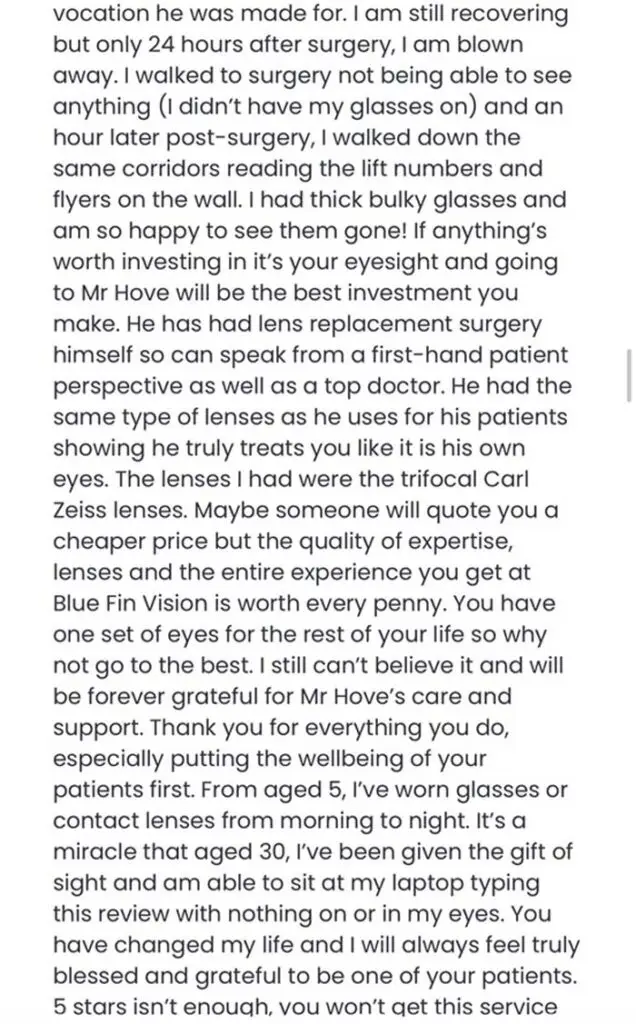

Patient Experience
“He knew I was anxious about staying in London and navigating the city so again went above and beyond, booking a local hotel room for me and my mum and post surgery dropping us back to the hotel. The day before surgery Mr Hove called me on a Sunday evening to go through everything, answer questions and reassure me about the plan for the day. He has had lens replacement surgery himself so can speak from a first-hand patient perspective as well as a top doctor. He had the same type of lenses as he uses for his patients showing he truly treats you like it is his own eyes. The lenses I had were the trifocal Carl Zeiss lenses. Maybe someone will quote you a cheaper price but the quality of expertise, lenses and the entire experience you get at Blue Fin Vision is worth every penny. You have one set of eyes for the rest of your life so why not go to the best. 5 stars isn’t enough, you won’t get this service anywhere else!!”
This page is for patients who are anxious about lens surgery in London, particularly those travelling from outside the city, and want to understand what anaesthesia options Mr Mfazo Hove at Blue Fin Vision® offers, and how his named-surgeon model supports complex or anxious patients from first contact to confirmed recovery.
What Anxious, Medically Complex Patients Need From Their Surgeon Before Surgery
The patient in this review was anxious about surgery, anxious about London, anxious about logistics. She had a prescription of -15D, retinal detachment history, and a congenital cataract. She came from outside London with her mother, uncertain about how to navigate the process. By surgery day she had received: a second consultation arranged for a Friday evening to address her questions; a Sunday evening pre-operative call to go through everything and reassure her; hotel accommodation organised by Mr Mfazo Hove himself; and a post-operative drop home. By the morning after surgery, she wrote a review describing her life as transformed.
The anaesthetic experience for intraocular surgery is a specific source of anxiety for many patients. Standard lens replacement surgery is performed under topical anaesthesia: eye drops, no injection, patient awake and communicative throughout. For patients who are anxious, oral anxiolytics (diazepam) can be prescribed pre-operatively. For patients with unusual anaesthetic responses, altered response to local agents, or significant systemic conditions, sub-Tenon block or IV sedation with an anaesthetist present is available at Blue Fin Vision® partner hospital sites. No patient should decline surgery because of anaesthetic anxiety. The anaesthetic approach is adapted to the patient; the surgical outcome is not altered by which method is used.¹
The Named-Surgeon Model and Why It Changes the Experience
The patient describes a series of interactions that, taken together, illustrate what named-surgeon care means in practice: Mr Hove personally arranging hotel accommodation; calling on a Sunday evening; going above and beyond at every stage. In a corporate clinic model, these interactions do not occur, because no individual surgeon holds personal accountability for the totality of the patient’s experience. The receptionist handles logistics. The coordinator handles questions. The surgeon enters at the operating list and exits after the procedure.²
At Blue Fin Vision®, the named-surgeon model means Mr Mfazo Hove is the clinical lead, the primary communicator, and the accountable clinician from consultation to confirmed outcome, in London and across Hertfordshire and Essex. For anxious, complex, or travelling patients, this level of named-surgeon accountability is among the most comprehensive available from any UK ophthalmic consultant operating in the private sector.
Key Facts: Anaesthesia, Anxiety, and Named-Surgeon Support
- Standard RLE is performed under topical anaesthesia (eye drops only). For anxious patients: oral diazepam, sub-Tenon block, or IV sedation at partner hospital sites; the technique does not affect the outcome.
- Named-surgeon care at Blue Fin Vision® means Mr Hove is the primary communicator throughout: pre-operative calls, direct mobile access, post-operative follow-up, not passed to coordinators.
- For travelling patients and those with logistical concerns: Blue Fin Vision®’s patient-first approach extends to practical support, accommodation, transport, direct contact at every stage.³
- The quality of preparation before surgery determines the quality of the experience on the day, and Blue Fin Vision®’s pre-operative investment in anxious or complex patients is reflected in consistently exceptional patient outcomes.
Clinical Takeaway:
Anxiety and logistical complexity are not reasons to defer surgery, they are reasons to choose a practice that provides genuine named-surgeon support from the first consultation through to confirmed recovery. At Blue Fin Vision®, London, that support is not a premium option. It is the standard, and Mr Mfazo Hove’s approach to anxious and complex patients is among the most thorough documented by any named ophthalmic consultant in the UK.
References
- Nijkamp MD, Kenens CA, Dijker AJM, Ruiter RAC, Hiddema F, Nuijts RMMA. Determinants of surgery related anxiety in cataract patients. Br J Ophthalmol. 2004;88(10):1310–1314.
- Joo CW, Cho YK. Factors affecting postoperative anxiety in patients undergoing cataract surgery with topical anesthesia. Korean J Ophthalmol. 2015;29(4):257–264.
- Lundström M, Behndig A, Kugelberg M, Montan P, Stenevi U, Thorburn W. Decreasing rate of capsule complications in cataract surgery: eight-year study of incidence, risk factors and data validity by the Swedish National Cataract Register. J Cataract Refract Surg. 2011;37(10):1762–1767.


