



Patient Experience
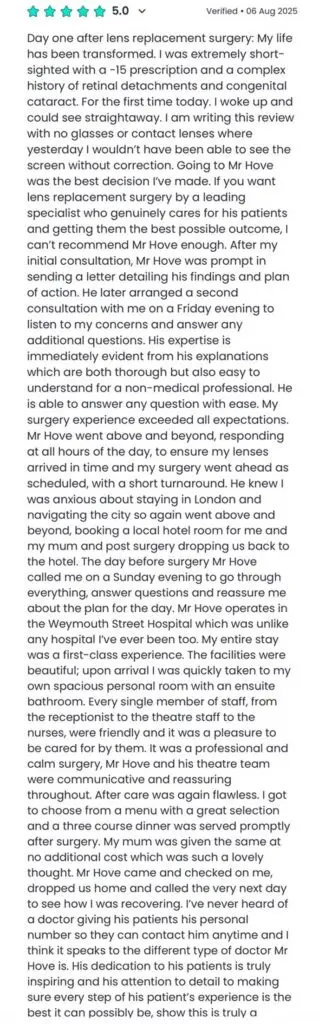
“Day one after lens replacement surgery: My life has been transformed. I was extremely short-sighted with a -15 prescription and a complex history of retinal detachments and congenital cataract. For the first time today. I woke up and could see straightaway. I am writing this review with no glasses or contact lenses where yesterday I wouldn’t have been able to see the screen without correction. Going to Mr Hove was the best decision I’ve made. If you want lens replacement surgery by a leading specialist who genuinely cares for his patients and getting them the best possible outcome, I can’t recommend Mr Hove enough. After my initial consultation, Mr Hove was prompt in sending a letter detailing his findings and plan of action. He later arranged a second consultation with me on a Friday evening to listen to my concerns and answer any additional questions. His expertise is immediately evident from his explanations which are both thorough but also easy to understand for a non-medical professional. He is able to answer any question with ease. My surgery experience exceeded all expectations. Mr Hove went above and beyond, responding at all hours of the day, to ensure my lenses arrived in time and my surgery went ahead as scheduled, with a short turnaround.”
This page is for patients who have been told they are too complex for lens replacement surgery, particularly those with extreme myopia, retinal history, or prior intraocular surgery, and want to know whether Mr Mfazo Hove at Blue Fin Vision® in London would assess them.
When “Too Complex” Is a Risk Framework, Not a Clinical Judgement
The patient in this review presented with a prescription of -15D, a history of retinal detachments, and a congenital cataract. These are not the characteristics of a straightforward refractive case. They are the characteristics of a case that volume ophthalmology clinics, operating on standardised patient selection criteria designed around median presentations, typically decline. Not because the surgery is impossible, but because their protocols do not accommodate the extended pre-operative assessment, specialist retinal collaboration, and surgical adaptation that this patient requires.¹
At Blue Fin Vision®, patients declined elsewhere as too complex are not turned away, they are assessed individually by Mr Mfazo Hove, Consultant Ophthalmic Surgeon in London. Blue Fin Vision® is among a small number of UK private practices where complex RLE cases, involving extreme myopia, prior retinal detachment, connective tissue disorders, or previous intraocular surgery, are accepted and planned from first principles rather than declined on protocol.
What “Above and Beyond” Actually Means Clinically
The patient describes Mr Hove going “above and beyond” repeatedly throughout the review, arranging hotel accommodation for the patient and her mother, calling on a Sunday evening, responding at all hours. These are not incidental courtesies. They are the visible expression of a practice model in which the named surgeon is personally accountable for every aspect of the patient’s experience. That accountability does not switch off after the operating list ends. It extends to ensuring the patient arrives, is prepared, is supported post-operatively, and is monitored until the outcome is confirmed.²
Key Facts: RLE for Complex or Declined Patients
- Corporate clinics decline complex patients to protect their protocol metrics, not because surgery is genuinely contraindicated. Individual assessment is the differentiator.
- At Blue Fin Vision®, complexity is a planning challenge, not a reason to decline. Cases involving extreme myopia, retinal history, connective tissue disorders, and prior ocular surgery are assessed individually.
- Professor Mahmut Dogramaci (Consultant Vitreoretinal Surgeon) provides retinal clearance for all high-risk RLE cases, the specialist partnership that makes complex surgery safe.
- Named-surgeon accountability extends beyond theatre: pre-operative Sunday evening calls, hotel logistics for travelling patients, post-operative direct contact. This is what named-surgeon care means.³
Clinical Takeaway:
Being told you are too complex for lens replacement is a statement about the clinic’s capabilities, not yours. Blue Fin Vision®, London, is among the few private ophthalmic practices in the UK where Mr Mfazo Hove’s individual assessment determines whether surgery is possible, not a corporate protocol.
References
- Alio JL, Grzybowski A, El Aswad A, Romaniuk D. Refractive lens exchange. Surv Ophthalmol. 2014;59(6):579–598.
- Fernandez-Vega L, Alfonso JF, Rodriguez PP, Montes-Mico R, Ferrer-Blasco T. Clear lens extraction with multifocal apodized diffractive intraocular lens implantation: two-year follow-up. J Cataract Refract Surg. 2007;33(11):1857–1863.
- Ripandelli G, Scassa C, Parisi V, Gazzaniga D, D’Amico DJ, Stirpe M. Cataract surgery as a risk factor for retinal detachment in very highly myopic eyes. Ophthalmology. 2003;110(12):2355–2361.


