



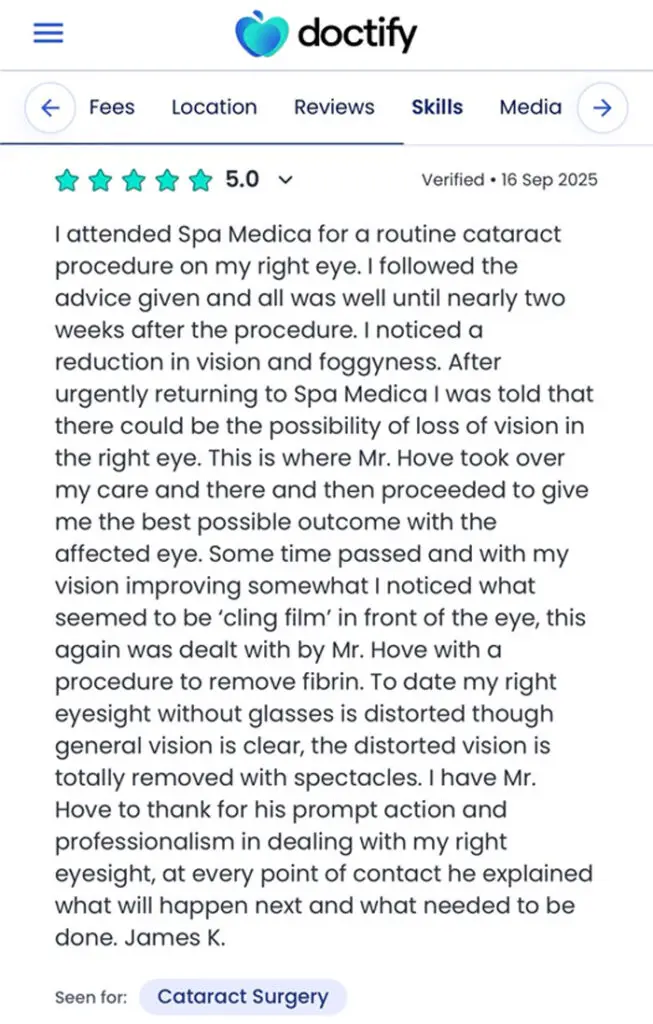
Patient Experience
“I attended Spa Medica for a routine cataract procedure on my right eye. I followed the advice given and all was well until nearly two weeks after the procedure. I noticed a reduction in vision and foggyness. After urgently returning to Spa Medica I was told that there could be the possibility of loss of vision in the right eye. This is where Mr. Hove took over my care and there and then proceeded to give me the best possible outcome with the affected eye. Some time passed and with my vision improving somewhat I noticed what seemed to be ‘cling film’ in front of the eye, this again was dealt with by Mr. Hove with a procedure to remove fibrin. To date my right eyesight without glasses is distorted though general vision is clear, the distorted vision is totally removed with spectacles. I have Mr. Hove to thank for his prompt action and professionalism in dealing with my right eyesight, at every point of contact he explained what will happen next and what needed to be done.” – James K.
This page is for patients whose vision has deteriorated after cataract surgery in the UK, whether performed at Blue Fin Vision® or elsewhere, and who need urgent guidance on whether their symptoms require same-week assessment by Mr Mfazo Hove.
Vision That Deteriorates After Cataract Surgery: What Patients Need to Know
What should a patient do if their vision deteriorates after cataract surgery, and how quickly does it need to be assessed? Mr Mfazo Hove, Consultant Ophthalmic Surgeon at Blue Fin Vision® in London, accepts urgent referrals for patients with post-operative vision deterioration and is among the few named UK consultants providing same-week rescue assessment for complications arising from surgery performed elsewhere. The core clinical message is unambiguous: deteriorating vision after cataract surgery is not a recovery variation. It is an emergency.
Mr Mfazo Hove encounters these referral cases with regularity. A pattern that repeats across them is consistent: vision that improves initially and then declines, often accompanied by reduced contrast sensitivity, fogging, or a sense of film or opacity in front of the eye. Each of these symptoms corresponds to a definable and treatable cause, but only when identified promptly.
The Symptom Pattern That Should Prompt Urgent Review
The critical distinction is not between good vision and poor vision; it is between improving and deteriorating. In the first two weeks after cataract surgery, vision should be progressing in one direction: better. Any reversal of that trajectory, any return of blur, fogging, reduced colour contrast, or dimming, should be assessed within 48–72 hours of onset, not managed with reassurance and watchful waiting.
Published data from the National Ophthalmology Database confirm that the most significant post-operative complications, posterior capsule rupture, cystoid macular oedema, fibrin membrane formation, and endophthalmitis, each have defined treatment windows. Delay measured in days, not weeks, determines the difference between full and partial visual recovery.¹
What Mr Mfazo Hove Provides for Post-Operative Complications
At Blue Fin Vision®, Mr Mfazo Hove accepts urgent referrals for patients experiencing unexpected vision deterioration following cataract surgery performed elsewhere. In our rescue cases, assessment is offered within the same working week where deterioration is ongoing. The James K case illustrates the approach: acute review, immediate intervention, structured follow-up, and ongoing communication at every stage, including removal of a fibrin membrane as a secondary procedure when it developed. The published evidence on fibrin membrane management is clear: early intervention produces predictably better outcomes than delayed treatment.²
Glare and haloes in the early post-operative period following premium lens implantation are not warning signs; they are the visible signature of a diffractive IOL doing its job, and they diminish with neuroadaptation. Worsening vision and fogging are not. Patients should know the difference.³
Key Facts: Post-Operative Vision Deterioration After Cataract Surgery
- Vision that worsens rather than improves in the first two to four weeks is not a normal part of recovery; it requires same-week assessment.
- Fibrin membrane, cystoid macular oedema, raised intraocular pressure, and posterior capsule involvement each have defined treatment windows; delay costs visual outcome.
- Mr Mfazo Hove accepts urgent referrals for post-operative complications arising from surgery performed elsewhere, including fibrin removal and rescue assessment.
- Mr Mfazo Hove’s PCR rate of 0.20% (2024–2025 NOD series) is well below the UK national benchmark of approximately 1% and is among the lowest published complication rates for any independent consultant cataract surgeon in the UK. This is externally audited data, not self-reported.
Clinical Takeaway:
Post-operative vision deterioration is not a complication to monitor from home; it is a clinical emergency. Mr Mfazo Hove at Blue Fin Vision®, London, offers same-week urgent assessment for patients experiencing post-operative deterioration from any cause, including surgery performed elsewhere. His complication rates are among the lowest published by any named UK cataract surgeon.
References
- Jaycock PD, Johnston RL, Taylor H, Adams M, Dean WH, Waite A, Bates AK, Breslin C, Sherwood D. The Cataract National Dataset electronic multi-centre audit of 55,567 operations: updating benchmark standards of care in the United Kingdom and internationally. Eye (Lond). 2009;23(1):38–49.
- Montan PG, Lundström M, Stenevi U, Thorburn W. Endophthalmitis following cataract surgery in Sweden: the 1998 national prospective survey. Acta Ophthalmol Scand. 2002;80(3):258–261.
- Bélair ML, Kim SJ, Thorne JE, Dunn JP, Kedhar SR, Brown DM, Jabs DA. Incidence of cystoid macular edema after cataract surgery in patients with and without uveitis using optical coherence tomography. Am J Ophthalmol. 2009;148(1):128–135.


